
Written by Alya Liu — pearl farmer & jeweler.
Blue pearls are expensive because natural blue is one of the rarest color effects in pearls. In the same quality level, a beautiful blue or teal pearl can cost three to four times more than a more common pearl color. The price rises even faster when the pearl is large, high-luster, clean-skinned, naturally colored, and suitable for fine jewelry.
When people ask me, “why is blue pearl so expensive?”, my answer is always the same: rarity first, then beauty. Blue and blue-green pearls are not only hard to grow; they are hard to match, hard to photograph accurately, and hard to replace once sold. In this guide, I’ll explain the main blue pearl categories, how much blue pearls are worth, and how to avoid confusing natural color with dyed freshwater pearls.
We often carry blue, teal, and peacock green pearls in limited quantities. For current inventory, follow @alyapearls on Instagram or email me at alya@margaretjewelry.com for custom blue pearl jewelry.

Quick Answer: Why Is Blue Pearl So Expensive?
Blue is rare in nature. Most blue colors in living things are not true blue pigments; they are often caused by the way light interacts with surface structures. The same idea helps explain why blue pearls feel so special: the most beautiful blue pearls are usually not “painted blue.” Their color comes from nacre structure, body color, overtone, orient, and light movement.
In pearls, blue is one of the rarest desirable color effects. A pearl has to be the right type, the right size, and the right quality — and then it still has to show blue, teal, peacock, or blue-purple color from multiple angles. If the pearl is over 13mm, clean, high-luster, and strongly blue-green, the rarity becomes extreme.
From my own sourcing experience, high-quality 13mm+ blue Tahitian pearls are among the hardest pearls to find. I would describe them as a tiny fraction of production, not a normal commercial lot. When one appears with strong luster and clean surface, it enters a collector-level category very quickly.
This is why blue pearls can cost several times more than other pearls of similar size and general quality. It is not just color. It is rare color plus jewelry-grade quality.

What Counts as a Blue Pearl?
A blue pearl can mean several different things. It may be a naturally blue-green Tahitian pearl, a silver-blue Akoya pearl, a blue-violet Mabe pearl, a new experimental blue freshwater pearl, an irradiated pearl, or a dyed pearl.
This is why buyers need to ask two questions:
- What type of pearl is it?
- Is the blue color natural, irradiated, dyed, or otherwise treated?
A dyed freshwater pearl may still be a real cultured pearl, but it should not be priced like a natural-color blue Tahitian pearl or a high-quality natural blue Akoya strand. Disclosure matters.
Blue & Teal Tahitian Pearls: The Main Source of Peacock Color
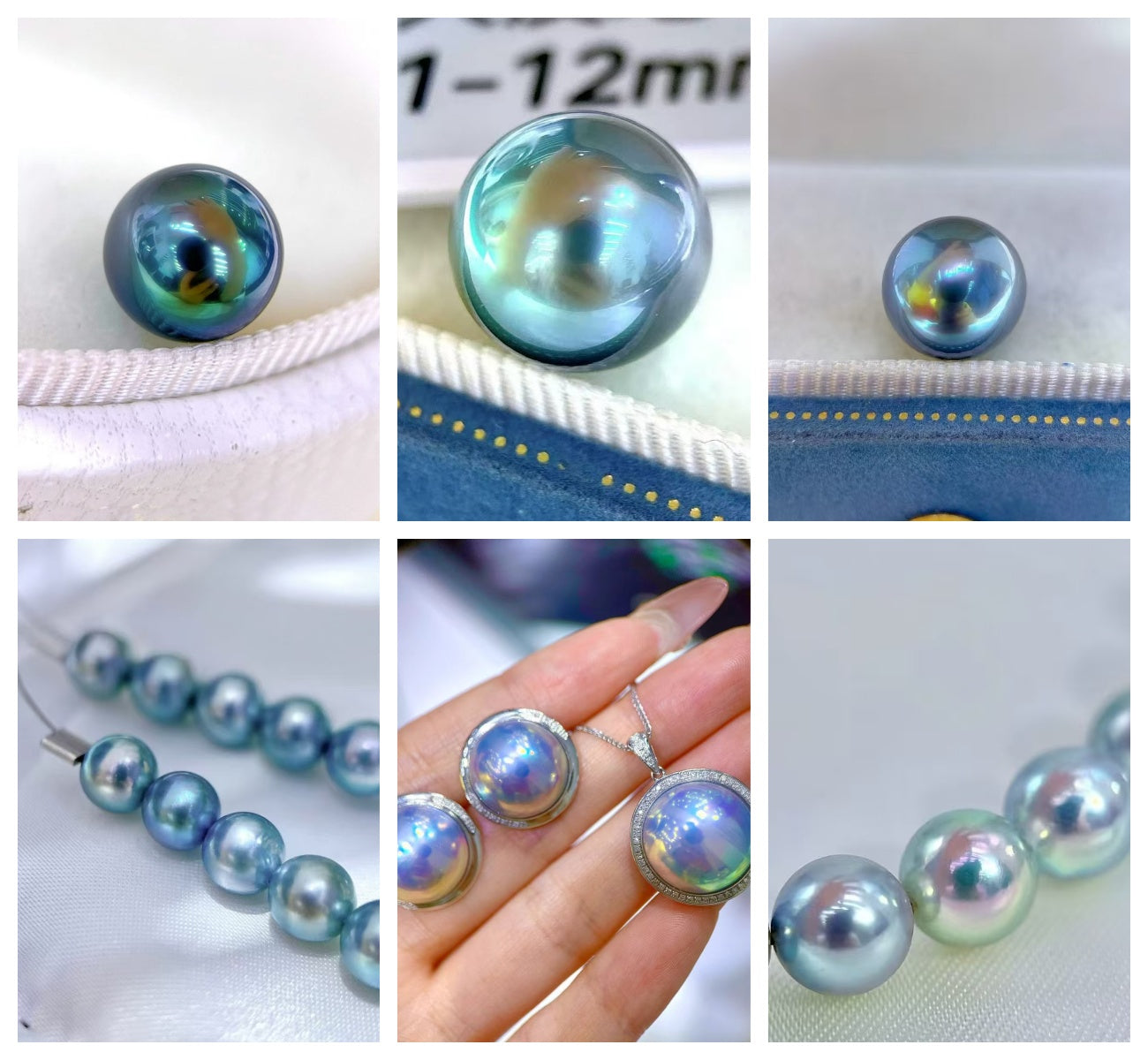
The most important source for blue, teal, and peacock green pearl color is Tahitian pearl. Tahitian pearls usually have a dark body color — black, charcoal, gray-green, or dark green. The blue or teal effect often appears as overtone and orient over that dark base.
A fine blue Tahitian pearl is rarely pure blue. More often, it is blue-green, green-blue, peacock, blue-purple, or multicolor. This layered color is what makes it valuable. When you tilt the pearl, the surface may shift from ocean blue to peacock green to violet. That movement is much more beautiful than a flat, single-color blue.

8-9mm for $140 in Alya Pearls
For loose pearls, my current Alya Pearls examples are:
- 8–10mm blue or teal Tahitian pearl: often around $150 for a jewelry-grade single pearl in my sourcing examples.
- 10–12mm blue or teal Tahitian pearl: often around $200–$300 depending on luster and surface.
- 12–13mm blue or teal Tahitian pearl: can reach around $500 when the quality is strong.
- 13–14mm high-quality blue-green Tahitian pearl: around $700 in the example I often show clients.
These are not universal market prices. They are real sourcing examples from my inventory and buying experience. If a pearl has exceptional luster, cleaner skin, stronger color movement, and better roundness, it can move beyond standard pricing and become a collector piece.

A collector-level blue Tahitian necklace
One of the hardest projects I ever worked on was a full blue Tahitian pearl necklace for a private client. It took me about eight months to collect enough pearls with matching blue tone, size, luster, and surface. The final necklace sold for over $120,000.
I cannot show that necklace here because of client privacy, but the price tells you something important: one beautiful blue Tahitian pearl is rare; a whole matched strand is another level of rarity. The challenge is not only finding blue pearls. It is finding blue pearls that belong together.
If you are looking for a custom blue Tahitian piece, follow @alyapearls or email alya@margaretjewelry.com. I can help you choose a single pendant pearl, a ring pearl, matching earrings, or start a long-term sourcing project for a strand.

Blue Akoya / Madama-Style Pearls: Natural vs Irradiated
The second major blue pearl category is blue-gray Akoya. Natural-color blue Akoya pearls often lean silver-gray, gray-blue, or soft blue. If the natural color is strongly silver-blue or blue, the price can rise sharply because matching a full strand is extremely difficult.
A natural-color blue Akoya strand, especially in premium quality, can exceed $6,000. This is because each pearl must not only be blue-gray; it also needs strong luster, good nacre, clean surface, compatible size, and a tone that matches the rest of the strand.
There is also a large market for irradiated blue-gray Akoya. Irradiation is a physical treatment that darkens the bead nucleus inside the pearl. When light passes through the nacre and reflects back from the darker core, the pearl can appear more silver-blue or gray-blue. This is not the same as dyeing the pearl surface, but it is still a treatment and should be disclosed.

In my current 2026 sourcing channels, irradiated blue-gray Akoya appears to represent the majority of blue Akoya offered to regular buyers. My practical observation is around 75%, though this is not an official lab statistic. The important point for buyers is simple: ask whether the color is natural-color or irradiated.
As a rough jewelry-price guide:
- Natural-color blue Akoya strand: can exceed $6,000 when quality and matching are strong.
- Irradiated blue-gray Akoya strand: often around $1,000–$3,000 depending on size, luster, and matching.
- 7–8mm matched blue-gray Akoya studs: often around $300–$400 for high-grade pairs in my sourcing examples.

Blue Japanese Mabe Pearls: Dreamy Dome-Shaped Iridescence
Another blue pearl category that deserves more attention is Japanese Mabe, especially Amami Oshima Mabe pearls. These pearls are dome-shaped rather than full round pearls. They are usually grown against the inside of the shell, then worked into a flat-backed, domed pearl for jewelry.
A fine blue Mabe does not always look like a flat blue stone. Instead, it shows dreamlike surface color — blue, pink, violet, green, and sometimes golden flashes moving across the dome. This is the beauty of pearl orient. The broad curved nacre surface acts like a small moonlit screen, catching light from different angles.
Color in Mabe pearls comes from the mollusk species, nacre thickness, nacre smoothness, and how light interacts with the wide dome surface. In Amami Oshima Mabe, the best examples can show an aurora-like glow: blue in one angle, pink in another, violet or green as you turn it.
Price grows quickly with size and color quality:
- 13–14mm blue Mabe pearl: often around $500–$700 in strong quality.
- 20mm+ blue or aurora Mabe pearl: can rise sharply.
- 22–23mm high-quality blue Mabe pearl: may reach around $2,000–$4,000 depending on dome quality, color movement, luster, and setting.

Experimental Blue Freshwater Pearls: The New Frontier
The final category is new natural-color blue freshwater pearls. This is still an emerging area, not yet a stable commercial category.
In the main freshwater pearl-growing regions, new grafting and tissue-selection techniques have recently encouraged colors that used to be very rare in freshwater pearls: green, blue, teal, and light gold. These experiments began around 2024 in some farming areas, and small-batch production is still limited.
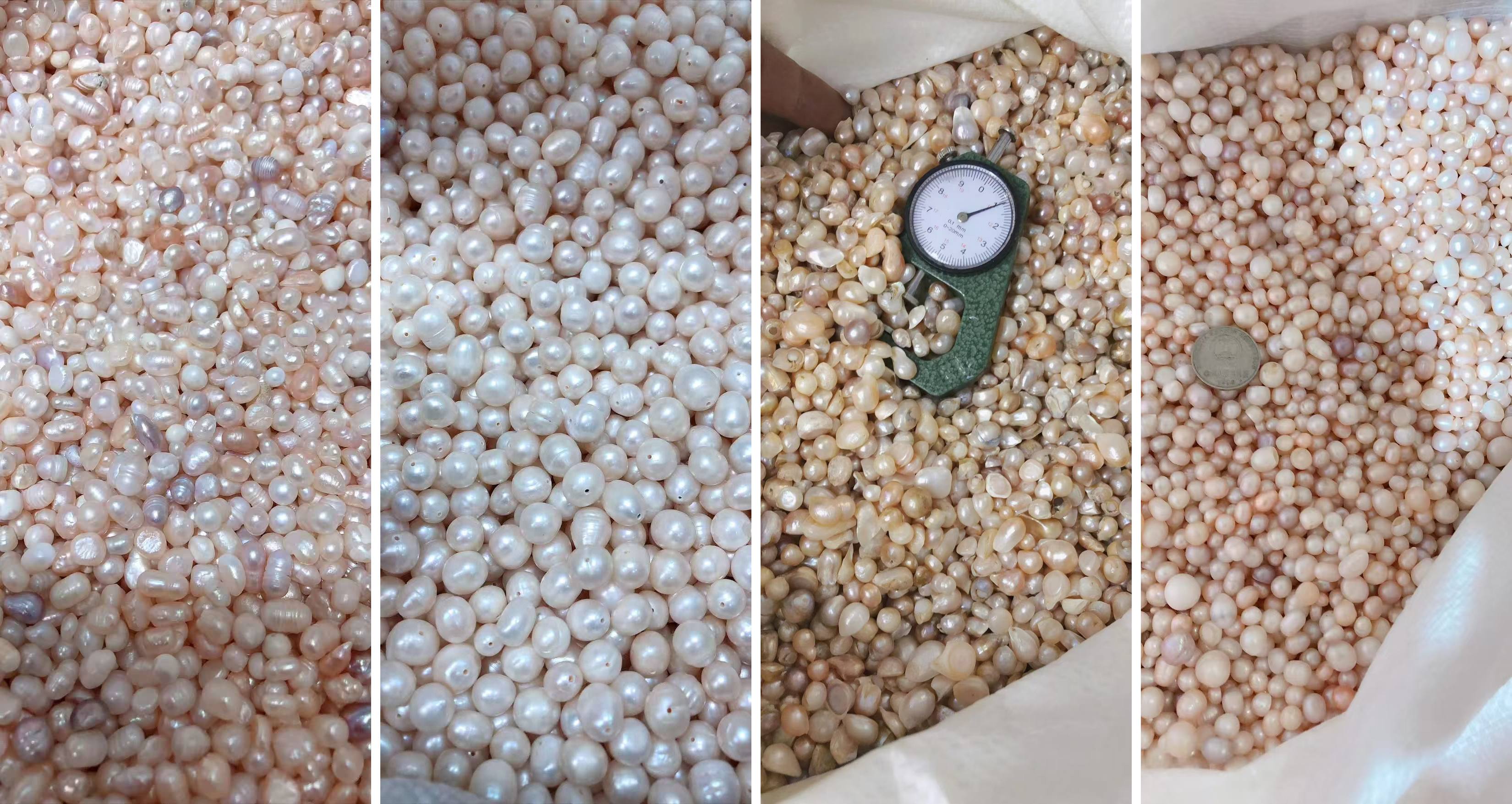
As a pearl farmer, I am excited about this direction. I believe that in the next few years, we may see more high-quality colored freshwater pearls, including blue and teal. But right now, a seller offering cheap bright-blue freshwater pearls is usually selling dyed pearls, not naturally grown blue freshwater pearls.

How Much Are Blue Pearls Worth?
The answer depends completely on the type of pearl. A dyed blue freshwater pearl, a blue Tahitian pearl, a natural blue Akoya strand, and a blue Amami Oshima Mabe are different products with different value systems.
| Blue Pearl Type | Typical Look | Example Price Range | Why It Costs This Much |
|---|---|---|---|
| 8–10mm blue/teal Tahitian pearl | Blue-green or peacock overtone over dark body color | Around $150 in Alya Pearls sourcing examples | Rare color, but still in a more available size range. |
| 10–12mm blue/teal Tahitian pearl | Stronger presence; good for pendants and rings | Around $200–$300 | Price rises with size, luster, and clean surface. |
| 12–13mm blue/teal Tahitian pearl | High-impact jewelry size | Around $500 | Large blue pearls are much harder to source. |
| 13–14mm high-quality blue Tahitian pearl | Collector-level size with rare blue-green color | Around $700+; much higher for collector quality | Large size plus rare color creates a steep jump. |
| Natural-color blue Akoya strand | Soft silver-blue or gray-blue with high luster | Often $6,000+ for premium matched strands | Natural color and strand matching are both rare. |
| Irradiated blue-gray Akoya strand | Cool gray-blue, often more uniform | Around $1,000–$3,000 | Treatment makes the color more available, but quality still matters. |
| 13–14mm blue Mabe pearl | Blue, pink, violet, or rainbow dome iridescence | Around $500–$700 | Wide dome surface and iridescent orient add value. |
| 22–23mm blue Mabe pearl | Large dome with aurora-like color movement | Around $2,000–$4,000 | Size increases value dramatically when color and luster are strong. |
| Dyed blue freshwater pearl | Often flat, bright, or very even blue | Much lower than natural blue pearls | A real pearl can still be dyed; disclosure is the key. |
How to Avoid Dyed Blue Freshwater Pearl Imitations
Many blue pearls on the market are dyed freshwater pearls. This is not automatically bad if the seller is honest. A dyed pearl can be fun, affordable, and pretty. The problem happens when dyed freshwater pearls are sold as natural blue Tahitian, natural blue Akoya, or rare teal pearls.
Here are my buyer checks:
- Look for depth, not flat color. Natural blue or teal pearls usually show layers and color movement.
- Check the drill hole. Dye can collect around holes, cracks, pits, or surface-reaching features.
- Ask the pearl type. “Blue pearl” is not enough. Is it Tahitian, Akoya, Mabe, or freshwater?
- Ask about treatment. Natural color, irradiation, dyeing, and optical brightening should be disclosed.
- Use a lab for expensive purchases. For high-value pearls, reports from GIA, PSL, GUILD, GRC, or another trusted lab can help confirm identity and treatment.

Alya’s Buying Advice
When I buy blue pearls, I do not chase the word “blue” alone. I look for luster first. Then I look for color movement. A good blue pearl should change slightly as you tilt it. It should feel alive.
For a single pendant, one strong blue Tahitian or Mabe pearl can be enough. For earrings, matching matters more. For a full necklace, prepare for a long search, because matching blue pearls is one of the hardest tasks in pearl sourcing.
If you want a custom blue pearl piece, follow @alyapearls or email alya@margaretjewelry.com. I can help you compare blue Tahitian, blue Akoya, Amami Oshima Mabe, and other available options based on your design and budget.
Watch: Rare Blue Akoya Pearls
This video is a helpful visual reference for rare blue Akoya pearls and how different they look from classic white Akoya pearls.
FAQ
Why is blue pearl so expensive?
Blue pearl is expensive because natural blue and teal color effects are rare. When rare color combines with large size, strong luster, clean surface, good shape, and natural origin, the price rises quickly.
Are teal pearls real?
Yes. Teal pearls can be real, especially in Tahitian pearls where blue-green or peacock overtones appear naturally. But some teal pearls are dyed freshwater pearls, so treatment disclosure matters.
How much are blue pearls worth?
It depends on pearl type. In my sourcing examples, blue Tahitian loose pearls may range from around $150 to $700+ depending on size and quality. Natural-color blue Akoya strands can exceed $6,000, while irradiated blue-gray Akoya strands may be around $1,000–$3,000.
What is a peacock green pearl?
A peacock green pearl is usually a Tahitian pearl with green body color or green hue plus strong overtone or orient. It may show rose, blue, purple, or gold flashes as it moves.
Are blue Akoya pearls dyed?
Some blue Akoya pearls are natural-color gray-blue pearls, while many are irradiated to create a darker gray-blue look. Irradiation is not the same as dyeing, but it is still a treatment and should be disclosed.


Leave a comment
This site is protected by hCaptcha and the hCaptcha Privacy Policy and Terms of Service apply.