
Written by Alya Liu— pearl farmer and jeweler
Follow @alyapearls on Instagram and join our jewelry channel for daily updates on our newest handmade Saltwater pearl pieces. Like Tahitians or SS gold design!
Pearl blemishes are often misunderstood.
Many shoppers see a small pit, spot, wrinkle, or line and immediately think the pearl is “bad.” But pearls are organic gems formed by nature. Their surfaces are built layer by layer, and during that process, small marks can appear. Some are natural growth features. Some are later damage. Some matter a lot. Others can be hidden beautifully through smart jewelry design.
This guide will help you understand the difference. By the end, you will know how to read pearl blemishes, which marks affect value, which ones affect durability, and how jewelers decide whether a pearl is worth using.

What Are Pearl Blemishes?
Pearl blemishes are visible features on the surface of a pearl. They may appear as tiny pits, raised ridges, white spots, dark spots, scratches, wrinkles, growth rings, uneven skin, or areas where the nacre looks different.
In pearl grading, surface quality is not judged by one mark alone. A jeweler looks at the type, size, number, location, and visibility of blemishes. A tiny mark near a drill hole may matter very little. A deep crack across the front of a ring pearl matters a lot.
This is why two pearls with the same size and color can have very different prices. One may look clean from normal viewing distance. Another may have obvious surface problems that reduce beauty or durability.

How Pearl Blemishes Form
Pearls grow inside living mollusks. As nacre is deposited over time, the growth environment is never perfectly controlled. Changes in water quality, temperature, nutrition, stress inside the oyster or mussel, foreign particles, or uneven nacre deposition can all leave marks on the pearl surface.
In simple terms, a pearl is not manufactured like glass. It grows. That growth process creates tiny “fingerprints.” A small pit, wrinkle, or patchy area can be part of the pearl’s natural history.
The longer a pearl grows, the more time it has to develop size and nacre depth — but it also has more time to develop marks. This is one reason large, clean, high-luster pearls are valuable: they had to grow well and stay visually clean at the same time.
Some blemishes happen later. Scratches may come from rough handling, storage against metal, or improper cleaning. Cracks and nacre peeling are more serious because they can weaken the pearl’s structure. Bead exposure can happen when the nacre is too thin or damaged, revealing the bead nucleus inside a bead-nucleated cultured pearl.
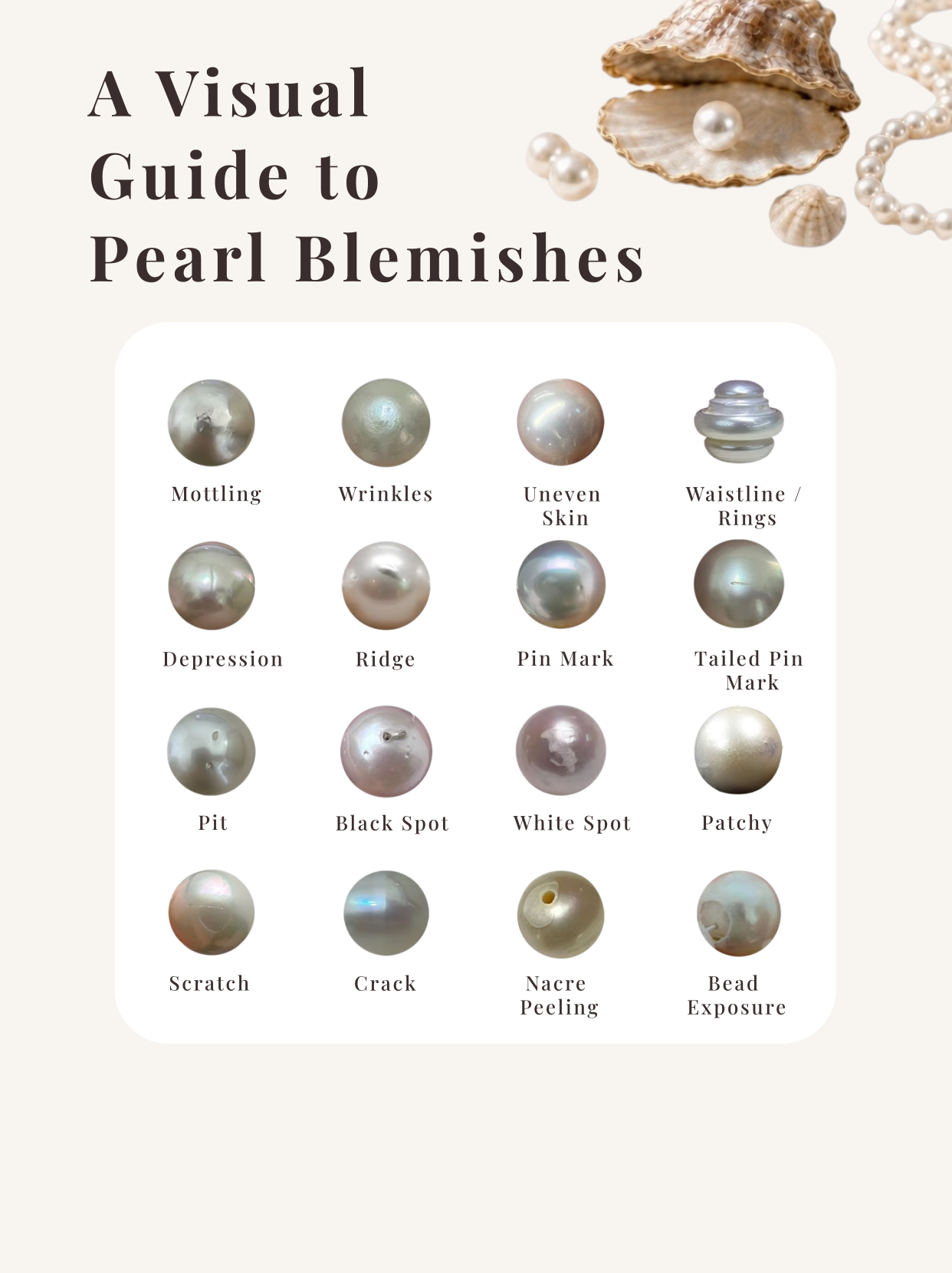
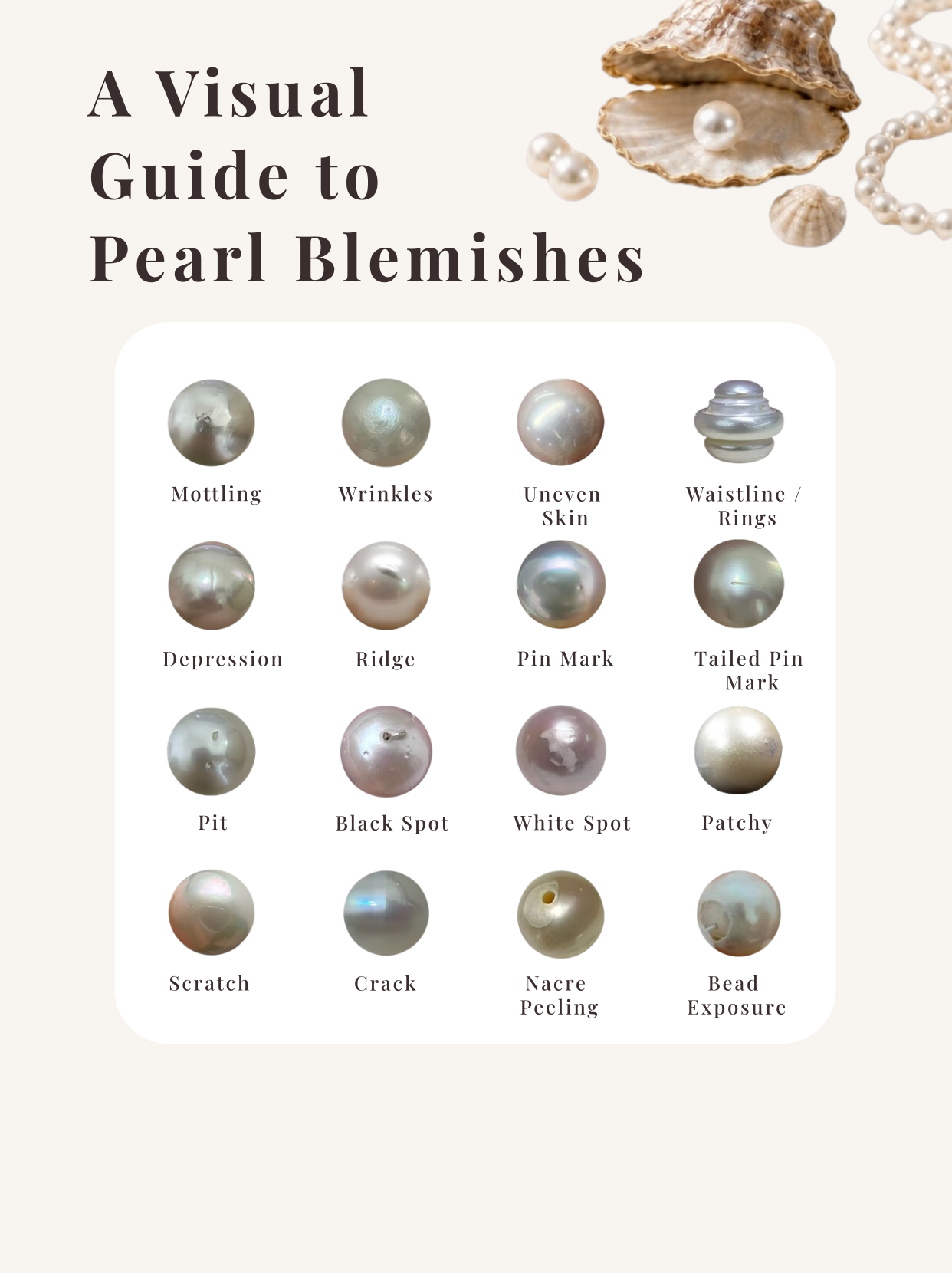
A Visual Guide to Common Pearl Blemishes
Not all blemishes carry the same meaning. Some are mostly cosmetic. Some affect design. Some can affect durability. Here is the practical way I explain them to buyers and jewelry clients.
Growth patterns: mottling, wrinkles, uneven skin, and waistlines
Growth patterns are faint layered textures visible on the pearl surface. They often feel smooth to the touch rather than sharply raised or sunken. They may appear as mottling, wrinkles, uneven skin, or waistline rings.
Fine, even mottling can sometimes add natural character. But if the texture is too rough or visually distracting, it may reduce smoothness, harmony, and price. Waistlines are growth rings that circle the pearl; in strong cases, they can affect the pearl’s shape.

Surface marks: depressions, ridges, pin marks, pits, and spots
A depression is a localized shallow dip or sunken area. A ridge is a raised area caused by uneven nacre build-up. Pin marks are tiny point-like marks, similar to pinholes. A tailed pin mark looks like a tiny pit with a short tail-shaped sunken area.
Pits are clearly visible point-like holes or dips. Black pits or dark spots may form when foreign matter is trapped during nacre growth. White spots appear as pale dots or patches. Patchy areas show uneven color or organic material distribution.


Serious Damage: When a Blemish Becomes a Durability Problem
Some marks are more than cosmetic. I place scratches, cracks, nacre peeling, and bead exposure in a more serious category. They require closer inspection because they can affect wear life.
Scratches are usually caused by improper wear, storage, or handling. They appear as fine shallow lines on the surface. Some light scratches can be reduced by professional repolishing, but deep scratches may remain visible.
Cracks are deeper breaks caused by impact, stress, or environmental changes. A crack can weaken durability and should not be ignored, especially on rings or bracelets that may receive more impact.
Nacre peeling happens when the surface nacre lifts or flakes off in patches. Bead exposure occurs when the implanted nucleus shows through, often because the nacre is too thin or damaged. In my studio, bead exposure is one of the clearest signs that the pearl should be priced and used very carefully.

How Pearl Surface Quality Is Graded
In pearl grading, surface quality is usually described by how clean the pearl looks to the eye. A simple working scale is:
- Nearly flawless: very few visible marks, difficult to notice without close inspection.
- Slight blemishes: small marks visible on close inspection but not distracting in normal wear.
- Moderate blemishes: visible marks that affect the pearl’s appearance or design choices.
- Heavy blemishes: obvious marks covering a significant area or affecting durability.
A pearl does not need to be flawless to be beautiful. But it needs to be judged honestly. For jewelry making, the most important question is not “Does this pearl have any blemish?” The better question is: “Where is the blemish, and will the wearer see it?”

How Jewelers Hide or Work Around Pearl Blemishes
This is where pearl selection becomes practical. A pearl with a blemish is not automatically unusable. If the blemish is clustered in one area, drilling or setting can often hide it.
For example, a pit near one side may be placed near the drill hole of a necklace. A small spot on the back of a pearl can be covered by a cup setting. A slightly uneven area can sometimes be turned toward the metal support in a ring. A baroque pearl with a natural ridge may become more interesting when the design follows its shape.
In jewelry making, “perfect” is not always the only goal. The real goal is harmony. A clean, bright pearl with one hidden mark can make a beautiful pendant. A pearl with moderate visible marks may still be valuable if it has exceptional luster, rare color, or a shape that works beautifully in design.
| Blemish situation | Jewelry solution | Best use |
|---|---|---|
| Small pit near one side | Place near drill hole or covered setting | Necklace, pendant, earrings |
| Clustered spots on one area | Turn blemished area toward the back | Ring or pendant setting |
| Waistline or ring growth pattern | Use design to echo the line | Artistic or baroque jewelry |
| Crack, peeling, bead exposure | Use only with caution, or reject for fine jewelry | Not ideal for daily-wear pieces |
Alya’s Buyer Rule: Luster First, Color and Shape Next, Blemishes Last
I am very open to small blemishes. After working with pearls for years, I know that tiny marks are part of real pearl life. There is also a special satisfaction in using design to hide them well and turn them into jewelry that looks polished and beautiful.
This is what I call “social-distance flawless.” At normal social distance, most people will never notice a tiny scratch, shallow pit, or small off-center spot. But they will notice luster. They will notice color. They will notice whether the jewelry feels balanced.
For me, luster always comes first. Then color and shape. Blemishes come after that. A tiny blemish is not always a deal breaker — especially when the pearl has beautiful glow and the design can protect or hide the mark.

Watch: How GIA Evaluates Pearl Surface Quality
This video is a useful visual companion if you want to understand how surface quality fits into professional pearl grading.
FAQ: Pearl Blemishes
Are pearl blemishes normal?
Yes. Pearls are organic gems, and many real pearls have small natural surface features. A completely clean pearl is rarer and usually more expensive.
Do blemishes mean a pearl is fake?
No. In fact, small natural blemishes can be one sign that a pearl is real. However, blemishes alone are not enough to identify a pearl. If you are wondering how to tell real pearls from fake, you should also consider luster, surface feel, weight, drill holes, and seller transparency.
Which pearl blemishes are serious?
Cracks, nacre peeling, and bead exposure are the most serious because they may affect durability. Small pits, spots, or wrinkles are often less serious if they are not distracting.
Can pearl blemishes be repaired?
Some light scratches or surface dullness may be improved by professional repolishing. Deep cracks, peeling nacre, and bead exposure are much harder to correct.
Should I buy pearls with small blemishes?
If the pearl has strong luster, beautiful color, and the blemish is small or easy to hide, it can be a smart choice — especially for everyday pearl jewelry.


Leave a comment
This site is protected by hCaptcha and the hCaptcha Privacy Policy and Terms of Service apply.