
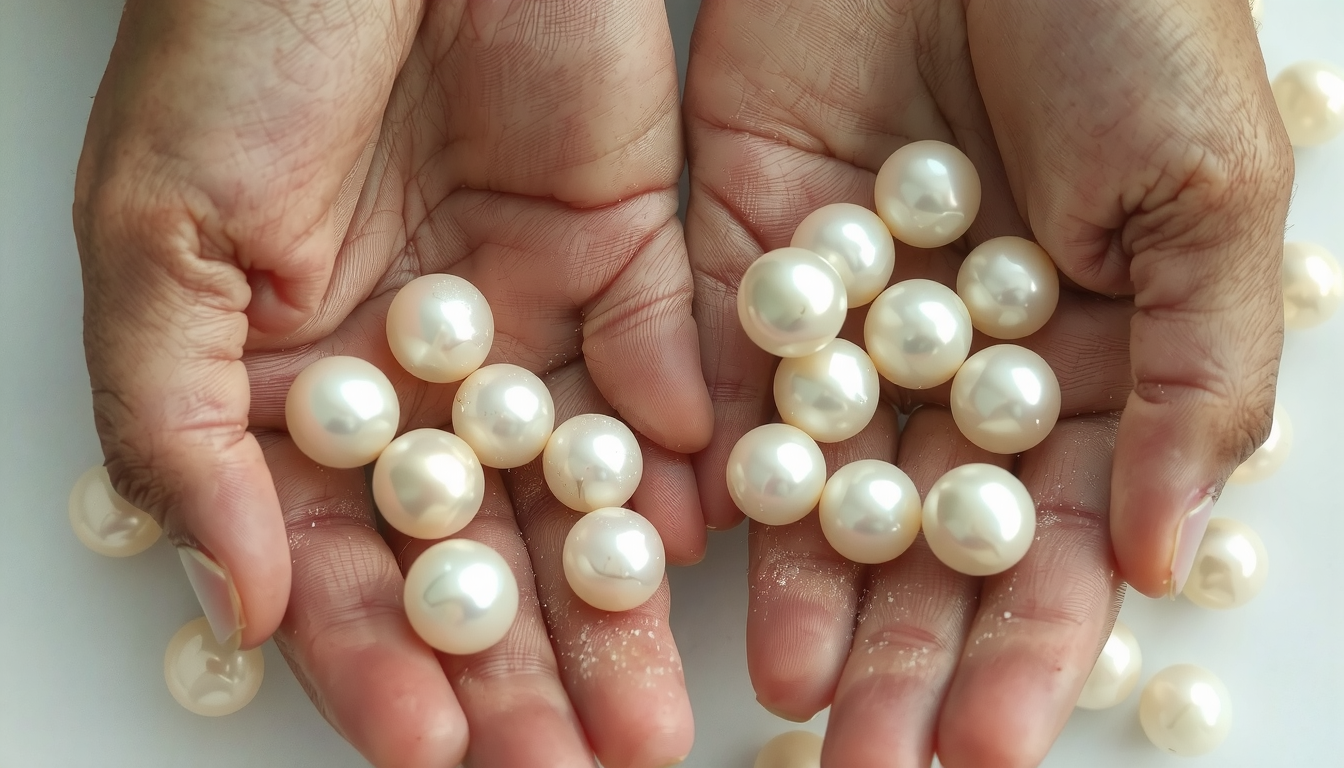
How Can You Tell If Pearls Are Real? 6 Easy Tests 2026
Identifying Real Pearls: 6 Easy Methods to Verify Their Authenticity
The concern of buying artificial pearls is not only exclusive to a few individuals, as it is a widely shared concern that we often hear at Alya Pearls. In the year 2026, when there are so many fake pearls on the market, it will be particularly challenging to know the actual product. However, telling a fake from a real one does not have to be difficult at all. You can acquire the skill of recognizing natural pearls if you have the right knowledge.

My family is engaged in the business of pearl farming for the past 60 years and pearls are the air we breathe. The company was started by Alya Liu who is a qualified Pearl Specialist (GIA & GUILD) and Jewelry Designer (NGTC). So far, we have assisted more than 10,000 clients on the techniques to identify if the pearls are genuine. Our 400K+ followers on Instagram have also accessed this information. Today, we will be transferring the same simple tests we apply daily. Thus, you will be able to have all the confidence in the world about your jewelry.
Key Takeaways
- Temperature Test: The actual pearls are cool to touch, they need a while to warm up. The artificial pearls get warm instantly. They are at the room temperature.
- Surface & Shape: Check for little defects. The perfectly round and the perfect ones are probably fake.
- Tooth Test: Lightly rub a piece of pearl on the surface of your tooth. The real pearl will have a rough feeling a little, but the fake one will have a smooth feeling.
- Luster: The actual pearls come with an inner, deep glow while the fake ones only have a shallow and glassy shine.
- Drill Hole: Inspect the drill hole and see whether it is sharp and clean. The fake pearls usually have chipped coats or uneven holes.
The 3-Second Triage: Quick Tests for On-the-Go Assessment
When you want to buy some pearls, you should find rapid ways to decide their reality. These simple tests can help you know what you are dealing with in a matter of seconds.
Test 1: The Temperature Test
Put the pearls in your palm. Authentic pearls are cold to the touch and they require about a few seconds to equalize with the temperature of your body. Fake ones particularly plastic ones would feel just like the room temperature. They get warm within a very small interval.
It is possible through this technique because authentic pearls possess the property of being made of packed, organic layers. The organic layers that are the outer cover for real pearls are not good heat conductors. This quality is not present in plastic and other fake materials. Glass imitations sometimes seem cold to the touch, but they generally have a different feel. The temperature difference is a good indicator for a quick check.
Test 2: The Visual Inspection for Imperfect Perfection
Take your time to examine one pearl at a time very closely. Authentic pearls are the products of the sea. Therefore, they will have their idiosyncrasies in terms of shape, size, and surface texture.
You should be able to see the tiny imperfections, the small ridges, or other insignificant problems at first glance. A necklace with a string of pearls that has every single one of them completely identical and round is a glaring red flag.

With over 20 years of experience dealing with thousands of pearls, we can assure you that real pearls never come in pairs. Their very signature is this individuality. This is also a wonderful indication of their natural origin. Experts would say that the unique, natural shapes and surfaces should be confirmed accurately.
Test 3: The Weight Test
Gently toss the pearls in your hand. Authentic sea-pearls are of high density. They are expected to be heavier than what their size suggests.
The majority of plastic fakes are typically associated with a light, almost weightless feel and a cheap price. Caution, however, is advised when using this test. It is the least reliable method by itself. Premium quality fake glass pearls can be a little weighted to imitate the genuine pearls. It is advisable to use it in conjunction with other methods rather than relying solely on it.
Deeper Dive: Confirmation Tests for Higher Confidence
If you have more time or you want to be this more definite, these following tests help a lot. The methods examine the structure of the pearl itself.
Test 4: The Tooth Test (and its Safer Alternative)
This is one of the authentic methods that pearl merchants have been using for many years. Smoothly and gently rub a pearl against the biting edge of your fangs. Do not bite down.
A real pearl will feel somewhat gritty or sandy. This is because its surface is composed of tiny, crystal-like layers of nacre. A fake pearl will feel completely smooth such as plastic or glass.
It doesn't have a rough, sandpaper texture; instead, it is a fine and subtle grainy material. The feeling is similar to the one you get when you touch fine mineral powder. After seeing countless pearls, this texture is easy to recognize. Nevertheless, if you have a teeth concern, there is a more convenient way. Just rub together two pearls from the same strand. You should notice a little of the friction. However, the fake ones will just smooth nicely past each other.
Test 5: Examining the Drill Hole

If the pearls are in a strand, observe the drill holes well. Employ a magnifying glass if available. The drill hole in a genuine pearl will bear a straight and fine edge.
Counterfeit pearls frequently expose themselves at this point. A chipped or peeling coating around the hole is a possible sight. This shows the different material underneath. The hole with a rough finish may be found here as well. On the inside rim, the paint might give an illusory look where the coating has coalesced. A clean drill hole confirms the pearls are genuine and it is also a sign of good craftsmanship.
Real vs. Fake Pearls: A Buyer's Confidence Checklist
This checklist is designed as a companion to you while you learn and use the different factors that make it easy to tell whether pearls are genuine or not. It contains all the attributes that you can check.
| Attribute | Real Pearl | Fake Pearl | Alya's Expert Note |
|---|---|---|---|
| Surface Texture | Slightly gritty or textured. | Perfectly smooth and glassy. | The grittiness is from natural nacre layers. |
| Temperature | Cool to the touch, warms slowly. | Room temperature, warms instantly. | The most reliable quick test you can do. |
| Shape | Minor variations, not perfectly round. | Perfectly uniform and identical. | Uniformity is the biggest red flag for fakes. |
| Weight | Feels heavy for its size. | Feels light (plastic) or glassy. | Best used with other tests for confirmation. |
| Drill Hole | Clean and sharp edges. | Chipped coating, uneven hole. | A sign of poor manufacturing. |
| Luster | Deep, inner glow that reflects light softly. | Shallow, glassy shine from the surface. | True luster cannot be painted on. |
Beyond Authenticity: The Real Eyes of a Pearl Expert
The first step on the road to knowing whether pearls are real or not is by recognizing the difference. One must learn about the second step in order to know what quality is. At Alya Pearls, we consider that apart from the obvious, true value is largely in the little things. Only deep-seated knowledge can impart these particulars.
The Nuance of Luster: A Deep Glow vs. a Superficial Shine
A pearl's main characteristic is its luster. This is the soft, deep glow that resembles it is from within. The cause of this phenomenon is light which is refracted, first through the layer of cover and next through nacre interlayer.
Fake pearls look shiny but actually lack interior glow because they are coated beads reflecting only the light from the surface. They may seem to be bright, but they are not profound at all. In a way, our "From Pearl Farm to Finished Jewelry" act as a bridge between both ends. The very beginning of our process at farm level lets us witness the pearls during the time they are being harvested. This is why we ascertained that the only way to produce really top-grade luster is to have it developed within the oyster over time.

The Art of the Strand: Harmony Over Uniformity
The quality of a pearl necklace is not in the finding of identical pearls. This is more about the power of the match. A designer who is an expert would choose the finest pearls to create a cohesive design based on the size, shape, color, and luster of the pieces.
A long time is required for this technique to be acquired. It ensures the resulting necklace has a harmonious flow and a balanced appearance. This is a perfectionist quality in jewelry design that distinguishes a good piece of jewelry from the other.
Nacre Thickness: The Key to Durability and Beauty
Nacre is the lovely, rainbow-colored substance an oyster creates to manufacture a pearl. In a cultured pearl, the thickness of this nacre layer is crucial. More nacre, which means a higher luster, and a pearl that will live for ages.
The nacre layer of cultured pearls should be at least 0.4mm thick, as a rule. This is the standard that we closely observe at Alya Pearls. This careful attention to nacre, luster, and matching is what defines a truly timeless piece. This is the leading rule of each necklace we craft, thus both aesthetic and longevity are ensured. An example is our staple freshwater pearl necklace. It is the piece we always recommend for its evergreen elegance and a duet of quality. The necklace contains the best pearls that express the depths of harmony and luster we seek. For those who do not know about pearls, the Alya's - Classic Pearl Necklace is a fantastic start to the world of quality pearls.
The Best Answer When You are in Doubt for Sure
These self-testers are of great help, but verifying the authenticity of a pearl can only be fully done in one way. This point is highly relevant for valuable or familial possessions.
Depend on a Specialist
The most certain reply would always come from a qualified gemologist or an authorized jeweler. They possess special devices that examine the pearl's physical properties.
In addition, you must select professionals with credibility from reputable organizations. For example, Alya Liu, the founder of the company, is a member of both GIA (Gemological Institute of America) and GUILD. Such profound authority in the field is what you should aim for. The most critical point, however, is that you should always purchase from trustworthy vendors who are straightforward about the pearls they sell and guarantee the quality of their products.
Frequently Asked Questions about Authenticity of Pearls
Here are the answers to some of the most frequently asked questions by our 10,000+ customers.
1. Are cultured pearls considered to be "real" pearls?
Yes, of course. Cultured pearls are found in real oysters or mussels, just as natural ones. What sets them apart from each other is the fact that a professional technician helps to begin the process. They are chemically and physically the same as natural pearls and are considered real in every way.
2. Is it possible to find completely round real pearls?
It is indeed a fact that there are perfectly round actual pearls, but they are seldom seen and are very expensive. Genuine pearls in general tend to have some variations in shape or small openings on the surface. These variations are the best proof of the pearls' natural origin.
3. Can the tooth test harm the pearl?
The tooth test will not be able to damage a pearl only if it is applied with gentleness. The nacre is very solid and hard to break apart. Nevertheless, if you want to be fully secure, we would suggest the alternative method that you can rub two pearls from the same strand together. You can then achieve the same gritty feeling but without any risk.
4. What is the primary indication of a false pearl?
During our 20 years of experience in the field, we have discovered that the most apparent sign of a fake is perfect uniformity. If each pearl on a strand is absolutely the same in size, shape, color, and has no single surface flaw, they are likely made of plastic. It is very uncommon for the nature to be that perfect.
5. Why do real pearls feel cold?
Real pearls consist of dense, organic materials formed in concentric layers called nacre. This material has low thermal conductivity, or it is simply a bad heat conductor. A real pearl is the one that, when you touch it, it draws warmth slowly away from your skin, hence it feels cool. Plastic, on the other hand, is an insulator, which means it feels like room temperature.


Leave a comment
This site is protected by hCaptcha and the hCaptcha Privacy Policy and Terms of Service apply.