
How to See if a Pearl is Real: Expert's 5-Step Guide 2026
"Is my pearl real?" This is a question we hear so often. We have been of help to more than 10000 clients due to our experience of over 20 years. Perhaps you procured a family heirloom. Or, you are considering buying pearls for 2026. Regardless, you must be certain and find out real facts about those pearls.

There are numerous tests you can undertake. However, it might be a surprise that one or two are significantly more effective than others. To be precise, we have pearls in all stages from the farm to the store. This means we can provide you with a step-by-step guide about what exactly to look for.
Alya Liu is our founder. With over 60 years of pearl farming, her family knows the business well. Her expertise is our "From Pearl Farm to Finished Jewelry" guarantee. Hence, this guide is aimed at showing you the most professional way to test the pearls. To wrap it all, we will present you the very easy tests that you can perform at your home.
Key Takeaways
- Microscope is Best: The most effective means of examining if a pearl is real is to take a gander at the surface with a microscope. This magnification reveals a one-of-a-kind scale-like design that fake ones lack.
- Use Your Phone's Light: A genuine pearl never allows light to go through its center. In case your phone's flashlight glows through it, then it might be glass or plastic.
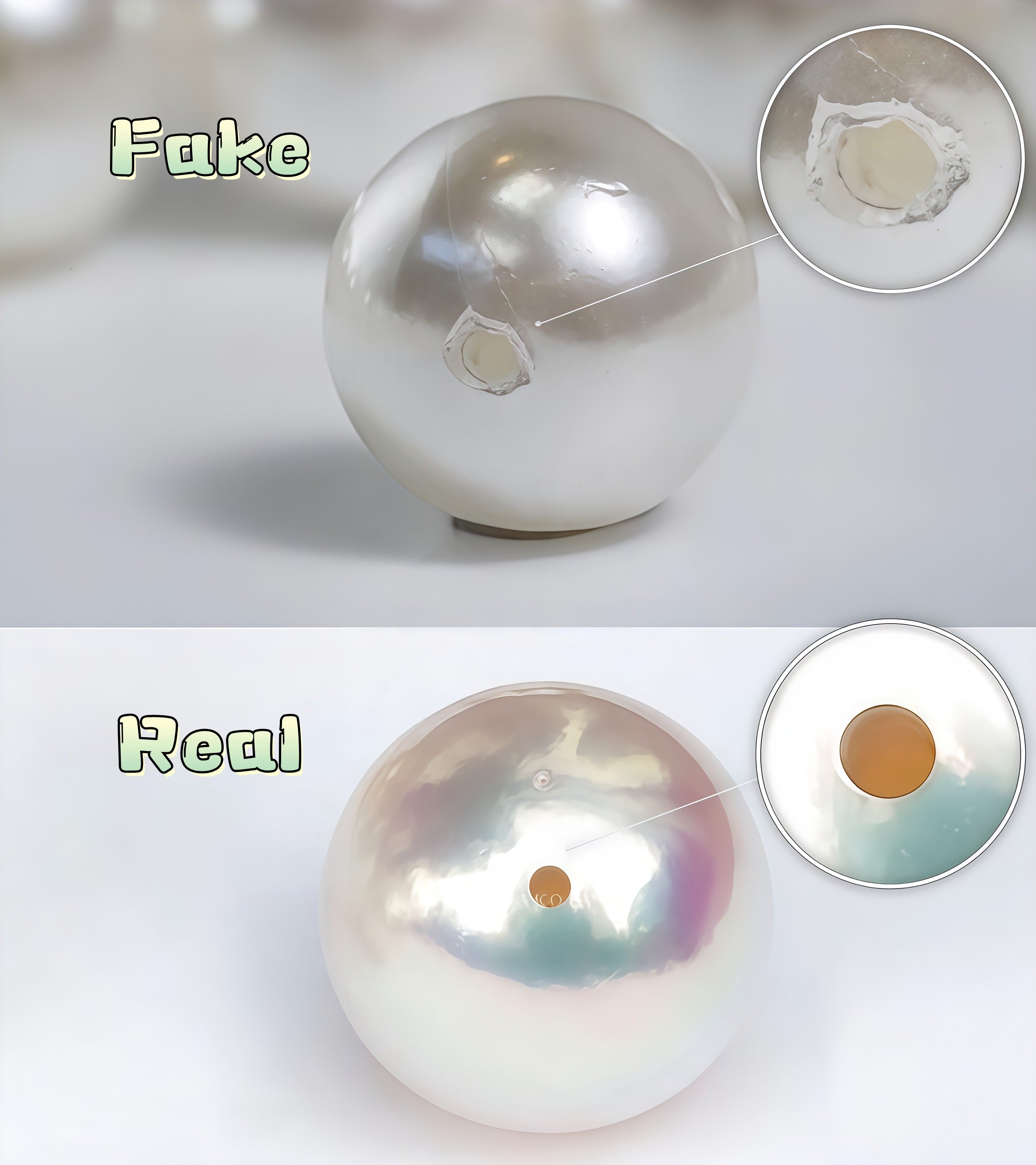
- Check the Drill Hole: The drill holes of real pearls are fine and as sharp as you can imagine. There are some you may view the inside of the layers. The fakes have shoddy coatings often chipped or with the edges very messy near the hole.
- Feel the Difference: Real pearls have a faint, cold feeling while you touch them. They are significantly more massive than they appear. Plastic fakes tend to feel warm and light.
- Trust the Source: The most reliable method to buy original pearls is to go with a good seller. Such a vendor should have certification and be straightforward in their production process.
The Expert's Take: Observation under Microscope Is the Most Direct Method
In gemology, precision is everything. The best way to determine if a pearl is authentic is by examining it through a microscope, or a jeweler's loupe with 10x magnification or higher. This is the top method that our founder uses every day. Alya Liu is a GIA & GUILD Certified Pearl Specialist.
What We Look For Under Magnification
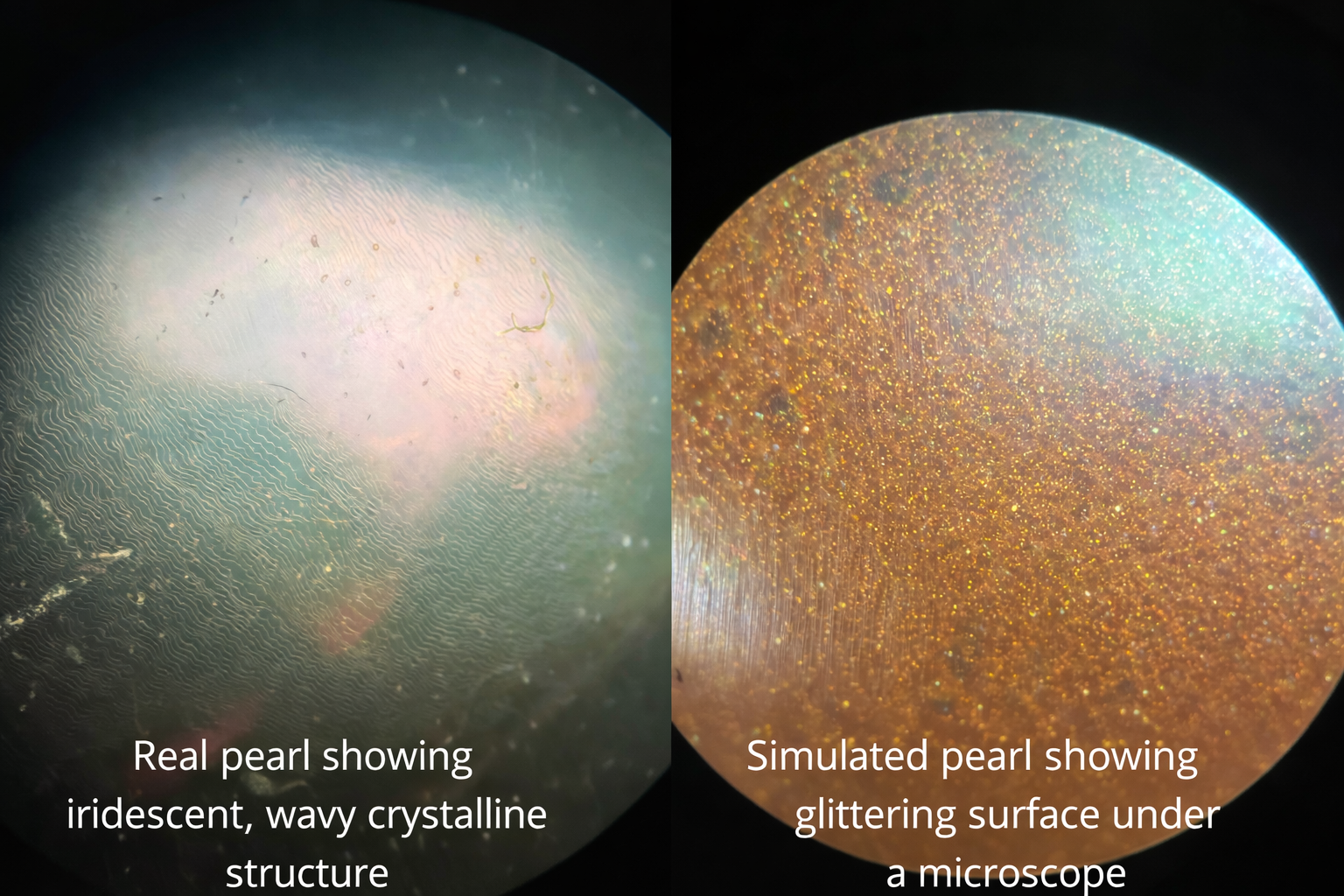
An actual pearl will never have a perfectly smooth surface. Instead, when you look at it magnified, it will exhibit a beautiful, intricate structure. You will observe a pattern that is very subtle and overlapping. It resembles scales or a labyrinth. This is nacre, the material formed by the oyster over time, layer by layer. Just like a human fingerprint, the surface of every genuine pearl is totally different.

A side-by-side comparison of a magnified real pearl showing nacre scales vs. a magnified fake pearl showing a smooth, artificial surface.
Seeing a fake pearl is much easier. A patterned plastic bead or coated glass will look perfectly smooth. It might have a grainy texture. Some false ones will have little bumps that are all the same. They are spotted like orange peels. The only thing you won't find is the natural pattern of nacre, which is scale-like.
We've examined more than 10,000 pearls using microscopes in our 20+ years. The difference is apparent once you learn what to look for. The unique, layered beauty of genuine nacre cannot be copied perfectly.
| Feature Under Magnification | Real Pearl | Fake Pearl |
|---|---|---|
| Surface Texture | Unique, overlapping scales that look like a maze. | Too smooth, grainy, or has a uniformly bumpy texture. |
| Luster | Depth that comes from layers of nacre underneath. | A superficial, painted-on appearance. |
| Imperfections | There may be organic growth characteristics but small. | Either perfectly uniform or they have unnatural characteristics like pits or bubbles. |
Four Simple At-Home Tests You Can Do Right Now
A microscope gives you exact results. But you can also be quite confident at home. Here are four simple tests. The first we present is the most practical. The last one is the one we merely tell about for teaching motives.
Test 1: The Light Test (Using Your Phone's Flashlight)

This is a great method to help you figure out whether a pearl is real. It's particularly useful for eliminating the most common fakes.
- First, go to a dimly illuminated or dark place.
- Next, switch on your phone's flashlight.
- Then, hold the pearl close to the light. Allow the beam to shine on it from the back.
A real pearl is opaque because it is formed of many layers of nacre that are dense and overlapping. Light will not go through the center of the pearl. You might just see a soft and gentle glow near the edge but not in the center.
On the other hand, a fake pearl often has a translucent effect. That particularly happens for glass or some types of plastic. The flashlight light will go straight through it. You may even see a spot on it that is bright and focused. When light goes through, it is clearly fake.
Test 2: Inspecting the Pearl's Drill Hole
A small drill hole is a feature that reveals much about the pearl's origin. All of our pearls are drilled by ourselves according to our "From Pearl Farm to Finished Jewelry" policy. This gives us a peculiarity to be informed about what the drill hole suggests about whether it's real.

You can use a magnifying glass to help with this test.
-
Drill Hole of Real Pearl: The edge of the hole will be sharp and well-defined. You are looking at a solid object, so the hole will look clean. If your magnifying glass is very powerful, you may see the nacre layers' fine lines. They look like the rings of a tiny tree.
-
Fake Pearl Drill Hole: Often the drill hole area is very messy. You can notice that there is a problem like paint or coating that has chipped or flaked. A visible ridge or "lip" is where the coating has been built up around the hole during production. For a coated glass bead, you may sometimes see a clear line between the inner bead and outer layer.
Test 3: The Physical Properties (Weight & Temperature)
Your sense of touch can give significant hints. This test is best for distinguishing between real pearls and lightweight plastic fakes.
| Property | Real Pearl | Fake Pearl |
|---|---|---|
| Temperature | It feels cool, almost cold, when you first touch it. It takes a few seconds to warm up against your skin. | It feels room temperature or slightly warm. Plastic fakes have no initial coolness. |
| Weight | It feels surprisingly heavy for its size. It has a satisfying density. | It feels very light, sometimes almost hollow. It lacks a sense of substance. |
A brief footnote: fake-shape glass pearls can feel both cool and heavy. Therefore, it is good to be cautious and use several tests for measurement. Light test and drill hole check should also be implemented. They will all give you an accurate assessment. Even though some sources mention other simple at-home tests, mixing visual, temperature, and weight tests is a powerful technique.
Test 4: The Fire Test (Effective, But NOT Recommended)

This is a technique that old-school pearl traders know. While it is effective, we still need to give you a sharp warning.
The basic idea is based on the composition of a pearl. The Genuine nacre is made of calcium carbonate. It is not easily affected by fire. If you heat a real pearl in a flame for a few seconds, it will never burn. It might get dirty with soot but it can be cleaned off. The pearl remains intact.
A plastic pearl will be destroyed. A plastic pearl will burn and melt almost instantaneously. Its chemical smell is bad. A coated glass pearl will have its surface blister, blacken, and peel away, exposing the plain bead underneath.
IMPORTANT WARNING: We categorically DISCOURAGE carrying out this test on your own. If the jewelry is fake, you may end up permanently damaging it. Even if the item is a real pearl, a lengthy exposure to fire can ruin the luster of the piece. The surface can crack, too. We mention this test only for educational purposes. We want to explain the way that pearls are sometimes tested for authenticity involving flame.
The Ultimate Test: Trusting Your Source
After all these tests, you can make the easiest choice by starting with the source you trust. A trusted local jeweler does not just sell jewelry. They also assure you that it is authentic.
Alya Liu is certified GIA & GUILD Certified Pearl Specialist. Our family has been in the pearl business for over 60 years. Our entire brand is based on authenticity. That is why our "From Pearl Farm to Finished Jewelry" standard is so important. It means we manage every aspect. We guarantee that every pearl we sell is genuine, of high quality, and belongs to an ethical supply chain. Following the expert's advice about real pearls is helpful. Nevertheless, buying from a reputable jeweler is perhaps the most important step.
If you are in the collection of real pearls, we are glad to invite you to choose from our offer of Alya Pearls - Pearl Necklaces | Freshwater, Baroque, Choker & Pendant. The items are made with the best deep-sea pearls. The collection includes classic choker, modern baroque pendant, which carry the timeless quality that we have discussed. As a way to express our gratitude to the community in 2026, you will receive a 20% discount with the code LOVE20. Meanwhile, each order will support our cause by donating pearl studs to girls in need. You can also get additional savings on bigger orders.
Conclusion: Your Newfound Confidence in Pearls
A clear, expertly done checklist is now available that shows you how to see if a pearl is real. Using a microscope for quality assurance is the best method of detecting any shortcomings. The use of light tests, drill hole inspection, and physical properties at home will make you competent in asserting authenticity. These are the tools that you can count on the most. They lift the surface and help you discover the inherent nature of your gem.
The most respectable way to get a pearl is to buy it from a real expert. Find someone with a transparent process and proven skills. We're the ones who deliver beautiful jewelry and give you the guarantee that the piece is authentically made.
Frequently Asked Questions (FAQ)
1. Are real pearls perfectly round?
Not really. The most perfectly round pearls are the rare and most valuable shapes. The majority of the pearls are of a slightly different shape and, thus, are not perfect. This is particularly true for freshwater pearls, which can be off-round, oval, or baroque. In addition, it is a mark of their natural origin. Fake pearls, on the other hand, are mostly found in a suspiciously perfect shape.
2. Can you tell if a pearl is real by its color?
No, you cannot tell by color alone. Real pearls have a multifaceted dark and beautiful luster which is called overtone. It is a secondary color that is visible on the surface. High-quality fake pearls imitate the different colors popular among consumers. But imitating the depth and the way light interacts with the overtones of real pearls is almost impossible.
3. Do real pearls peel?
No. The nacre of an authentic pearl is mighty and will not chip away. It is a component of its structure. If you spot a surface that is cracking, flaking, or peeling, then the item you are looking at is most likely a coated fake pearl. The outer layer is ripping where it was not attached to the inner bead.
4. What is the tooth test and do you recommend it?
The tooth test means to gently rub a pearl across your tooth. A real pearl feels slightly gritty due to the nacre structure. A fake one, in contrast, feels smooth. We do not actively recommend it even though it works. It may be unsanitary. There is a little chance of damaging the pearl's surface if it is done too hard. The tests we outlined above are safer and just as effective.
5. If a pearl passes the light test, is it definitely real?
Yes, if the pearl is opaque, and is not letting the light through in the middle it has passed a very important authenticity test. It is very possible that it's real. There is no single home test which will always be 100% reliable on all types of fakes. But, the light test is dependable for dismissing any plastic and glass copies. For 100% certainty, mix it with a drill hole and surface inspection.


Leave a comment
This site is protected by hCaptcha and the hCaptcha Privacy Policy and Terms of Service apply.