
How Can You Tell If Pearls Are Real? 5 Expert Tests 2026
Most of the time, we receive inquiries like, "What are the ways to tell if pearls are real?" Could it be that you received a family heirloom? Or else, you found a gorgeous one at a thrift store. Knowing whether the pearls are genuine is critical. You can tell if a pearl is genuine or imitation depending on what you watch for.
Our pearl spotting expertise comes from 20 years of experience. We have our own pearl farms as a family. We have crafted jewelry for over 10,000 customers, which has taught us how to tell if pearls are real. This guide reveals today's tips from the experts. We also have made it easier for you to access them at home in 2026.

Key Takeaways
- The Tooth Test: A real pearl feels a bit rough against your tooth. A fake one will feel smooth.
- Temperature: Real pearls are initially cold, then they warm up to your skin. Fake ones usually feel room temperature.
- Imperfections: Natural pearls have tiny surface irregularities. They are rarely identical in a strand.
- Luster and Weight: Look for a deep inner glow. Real pearls are heavier than you think.
- Professional Help: For valuable items, only a certified expert can be 100% sure.
5 Must-Know Home Tests to Determine Pearl Authenticity
Now, we will go through five easy tests that you can do right now. They are harmless and will give you a clear idea about the authenticity of your pearls.
1. The Tooth Test: The Original Way
Gently slide the pearl surface on the edge of your front tooth. Just be careful that you don't bite or scratch it.
A real pearl will feel slightly rough or gritty. This is due to the natural layers that form the pearl. A fake pearl has a feeling of perfect smoothness, like plastic or glass. This test is the main one that professionals use. It's a great way to start checking if your pearls are real.
2. The Temperature Test: A Fast Sensory Hint
Take the pearls in your palm. If they were in a closed drawer or a jewelry box, they should feel cool.
Real pearls feel definitely cool at first. After some time, they will become warm as your skin. Fake pearls, particularly plastic ones, will often feel room temperature. Most times, they will feel warm shortly after.

3. The Weight Test: Get the Distinction
Gently bounce the pearls on your palm. This allows you to feel the weight better.
Authentic pearls have a distinct weight to them. They will be denser and heavier than you imagine. Imitation plastic pearls can be too light and hollow. Good quality glass fakes can deceive you, though. Thus, combine this test with the rest.
4. The Imperfection Test: Nature's Signature
Observe the pearls closely while rotating them under a bright light. Look at each pearl by itself.
A real pearl will have slight surface marks. You might see a slight difference in shape, size, or color from one pearl to another. They are not defects; they are signatures of nature. Imitation pearls usually look "too perfect." They are exactly round in shape and the surface has the same shine. No pearl in a strand has surface marks.
5. The Rub Test: Friction Tells the Truth
If you have a strand, then take two pearls. Gently rub them against each other.
With real pearls, you will feel a little friction or roughness. If you look closely after rubbing, you might see a fine powder. The surfaces of fake pearls will slide smoothly against each other. There will be no resistance.
A Visual Checklist by Our Expert: Our Key Indicators at Alya Pearls
Basic tests are a great place to start, but a sharp eye will always see subtle signs beyond those. Mastering these signs will make you excel in knowing how to tell if pearls are real. At Alya Pearls, this visual check is an integral part of the process that we call "From Pearl Farm to Finished Jewelry". This is the way we ensure that every pearl meets our exacting standards.

| Feature | Real Pearl (What We Look For) | Imitation Pearl (Red Flags) |
|---|---|---|
| Luster | Deep inner glow as if it comes from inside. The reflection is sharp on the surface, but has depth. | A shallow, glassy shine that lies on the surface. The reflections can look flat or like plastic. |
| Surface | There will be a few blemishes, pits, or ridges that one typically finds in nature. Even if we sort thousands of pearls, a top-grade one ("AAA") has minuscule imperfections often visible under magnification. | A completely defectless, smooth, and uniform surface. Looks like a manufactured bead. |
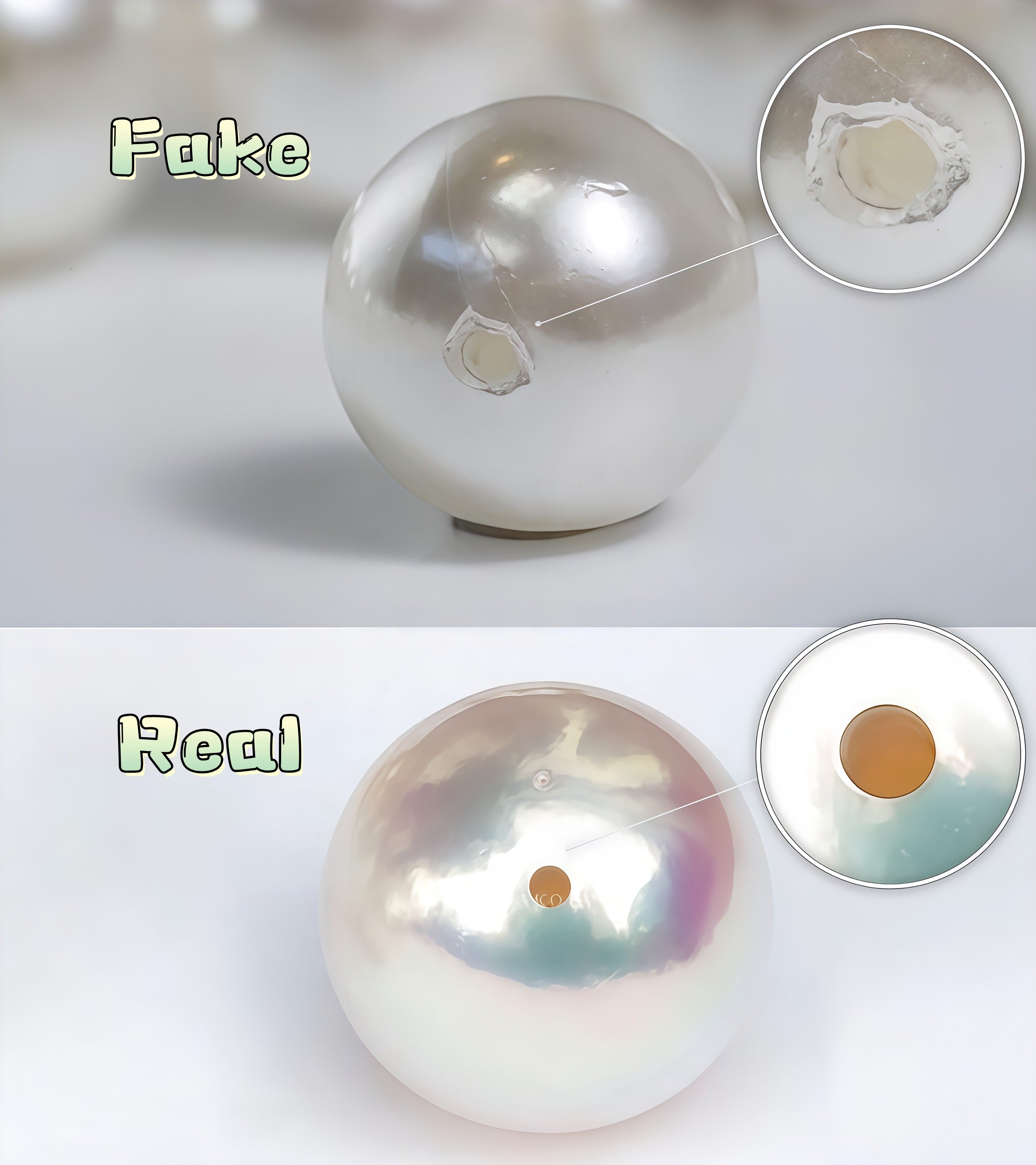
| Drill Hole | The edges of the drill hole are typically sharp and well-defined. Under a magnifier, you may see the concentric layers of nacre. | The coating around the drill hole may look thin, chipped, or have a paint-like ridge. The hole may be larger and less precise. |
| Shape & Size | Even in a well-matched strand, there are slight variations in shape and size. The perfectly round pearls are the rarest and the most expensive. | All pearls are identical in shape and size, which is an indication that they come from a mold, not an oyster. |
Myths and Misleading Tests: What to AVOID When Checking Your Pearls
The Internet is full of bad advice. This can mislead you or even damage your jewelry. We have handled pearls for over 20 years, and we want to warn you against these harmful methods.
The "Fire Test" – A Destructive Myth
The myth says that a real pearl will not be hurt by a flame.
The truth is DO NOT DO THIS. Fire can and will damage the pearl layers. It can crack the pearl and obliterate its shine. This is true whether it's real or fake. This test is not conclusive; all it does is destroy the gem.

The "Vinegar/Acetone Test" - A Damaging Chemical Reaction
The myth says a real pearl will dissolve in vinegar or it will not be affected by acetone.
The truth is that real pearls are made of calcium carbonate. They will be damaged or dissolved by an acid like vinegar. Acetone can also harm the surface of low-quality pearls. It will strip the coating off many fakes. It is not worth the risk.
The "Over-Reliance" Trap
Our advice is that no single at-home test is 100% perfect. A high-quality glass fake might feel cool and heavy. To get the right answer, use all five essential tests together. According to jewelry experts, it's best to combine multiple observations.
When to Seek a Professional: The Limits of At-Home Tests
If you have already tried the at-home tests and are still unsure, it's time to ask a professional. This is also true if the pearls might be very valuable.

Why a Jeweler's Opinion Matters
For valuable family pieces, antique items, or any strand you still doubt, a professional check is the only way to be certain. A certified gemologist can give you a clear answer on how to tell if pearls are real.
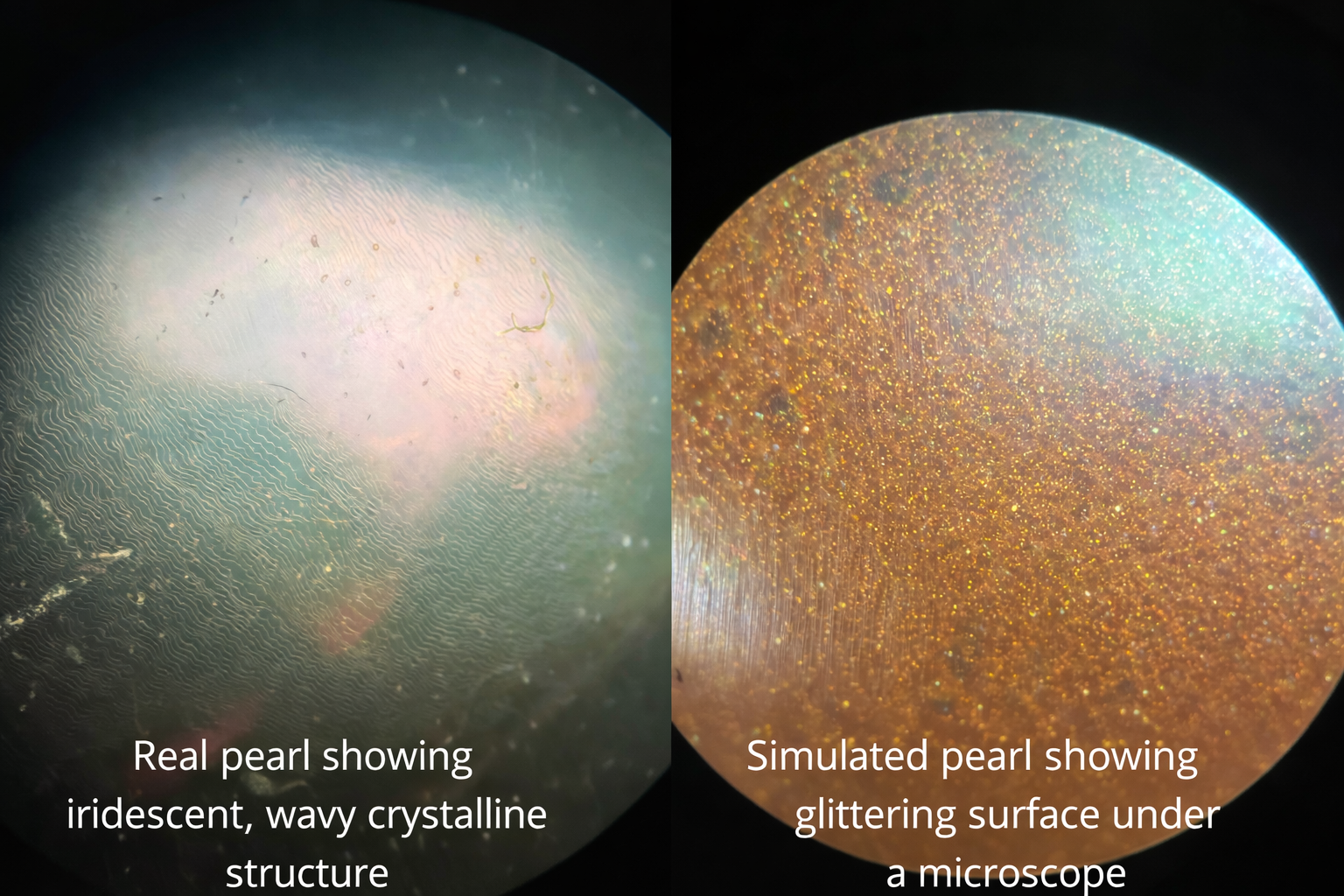
A professional uses high magnification and specific tools. They are able to check the pearl's layer thickness and structure. To set apart natural (wild) and cultured pearls, laboratories use innovative methods. They conduct x-ray examination to look inside the pearl and establish its fundamental structure.
Understanding Pearl Certification
Reputable sellers will provide certification for their high-value pearls. This document details the pearl's origin, type, size, and quality grade. For anyone buying fine pearl jewelry, understanding the distinction between different types of real pearls is key. Certification provides that clarity.
Alya Liu, our founder, is a GIA & GUILD Certified Pearl Specialist. She is also an NGTC Certified Jewelry Designer. She ensures that every custom piece from Alya Pearls comes with clear documentation. This gives our 10,000+ customers complete confidence in their purchase. We believe that this is the gold standard of trust. It gives a final answer to the question of authenticity.
Frequently Asked Questions (FAQ)
Here are quick answers to some common follow-up questions we get.
1. Are cultured pearls considered "real"?
Yes, absolutely. Cultured pearls are grown in real oysters with human help. This is much like farmed vegetables are still real vegetables. They have the same beautiful layers and properties as natural (wild) pearls. They are considered genuine. Most real pearls on the market in 2026 are cultured.
2. Can real pearls be perfectly round?
Yes, but it is very rare. This makes them highly valuable. Akoya pearls are known for being the most consistently round type. However, if an entire strand of pearls is exactly and perfectly round, it is a strong sign that they are man-made fakes.
3. Does the "tooth test" damage pearls?
If done gently, it will not hurt the pearl. The roughness you feel comes from tiny pearl crystals. A light rub will not scratch or damage the surface. You should avoid grinding the pearl hard against your teeth.
4. What is the single biggest giveaway of a fake pearl?
While no single test is perfect, a combination of signs is a major red flag. If a pearl feels perfectly smooth on the tooth test, has a flawless, plastic-looking surface, and every pearl on the strand is identical in shape, it is almost certainly a fake.
5. How can I tell if my pearls are real without taking them off the string?
You can use most of the at-home tests on a strung necklace. The tooth test, temperature test, and a close visual check of the surface, shape, and shine can all be done. You can also carefully look at the area around the drill holes. Check for knots between the pearls. This is a sign of a quality-strung, likely real, pearl necklace.


Leave a comment
This site is protected by hCaptcha and the hCaptcha Privacy Policy and Terms of Service apply.