
If you’ve ever wondered where pearls are found, you’re not alone. In my studio, the question usually shows up in a more practical way: “Why does this strand look bright like a tiny mirror, while that one feels soft and creamy?” A big part of the answer is pearl origins — meaning the animal that made the pearl, and the water it lived in.
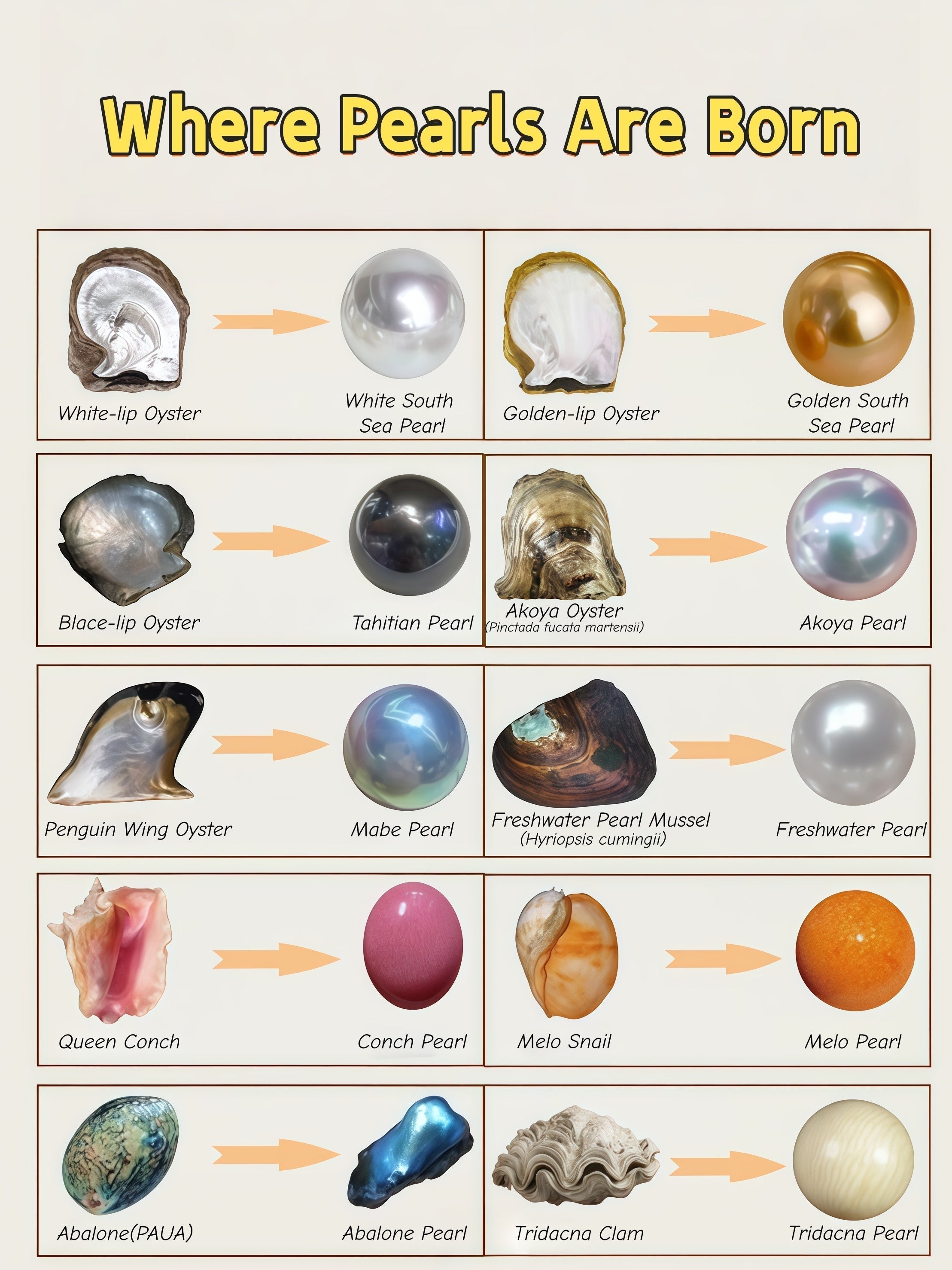
The infographic below is the simplest “map” I’ve found for explaining types of pearls. It shows the shell (the maker), the pearl (the result), and why certain pearl families naturally lean toward certain sizes, colors, and price tiers.

Key Takeaways
- Most fine-jewelry pearls are cultured (real pearls, farmed with human help).
- Saltwater pearl oysters produce Akoya, Tahitian, and South Sea pearls; freshwater mussels produce freshwater pearls.
- Size, color, and luster are strongly influenced by species + habitat — and that’s why price ranges vary so much.
Quick Answer: What Animal Makes Pearls? (Pearl Oyster vs Mussel)
Pearls are made by mollusks — soft-bodied animals with shells. In jewelry, you’ll hear two main “makers”: pearl oysters (saltwater) and mussels (freshwater). In plain English: saltwater pearls typically come from “oysters,” and freshwater pearls come from “mussels.”
And yes — a few other animals can produce rare “pearls,” too (like conch and melo), but the pearls most shoppers mean when they say pearl necklace or cultured pearl necklace are almost always from pearl oysters or freshwater mussels.

Types of Pearls at a Glance (Meaning, Look, and What Each Is Known For)
Below is the table I wish every shopper could see before buying. It summarizes the main pearl families in your image: their habitat, typical size and color, price tier, and the “meaning” in a practical sense — what each pearl is famous for, and why people choose it. (Prices vary wildly by luster, surface, shape, and matching; think of these as typical U.S. retail tiers.)
| Type | Animal (Maker) | Habitat / Origins | Typical Size | Signature Colors | Price Tier | What It’s Known For (Meaning) |
|---|---|---|---|---|---|---|
| South Sea (White) | White-/Silver-lip pearl oyster | Warm South Seas (Australia, Indonesia, Philippines) | Large (often ~10–13mm; can be bigger) | White, silver, soft pastels | $$$$ | Luxury + presence: the classic “statement pearl” with satiny glow |
| South Sea (Golden) | Gold-lip pearl oyster | South Seas (Philippines, Indonesia, Myanmar regions) | Large (often ~10–13mm; can be bigger) | Golden, champagne, deep gold | $$$$ | Iconic gold color: warmth, richness, “sunlit” elegance |
| Tahitian | Black-lip pearl oyster | Lagoons of French Polynesia | Medium-large (often ~9–11mm) | Gray to near-black; peacock/green/purple overtones | $$$ | Modern drama: dark body color with complex overtones |
| Akoya | Akoya oyster | Coastal waters (Japan, China) | Small-medium (often ~6–8mm) | White/cream with rose or silver overtones | $$–$$$ | Classic mirror luster: crisp, dressy, timeless strand look |
| Freshwater | Freshwater mussel | Lakes/ponds/rivers (primarily China) | Wide range (often ~4–10mm, can be larger) | White, cream, peach, lavender; many shapes | $–$$ | Versatility: best variety of shapes/colors for everyday styling |
| Mabé | Often “penguin-wing” oyster | Saltwater farms; assembled blister pearl | Looks large (domed) | White/cream; can be iridescent | $$ | Big look without full-sphere rarity |
| Conch | Queen conch (snail) | Caribbean | Variable | Pink to salmon; “flame” structure | $$$$+ | Collector rarity: non-nacreous “porcelain” glow |
| Melo | Melo sea snail | Southeast Asia | Variable | Orange to golden-orange; sometimes flame pattern | $$$$+ | Ultra rare: warm orange “sunset” pearl for collectors |
| Abalone | Abalone | Coastal cold waters (varies by species) | Variable | Strong iridescence (greens/blues/rainbow) | $$–$$$$ | Iridescent art piece: “opal-of-the-sea” vibe |
| Tridacna | Giant clam | Tropical reefs | Variable | White/cream; non-nacreous look | Varies | Proceed carefully: may be regulated; buy only with proper documentation |
Now let’s break these down in a way that’s actually useful if you’re choosing pearls for a necklace, earrings, or a gift.

South Sea Pearls (White & Golden): The Luxury Giants
If you want the headline version: South Sea pearls are among the largest cultured pearls in the fine jewelry world, and they’re often the highest-priced category among the “classic four” (Akoya, Tahitian, South Sea, freshwater). When a client tells me, “I want one pearl that looks expensive even across the room,” South Sea is usually the direction we explore.
Habitat & origins
South Sea pearls come from warm saltwater regions stretching between Southeast Asia and Northern Australia. In jewelry conversations you’ll often hear Australia and Indonesia first — and for golden pearls, the Philippines is especially important.
Typical size, color, and luster
- Size: commonly around 10–13mm, and can grow larger — which is a major reason they sit at the top tier.
- White South Sea: white to silver body color, sometimes with soft pink/blue/green overtones.
- Golden South Sea: yellow to deep golden tones — a naturally warm color that looks incredible on gold jewelry.
- Luster: often described as satiny or silky — less “hard mirror,” more “luxury glow.”
Price tier & what it means
I like to describe South Sea pearls as the “quiet luxury” pearl: big size, rich nacre character, and a glow that reads expensive without being flashy. If Akoya is the crisp white shirt, South Sea is the perfectly tailored silk blouse.
Alya’s styling note: If your wardrobe is mostly neutrals and clean lines, a single South Sea pendant is one of the most powerful “one-piece” upgrades you can wear.

Tahitian Pearls: Dark Color, Complex Overtone, Modern Drama
Tahitian pearls come from black-lip pearl oysters in the lagoons of French Polynesia. They’re famous for looking “black,” but the real magic is the overtone: peacock greens, graphite grays, and sometimes even aubergine or blue-gray flashes.
- Habitat: saltwater lagoons (that calm, protected water is part of their story).
- Typical size: commonly around 9–11mm; larger sizes exist, but become significantly rarer.
- Color range: light-to-dark gray through near-black, with vivid overtones.
- Price tier: generally high (especially for round shapes, clean surfaces, and strong overtone).
Meaning (in a style sense): Tahitian pearls are the “little black dress” of pearls — bold, sleek, and instantly modern. In the U.S., I often recommend them to clients who feel white pearls look too traditional on them.
Akoya Pearls: The Classic Mirror Luster
If your mental image of a “pearl necklace” is a perfectly matched strand with crisp reflections, you’re probably picturing Akoya. Akoya pearls are loved for that bright, mirror-like luster and the iconic, formal strand look.
- Habitat & origins: saltwater, typically produced in Japan and China.
- Typical size: often around 6–8mm, with a broader range outside that.
- Color: white to cream, often with rose/silver overtone.
- Price tier: mid to high depending on roundness, luster, and matching.
Meaning: Akoya is “classic refinement.” If you’re buying a graduation gift, a wedding piece, or a first “forever” strand, Akoya is the most traditional answer — and it earns that reputation.
Alya’s buying tip: For Akoya, ask for photos under neutral light. Great Akoya luster should look sharp and bright, not chalky.

Freshwater Pearls: The Most Versatile (and My Everyday Favorite)
Freshwater pearls are the pearls I use the most in my own designs — not because they’re “cheaper,” but because they’re the most creatively flexible. If you love baroque, oval, drop shapes, soft overtones, or a more organic feel, freshwater pearls give you the biggest playground.
- Habitat & origins: grown in freshwater lakes, ponds, and rivers — today, primarily in China.
- Typical size: very broad; everyday strands often sit around the mid sizes, and larger statement pearls exist too.
- Colors: white, cream, peach, lavender, purple — plus many dyed colors on the market.
- Price tier: usually the best value across quality-to-price, especially for everyday jewelry.
Meaning: Freshwater pearls are “wearable personality.” They don’t need to look perfectly uniform to look expensive. In fact, slight variation is often the beauty — especially for a modern freshwater pearl necklace or mixed-shape earrings.
Where I’d add your brand emphasis: this is the section where you can link to your freshwater collections, your care guide, and any education pages you’ve written.
Other Pearls in Your Image (Quick but Important)
Mabé (Blister) Pearls
Mabé pearls are typically blister pearls grown against the inside of a shell, then assembled into a domed pearl. They give you a bold look — great for earrings and pendants — but they’re a different structure than a full round pearl.
Conch & Melo Pearls (Rare, Non-Nacreous)
Conch and melo pearls aren’t nacreous like oyster/mussel pearls. They can have a porcelain-like appearance and sometimes a “flame” structure. These are collector gems more than everyday staple pearls, and pricing can jump dramatically with size, color, and quality.
Abalone Pearls (Iridescent, Ocean-Art Vibes)
Abalone-related pearls and nacre are famous for intense iridescence — greens, blues, and rainbow flashes. When a client wants something that feels like ocean light in motion, abalone is one of the most visually striking options.
Tridacna (Giant Clam) Pearls — Please Buy Responsibly
Giant clam materials can be regulated depending on species and jurisdiction. If you ever buy or sell this category, it’s crucial to check documentation and local regulations. When in doubt, I tell clients to choose classic cultured pearls instead.
How to Choose the Right Pearl Type (The Real-World Checklist)
If you’re deciding between freshwater pearls vs saltwater pearls, here’s the simplest way I explain it:
- Choose South Sea when you want maximum presence, luxury glow, and high-end statement value.
- Choose Tahitian when you want dark color, modern styling, and overtone complexity.
- Choose Akoya when you want the classic, crisp strand look with bright luster.
- Choose Freshwater when you want versatility, creative shapes, softer glow, and strong everyday value.
And if you’re comparing Akoya pearls vs freshwater pearls, ask yourself one question: do you want “perfectly classic,” or “beautifully varied”? Neither is better — they’re just different aesthetics.
Watch: A Behind-the-Scenes Look at Pearl Farming
If you’re a visual learner, this video is a helpful way to understand how saltwater pearl farming works — and why pearl origins matter.
FAQ
Where are pearls found in nature?
Pearls can form anywhere pearl-producing mollusks live — oceans, lagoons, and freshwater bodies. In modern jewelry, most pearls are cultured on farms, then harvested and graded.
Are cultured pearls “real” pearls?
Yes. Cultured pearls are real pearls formed by mollusks. “Cultured” simply means humans helped start the process in a controlled environment.
What pearl type is best for everyday wear?
For most people, freshwater pearls are the easiest daily option because they come in so many shapes and price points. For a single luxury everyday piece, a South Sea pendant is incredibly wearable.
Why do some pearls look mirror-bright and others look softly glowing?
Luster depends on nacre structure, surface quality, and the pearl’s type. Akoya often reads “mirror,” while South Sea and many freshwater pearls can read more “satiny” or softly luminous.


Leave a comment
This site is protected by hCaptcha and the hCaptcha Privacy Policy and Terms of Service apply.