
Written by Alya Liu — pearl farmer & jeweler.
Today, almost every pearl you see in fine jewelry is a cultured pearl. That includes White South Sea pearls, Golden South Sea pearls, Tahitian pearls, Akoya pearls, freshwater pearls, and Mabe pearls. They are real pearls — not imitation pearls — but they are grown with human help inside living oysters or mussels.

The modern pearl world exists because pearl farmers spent the last century improving nucleation, grafting, water management, oyster care, harvesting, and sorting. In the last 50 years especially, both the quality and availability of cultured pearls have changed dramatically. Pearls are no longer only antique treasures found by chance; they are organic gems grown through skill, patience, and risk.
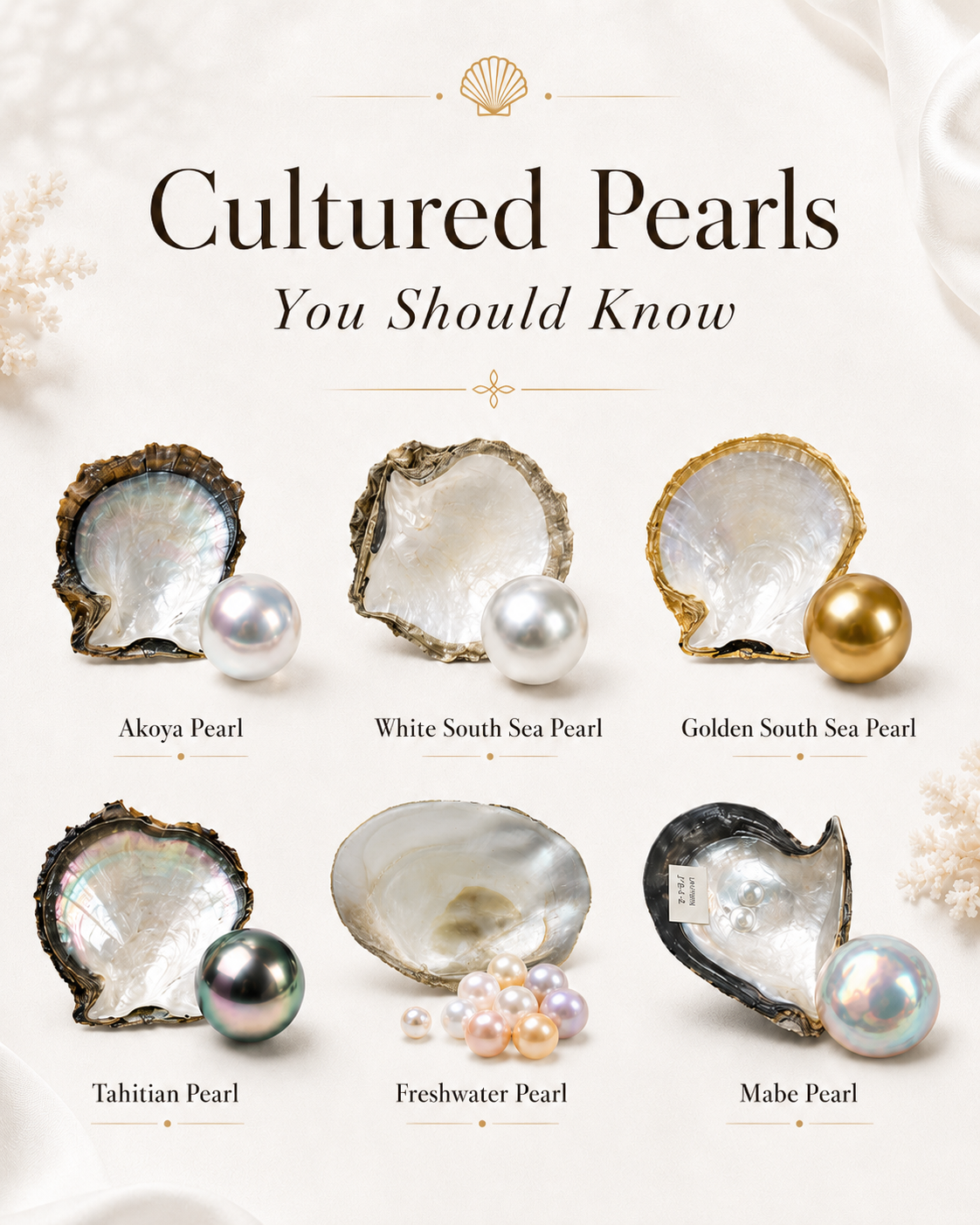
In this guide, I will explain the most important types of cultured pearls, what makes each one valuable, and how the market is changing. My focus will be on White South Sea pearls, Golden South Sea pearls, Tahitian pearls, and Akoya pearls. Freshwater pearls and Mabe pearls are also important, but they deserve deeper guides of their own.

Quick Answer: Are Cultured Pearls Real?
Yes. Cultured pearls are real pearls. The word “cultured” means the pearl was grown on a pearl farm with human assistance. A natural pearl forms without human intervention; a cultured pearl forms after a pearl farmer implants a bead nucleus, a piece of mantle tissue, or another starter that encourages nacre growth.
This distinction matters because many shoppers hear “cultured” and think it means “fake.” It does not. Fake pearls are imitation pearls made from glass, plastic, shell, or coated beads. Cultured pearls are organic gems formed inside living mollusks.
In modern jewelry, cultured pearls are the standard. The traditional natural pearl market belongs mostly to antique jewelry, auction pieces, and collector gems. For most buyers today, the real question is not “natural or cultured?” The better question is: What type of cultured pearl is it, how good is the luster, how thick is the nacre, and is the seller honest about origin and treatment?
Why Cultured Pearls Changed the Jewelry World
Before pearl farming, fine pearls were rare accidents. Divers could open thousands of oysters and find only a few usable pearls. This scarcity made pearls symbols of royalty, wealth, and status for centuries.
Cultured pearl farming changed that history. It did not make pearls “easy,” but it made them possible. Farmers learned to work with living mollusks, insert nuclei or tissue grafts, protect oysters through years of growth, and harvest pearls at the right moment. This shifted pearls from pure luck into a craft.
I think this is one reason cultured pearls are culturally powerful. They sit between nature and human intention. The farmer begins the process, but the oyster or mussel finishes it. That cooperation is what makes pearls different from mined stones or lab-grown crystals.
Main Types of Cultured Pearls
Each cultured pearl type has its own language. Some are valued for size, some for luster, some for color, and some for their modern design potential.
| Pearl Type | Main Origin | Best Known For | Jewelry Mood |
|---|---|---|---|
| White South Sea Pearl | Northern Australia, Indonesia, South Sea region | Large size, white/silver body color, satin luster | Royal, refined, timeless |
| Golden South Sea Pearl | Philippines, Indonesia, Southeast Asian waters | Natural golden color, luxury glow | Warm, wealthy, symbolic |
| Tahitian Pearl | French Polynesia | Dark body color, peacock, green, blue, purple overtones | Powerful, modern, expressive |
| Akoya Pearl | Japan, especially traditional coastal pearl regions | Small size, mirror-like luster, classic strands | Elegant, clean, bridal, formal |
| Freshwater Pearl | Mainly China | Variety, value, colors, baroque and bead-nucleated forms | Everyday, creative, accessible |
| Mabe Pearl | Japan, Australia, Indonesia, China, and more | Blister pearl dome, rainbow iridescence | Vintage, sculptural, dramatic |
White South Sea Pearls: The Satin-Luster Classic
White South Sea pearls are among the most traditional luxury pearls. They are usually large, calm, and luminous. Their beauty is not a sharp mirror shine like Akoya; it is a soft satin glow. This is why designers love them in high jewelry. A White South Sea pearl does not need to shout. It has presence by weight, surface, and light.
The finest White South Sea pearls are strongly associated with northern Australia. In the trade, Australian White South Sea pearls have become a symbol of quality, especially when the pearls show large size, clean surface, thick nacre, and refined silver-white or white body color.
Paspaley is one of the names most closely connected with Australian South Sea pearls. Their high-quality pearls and jewelry regularly appear in the world of high jewelry and auction conversation. When I see a beautifully matched Australian South Sea strand, I understand why collectors treat it differently from ordinary pearl jewelry. It feels like quiet wealth.


In recent years, high-quality Australian White South Sea pearls have become harder to source consistently. Climate instability, farming risk, and limited suitable waters all influence supply. When production cannot grow easily, the best pearls become more valuable.
Historically, this kind of pearl belongs to courtly jewelry. White pearls were often chosen for royal and aristocratic jewels because they carried purity, calm, and restraint. In Chinese and British royal-style jewelry, large white pearls have long felt appropriate for ceremonial dress. They are not trendy pearls; they are legacy pearls.
Golden South Sea Pearls: Wealth, Warmth, and Market Caution
Golden South Sea pearls are loved for their rich natural gold color. Their glow feels warmer than white pearls, almost like sunlight. In many cultures, gold is connected with wealth, prosperity, and good fortune, so a deep golden pearl naturally carries that symbolic weight.
These pearls are farmed in warm tropical waters, especially around Southeast Asia and the broader South Sea region. In recent years, production from Indonesia, the Philippines, Vietnam, and nearby regions has become increasingly important. The water conditions, temperature, currents, and farming practices all affect quality.
But Golden South Sea pearls also require caution. The market contains a wide quality range. Some pearls have beautiful natural color, smooth nacre, and strong luster. Others have weak surface, dull luster, heavy blemishes, or uneven color. In addition, dyed freshwater pearls are sometimes sold in ways that confuse less experienced buyers.
My advice is simple: if you are buying an expensive Golden South Sea pearl, buy from a trusted seller and ask for documentation when appropriate. A certificate or reliable source matters more here because color is one of the main value drivers.

Tahitian Pearls: Dark Color, Modern Power, and Rising Rarity
Tahitian pearls are cultured in the black-lipped pearl oyster, mainly in French Polynesian waters. They are famous for natural dark body colors and overtones that can include green, blue, purple, pink, bronze, and peacock.
Traditionally, the black Tahitian pearl symbolized mystery, authority, and strength. It was not the gentle “good girl” pearl. It had depth. It looked like a pearl made for someone who did not need to ask permission.
In recent years, I have seen blue and green Tahitian pearls become especially popular. These colors are rarer, more modern, and more expressive. A blue-green Tahitian pearl can feel like a symbol of contemporary feminine power: elegant, but not passive; luxurious, but not old-fashioned.
The Tahitian pearl industry also faces real biological pressure. Pearl oyster production depends heavily on healthy oyster populations, spat collection, genetic diversity, and lagoon conditions. When mother oysters become fewer or genetic diversity narrows, the industry becomes more vulnerable to disease and environmental stress.
This is one reason high-quality Tahitian pearl prices have risen. Top-grade Tahitian strands with strong luster, excellent matching, rare color, and clean surface can reach serious collector-level prices. In my current market observation, a high-end Tahitian pearl necklace at GUILD five-star or selected grade level can enter the tens of thousands of dollars, and exceptional strands may reach far higher.

Akoya Pearls: Mirror Luster and the Challenge from Freshwater Pearls
Akoya pearls are the classic Japanese saltwater pearls. They are usually smaller than South Sea and Tahitian pearls, but they are famous for sharp, mirror-like luster. When people imagine a traditional white pearl necklace, they are often imagining Akoya pearls.
Japanese companies such as Mikimoto and TASAKI helped make Akoya pearls a global symbol of elegance. Through long-term cultivation, grading, marketing, and design, Akoya became the representative pearl of cooler northern waters. It is clean, formal, and highly recognizable.
But Akoya pearls now face two pressures. The first is environmental: storms, heat stress, disease, and water quality issues have made Japanese pearl farming more difficult. The second is market competition: high-quality Chinese freshwater pearls are improving quickly in size, roundness, luster, and color.
This does not mean Akoya pearls will disappear. Brand, history, and the classic Akoya look still matter. But as freshwater pearl technology advances, Akoya’s premium will need to rely more on truly exceptional luster, strong brand trust, and transparent quality. If scarcity and performance are no longer obvious to buyers, the collectible premium becomes harder to defend.
I sometimes compare this pressure to what happened with diamonds and lab-grown diamonds — not because pearls and diamonds are the same, but because the psychology is similar. When a market’s value story depends heavily on rarity, new technology can challenge the old pricing language.

Freshwater and Mabe Pearls: Two Categories Worth Separate Guides
Freshwater pearls are mostly farmed in southeastern China. Modern freshwater pearls include traditional non-bead pearls grown with mantle-tissue grafting, as well as bead-nucleated Edison-type pearls. Their biggest strength is variety: colors, shapes, sizes, and price points.
For everyday jewelry, freshwater pearls are often the best value. They can be soft, romantic, colorful, baroque, near-round, or bold. The best modern freshwater pearls are no longer just “affordable alternatives”; some are beautiful enough to challenge lower-grade saltwater pearls.
Mabe pearls are cultured blister pearls. The most iridescent examples, such as those from penguin oysters around Amami Oshima, can show dreamy rainbow-like luster. They are often used in pendants, rings, earrings, and vintage-style jewelry because their dome shape gives a large pearl look without requiring a fully round pearl.
I will discuss freshwater pearls and Mabe pearls in more detail in separate articles because each one has its own farming method, grading logic, and design language.

Market Trends: Why Cultured Pearl Prices Are Changing
The cultured pearl market is no longer simple. For decades, buyers often thought in a fixed hierarchy: South Sea at the top, Tahitian and Akoya in the middle, freshwater as the affordable choice. Today, that hierarchy still exists, but it is being challenged.
White South Sea pearls remain luxury pearls because suitable farming waters are limited and top-quality production is difficult to increase. Golden South Sea pearls are becoming more visible, but quality varies widely. Tahitian pearls are gaining modern fashion value, especially in blue, green, and peacock tones, while biological pressure affects supply. Akoya pearls retain brand power, but improved freshwater pearls are changing buyer expectations.
In my opinion, the next decade of pearl buying will reward knowledge. Buyers who understand luster, nacre, origin, treatment, and certification will make better decisions than buyers who only follow type names.
How to Choose the Right Cultured Pearl
If you are buying cultured pearls, choose based on purpose, not only prestige.
| You Want | Best Pearl Type | Why |
|---|---|---|
| Classic bridal or formal jewelry | Akoya pearl | Crisp white look and mirror-like luster. |
| Luxury heirloom piece | White South Sea pearl | Large size, satin luster, and timeless high-jewelry presence. |
| Warm, wealthy, golden symbolism | Golden South Sea pearl | Natural golden color and luxurious glow. |
| Modern statement jewelry | Tahitian pearl | Dark body color, rare overtones, and stronger personality. |
| Value, creativity, daily wear | Freshwater pearl | Wide variety of shapes, colors, and price points. |
| Large dome, vintage feeling, rainbow glow | Mabe pearl | Blister structure creates a large, luminous design surface. |
My personal buying order is always: luster first, surface second, color third, then size and shape. A famous pearl type with dull luster is not a good pearl. A less famous pearl with excellent luster can still become beautiful jewelry.
For expensive South Sea, Tahitian, or Akoya pearls, I recommend buying from a trusted seller and asking for a respected pearl report when appropriate. For Golden South Sea and Tahitian pearls especially, treatment disclosure and origin confidence matter.
Watch: Cultured Pearls and Modern Pearl Farming
For a visual introduction to cultured pearls and how pearl farming works, this video is a helpful companion to the article.
FAQ
Are cultured pearls real?
Yes. Cultured pearls are real pearls grown inside oysters or mussels with human assistance. They are different from imitation pearls made from glass or plastic.
What are the main types of cultured pearls?
The main types are Akoya pearls, White South Sea pearls, Golden South Sea pearls, Tahitian pearls, freshwater pearls, and Mabe pearls.
Which cultured pearls are the most expensive?
High-quality South Sea pearls are often among the most expensive cultured pearls, especially large White South Sea and deep Golden South Sea pearls. Rare Tahitian colors and perfectly matched strands can also be very valuable.
Are freshwater pearls cultured pearls?
Yes. Most freshwater pearls on the market today are cultured pearls, mainly produced in freshwater mussels. Modern freshwater pearls can be tissue-nucleated or bead-nucleated.
Are Akoya pearls better than freshwater pearls?
Akoya pearls are famous for mirror-like luster and classic round strands. Freshwater pearls offer more variety and value. The better choice depends on your style, budget, and quality expectations.
Why are Tahitian pearls so popular now?
Tahitian pearls feel modern because of their dark body colors and natural overtones. Blue, green, and peacock Tahitian pearls are especially popular for statement jewelry and contemporary feminine styling.


Leave a comment
This site is protected by hCaptcha and the hCaptcha Privacy Policy and Terms of Service apply.