
Writen By Alya — pearl jewelry maker, raised in a pearl-farming family. I design and hand-select pearls for modern, wearable fine jewelry.
If you’ve ever compared two pearl strands and thought, “Why does one look like a tiny mirror, while the other feels softly luminous?” — you’re already asking the right question. A big part of that visual difference can come from how the pearl was cultured: nucleated (bead-nucleated) vs non-nucleated (often called seedless).
Key Takeaways
- Nucleated pearls grow around a bead nucleus and often come out rounder and more uniform.
- Non-nucleated pearls form with little to no bead nucleus and are typically more nacre-rich, with more organic shapes.
- Neither is “better” by default — your best choice depends on the look, color, shape, budget, and how you’ll wear them.

What Is a Cultured Pearl? (Cultured Pearls Meaning)
A cultured pearl is a real pearl formed inside a mollusk, with a little human help to start the process. In most modern pearl farming, technicians introduce a small “starter” so the oyster or mussel begins building nacre (the shimmering material that gives pearls their glow).
Natural vs Cultured Pearls
Natural pearls form without any human intervention and are extremely rare today. Cultured pearls are the standard in the jewelry market — the vast majority of pearls you’ll see in a pearl necklace, pearl earrings, or a pearl bracelet are cultured. The good news: “cultured” does not mean “fake.” It means farmed under controlled conditions, then harvested, sorted, and graded.
Further reading: GIA Pearl (Gem Encyclopedia) · The Pearl Association of America
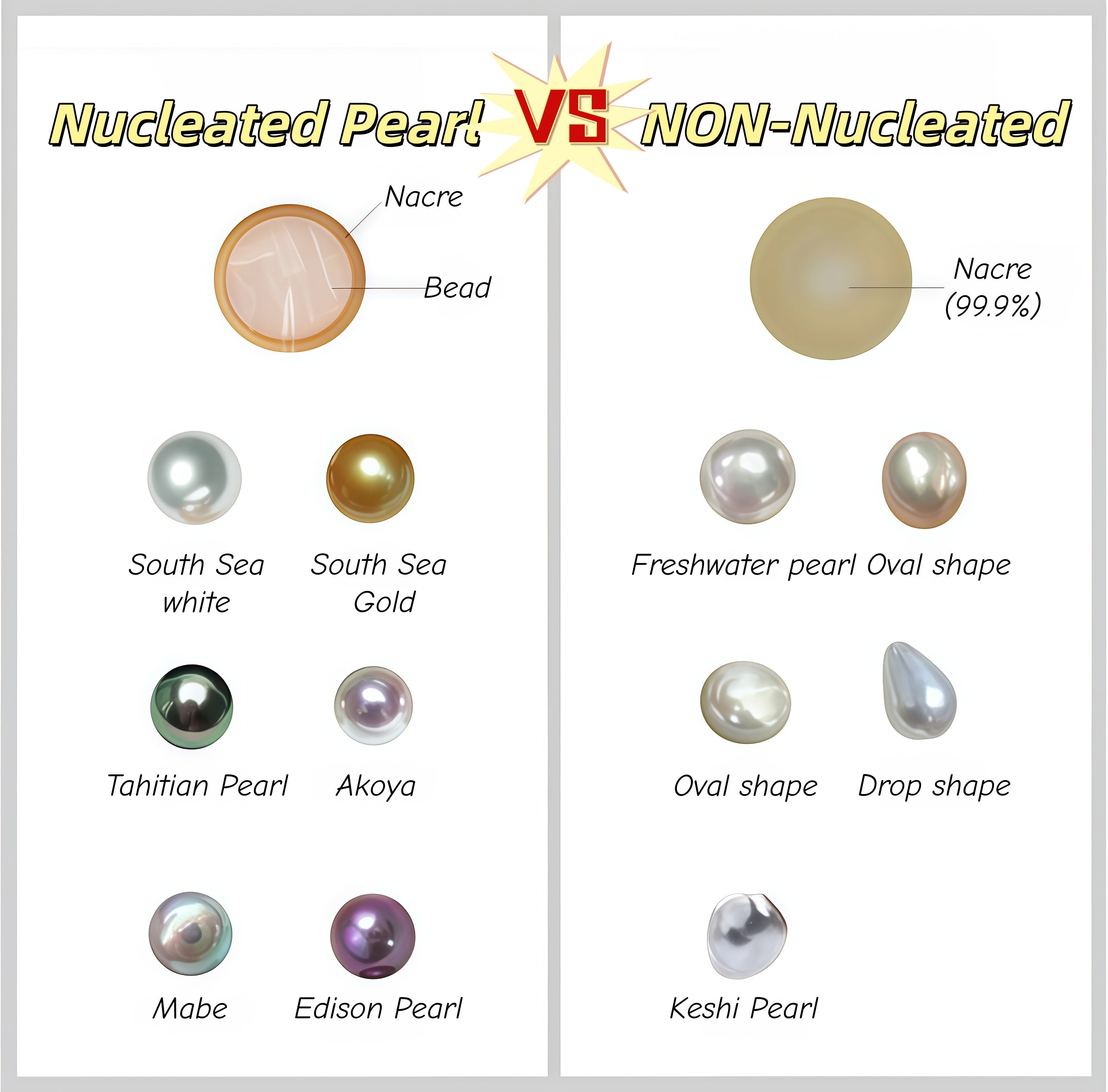
Nucleated vs Non-Nucleated Pearls: The Quick Definition
How bead-nucleated pearls are formed
In a bead-nucleated (often shortened to “nucleated”) process, a round bead is placed into the mollusk along with a tiny piece of mantle tissue. Over time, nacre builds around that bead, forming the pearl. This method is common in many saltwater pearl types and also exists in some freshwater pearl programs.
How non-nucleated pearls are formed
Non-nucleated pearls (often called “seedless”) typically form with tissue-only stimulation and little to no round bead nucleus. Because there isn’t a perfectly round bead setting the template, these pearls often show more shape variety — from oval to drop to baroque forms.

Luster, Nacre, Color & Shape: What You’ll See (and Feel) in Real Life
Pearl Luster: Mirror vs Soft Glow
Luster is the first thing I evaluate at my workbench. I look at how clean and sharp the reflections are, and whether the surface looks alive under light. Some pearls throw back a crisp, mirror-like highlight; others radiate a softer, candlelit glow.
What creates mirror-like luster
Mirror-like luster often appears when a pearl has excellent surface quality and strong nacre structure that reflects light cleanly. Many bead-nucleated pearls are grown with the goal of producing consistent, round shapes with a bright, “dressy” look — the kind that photographs beautifully for a classic cultured pearl necklace.
What creates a softer, warm glow
Soft glow is not “worse.” In fact, many clients prefer it for daily wear because it feels natural and flattering on skin. Non-nucleated pearls are often more nacre-rich, and that can create a deeper, gentler luminosity — especially in freshwater pearl strands where overtones can shift between white, cream, peach, and lavender.
Alya’s studio tip: If you’re choosing pearls for everyday wear, step near a window (indirect daylight) and compare. The one you keep staring at — that’s usually your match.
Nacre Thickness & Durability: What You’re Really Buying
Nacre is the pearl’s “wear layer.” Over years of use, pearls can show tiny abrasions — especially rings and bracelets that rub against surfaces. In general, more nacre can mean more long-term resilience, but the full story depends on how the pearl was grown and finished.
When “thin nacre” matters (and when it doesn’t)
Some bead-nucleated pearls are harvested earlier to keep shapes very round and surfaces very bright, which can result in comparatively less nacre than a nacre-rich, non-nucleated pearl. However, many high-end bead-nucleated pearls are grown longer and can be extremely durable. The real takeaway: ask for quality details and buy from sellers who clearly grade and stand behind their pearls.
Longevity tips for pearl necklace & pearl earrings
- Put pearls on last — after perfume, hairspray, and skincare.
- Wipe gently with a soft cloth after wearing.
- Store separately so pearls don’t rub against metal or gemstones.
- For a frequently worn strand, consider restringing periodically (especially for a freshwater pearl necklace you love daily).
Care reference: GIA Pearl Care & Cleaning Guide

Color & Overtone: Cool White, Cream, Gold, and Dark Tones
Color isn’t just “white or not.” Pearls have body color plus overtone — the subtle veil you see on top (pink, silver, rose, lavender, green). This is where personal taste really shows.
How to think about color without mixing up the categories
Nucleated vs non-nucleated doesn’t automatically decide color. In real shopping, pearl type and overtone usually matter more than the presence of a bead nucleus. What nucleation can change is the overall “look” you perceive—some pearls read brighter and more uniform, while others read softer and more organic. If you’re choosing for everyday wear, pick the overtone that flatters your skin under daylight (cooler silver/white vs warmer cream/peach).
Common treatments you should know
It’s normal for pearls to undergo gentle post-harvest processes to clean or refine appearance. The key is transparency: a trustworthy seller should tell you if pearls are dyed, treated, or color-enhanced — and price them accordingly.
Shape & Matching: Round, Oval, Drop, Baroque
If you want a perfectly classic strand, consistent roundness matters. If you want personality, you’ll probably fall in love with the imperfect ones. Non-nucleated pearls tend to give you more organic shapes — oval and drop silhouettes, and sometimes baroque character.
Why non-nucleated pearls vary more (and why that’s beautiful)
When there isn’t a round bead nucleus acting like a mold, shape becomes more expressive. This is exactly why collectors love keshi pearls and why a keshi pearl necklace can look so modern — every pearl feels slightly different, like brushstrokes.
Which Pearl Types Are Usually Nucleated (and Which Are Not)?
This is the part that helps you shop faster: many pearl types have a “typical” culturing method, so you can often predict whether you’re looking at a bead-nucleated pearl or a nacre-rich, non-nucleated pearl.
Often bead-nucleated (nucleated):
- Akoya (classic bright luster, refined matching)
- South Sea (often larger, luxurious presence)
- Tahitian (dark body colors with complex overtones)
- Mabe (typically a nucleus-based cultured pearl product)
Often non-nucleated (seedless / nacre-rich):
- Many freshwater pearls (especially with more organic shapes)
- Many keshi pearls (nacre-rich, irregular silhouettes)
Alya’s honest note: there are exceptions. Some freshwater pearls (for example, certain “Edison” programs) can be bead-nucleated. So if you’re buying online, the simplest high-trust move is to ask one direct question: “Are these bead-nucleated or non-nucleated?”
Why keshi pearls matter in this conversation: keshi pearls are famous for being nacre-rich and irregular. Many form as a byproduct of culturing, which is why they’re often discussed alongside “seedless” pearls. If you love a modern, organic look and you want pearls that feel very “nacre-forward,” keshi styles are one of the easiest ways to get that aesthetic.
How to Choose: A Practical Checklist
| What you care about | Nucleated (bead-nucleated) | Non-nucleated (often seedless) |
|---|---|---|
| Look | Often very bright, “dressy,” uniform | Often deeper glow, more organic feel |
| Shape | Typically rounder / more consistent | More oval, drop, baroque variation |
| Nacre feel | Nacre over a bead nucleus | Nacre-rich throughout |
| Best for | Classic strands, formal looks | Everyday wear, modern styling, one-of-a-kind pieces |
If you want a classic cultured pearl necklace
Choose pearls that match tightly in size and color, with crisp reflections. Ask for close-up photos under neutral light. Consistency is the beauty here.
If you want organic, one-of-a-kind pearls
Look for non-nucleated pearls, keshi pearls, or expressive freshwater strands where each pearl has personality. A little variation is the design.
Questions to ask before you buy online
- Are these pearls cultured freshwater pearls or saltwater pearls?
- Are they bead-nucleated or non-nucleated?
- What grade/standards are you using for luster and surface?
- Any treatments or color enhancement?
- Do you offer a clear return or exchange policy?

Tap photo to view our baroque necklace.
Watch: How Bead-Nucleated Cultured Pearls Are Made
If you’re a visual learner, this short video shows the nucleation step clearly — it’s the quickest way to understand what “nucleated” really means.
FAQ
Freshwater pearls vs saltwater pearls: which is better?
“Better” depends on your goal. Saltwater pearls often win for iconic, classic signatures (like Akoya’s refined look), while freshwater pearls often win for variety, value, and modern styling options. Choose the one that matches your taste and lifestyle.
Do non-nucleated pearls last longer?
Non-nucleated pearls are often nacre-rich throughout, which can be a durability advantage in real life. But longevity also depends on surface quality, how the pearl was grown, and how you care for it.
Are “seedless pearls” the same as natural pearls?
No. “Seedless” usually refers to non-nucleated cultured pearls — they’re still cultured (farmed), just without a round bead nucleus. Natural pearls are formed entirely without human intervention and are far rarer.


Leave a comment
This site is protected by hCaptcha and the hCaptcha Privacy Policy and Terms of Service apply.