
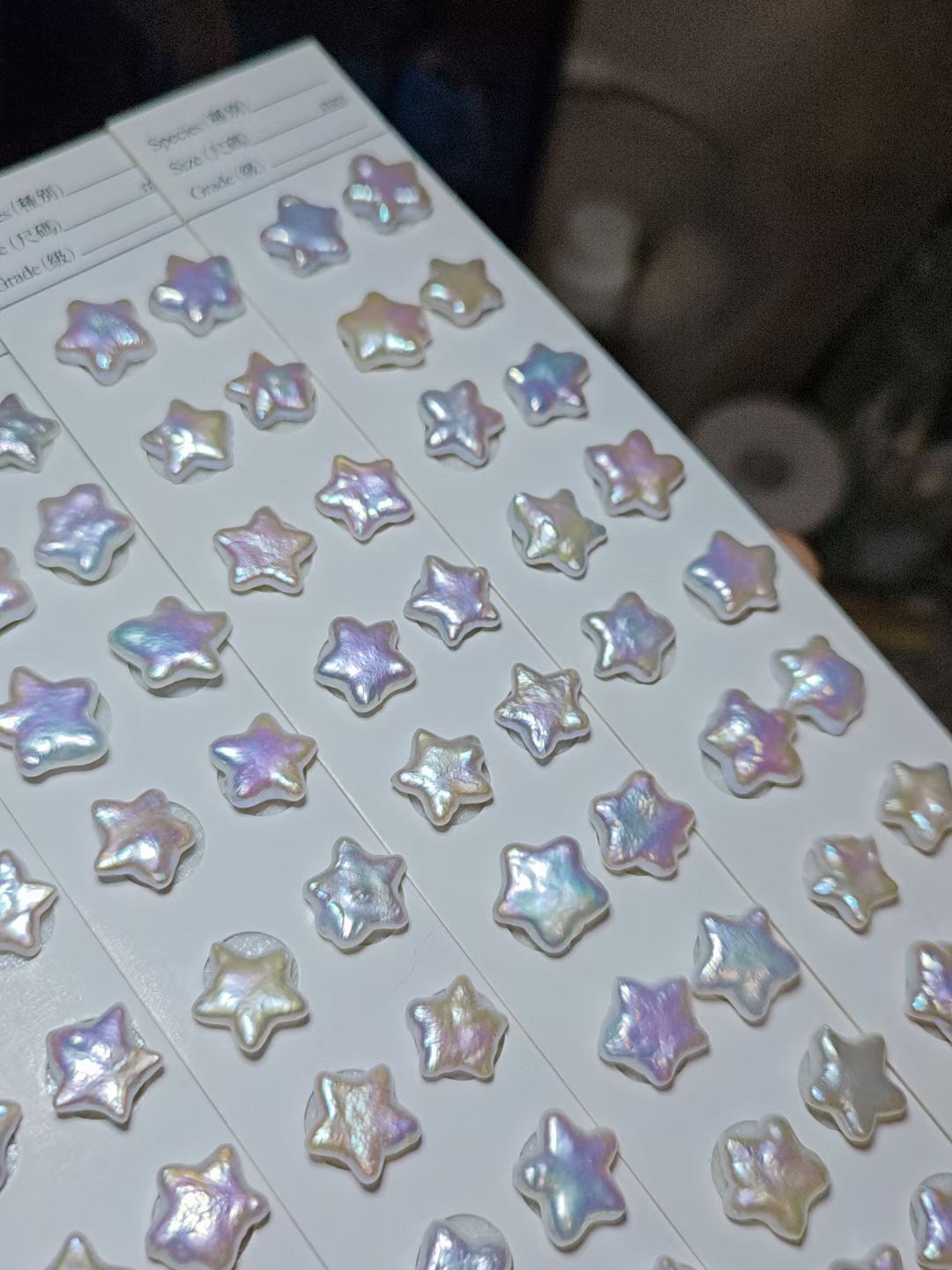
How Are Star Shaped Pearls Made? Are Star Pearls Real?
How Are Star Shaped Pearls Made? Are Star Pearls Real and How Do They Form?
Star-shaped pearls can look almost too perfect to be real. With crisp points, a symmetrical outline, and a soft nacre glow, they often raise the same question:
Are star pearls real?
Yes—star shaped pearls are real pearls. They are formed inside living mollusks (just like round pearls), but they are created using a specialized cultured-pearl technique that guides the shape during growth.
In this guide, you’ll learn how are star shaped pearls made, how are star pearls formed, what makes them different from classic pearls, and how to shop with confidence.

Natural Pearls vs. Cultured Pearls: The Key Background
Before we explain star pearls, it helps to understand the difference between natural pearls and cultured pearls.
What Are Natural Pearls?
Natural pearls form by chance when an irritant enters a mollusk without human involvement. Today, truly natural pearls are extremely rare. Historically, some natural pearls were found in regions like the Persian Gulf and in a small number of wild mollusks (including certain snails), but the supply is tiny compared with modern demand.
What Are Cultured Pearls?
More than 99.9% of pearls sold today are cultured pearls. Cultured pearls are formed when humans carefully begin the process, while the mollusk does the actual pearl-making by secreting nacre layer by layer. Star pearls fall into this category.
A Quick History of Pearl Culturing
Modern pearl culturing developed in Japan, where early innovators learned how to encourage pearl oysters to form pearls under controlled conditions. Around the 1980s, these techniques expanded into China, where freshwater pearl farming grew quickly and continued to evolve.
Over time, farms refined methods for creating non-round pearls—including star shaped pearl designs—by guiding how nacre forms during the growth process.
Two Main Cultured Pearl Methods (And Why Only One Makes Star Pearls)
There are two major approaches to cultured pearls. Understanding them explains why star pearls are possible.

1) Bead-Nucleated (Gonad) Pearls
This method is commonly used for larger saltwater pearls (such as South Sea and Tahitian pearls) and some freshwater varieties (such as Edison pearls). A bead is placed inside the mollusk, typically in the gonad area. This is great for producing larger, often rounder pearls.
This method is not the one used to create star shaped pearls.
2) Mantle-Tissue (Non-Bead) Cultured Pearls
This is the key technique behind star pearls. Instead of placing a bead in the gonad, technicians work with the outer mantle tissue, where multiple pearls can form in a single mollusk and where shape-guided pearls are possible.
How Are Star Shaped Pearls Made? Step-by-Step
Star pearls are not carved after harvest. Their shape is guided during growth using a mold and donor tissue.
Step 1: Preparing Star-Shaped Shell Molds
To make a star shaped pearl, technicians create tiny, star-shaped molds from shell material. These are carefully polished into the desired star silhouette. The mold defines the outline the pearl will grow around.
Step 2: Implanting the Mold and Donor Mantle Tissue
A trained worker makes a small incision in the mollusk’s mantle tissue and inserts:
- One star-shaped shell mold
- A small piece of donor mantle tissue
The donor tissue is essential. It helps “teach” the mollusk how to deposit nacre around the implant.
Step 3: What Determines Star Pearl Color? (An Insider Detail)
Pearl color is not random. While water conditions and minerals matter, a major driver is the donor mantle tissue used during implantation.
In practice, farms often find that a large portion of color influence (commonly around 70%) comes from the donor tissue, with the rest influenced by environment. This is why star pearls can appear in white, cream, silver, or soft pastel tones depending on the donor and the growing conditions.
Step 4: Early Cultivation and Stabilization
After implantation, the mollusks are kept under observation and grown for about six months so the tissue can stabilize and the initial nacre layers can begin forming cleanly.
Step 5: Long-Term Growth in Water
Once stable, the mollusks are placed into net pockets and returned to the water for continued growth. Many farms suspend them about 1–2 meters below the surface, where oxygen and plankton flow are often ideal.
Temperature management matters. A typical target range is 5–15°C (41–59°F), adjusted seasonally. This helps keep nacre secretion steady—fast enough to grow, but slow enough to maintain good luster and surface quality.

How Many Star Pearls Can One Mollusk Produce?
Because mantle-tissue culturing allows multiple implants, a single mollusk can produce multiple pearls. The yield depends on size and shape complexity.
| Pearl Type | Typical Pearls per Mollusk | Why It Varies |
|---|---|---|
| Small round pearls (3–6 mm) | 10–20 | Small implants allow higher counts |
| Star shaped pearls | 4–8 | Larger, more complex molds reduce yield |
| Other shapes (moon/heart, etc.) | 4–8 | Complex shapes require more space and care |
Are Star Pearls Real? A Clear Answer
If you’re still wondering are star pearl real, here’s the most direct explanation:
- Star pearls are real pearls because they are grown inside living mollusks.
- They are formed by natural nacre secretion, layer by layer.
- They are not plastic, resin, or glass.
- They are not carved from finished pearls after harvest.
The “star” is guided during growth using a mold—so the pearl’s nacre still forms naturally, but around a star-shaped base.

Why Star Shaped Pearls Are Less Common in Fine Jewelry
Even with the right technique, star pearls remain relatively uncommon because the process is more demanding than standard pearl culturing. Challenges include:
- Lower survival rates after implantation
- Stricter requirements for clean nacre formation
- Lower yield per mollusk compared with small round pearls
- Higher skill level needed for consistent results
Because of this, a well-formed star shaped pearl is often considered a special piece—especially when the points are crisp and the luster is strong.
Final Takeaway: Nature Builds the Pearl, Technique Guides the Shape
Star pearls are one of the best examples of how pearl farming blends biology and craftsmanship.
- Humans introduce the mold and donor tissue.
- The mollusk does the real work—secreting nacre and building the pearl naturally.
So when people ask how are star pearls formed, the answer is simple: they are formed the same way all pearls are—by nacre secretion—but their shape is guided through mantle-tissue culturing techniques.
If you’re shopping and want to verify authenticity, focus on the same qualities you would for any pearl: luster, surface, symmetry, and overall craftsmanship.
If you are interested in pearl jewelry, please explore our Star Pearl Collection .
Written by a pearl farmer’s family with decades of hands-on experience in freshwater pearl cultivation and processing.


Leave a comment
This site is protected by hCaptcha and the hCaptcha Privacy Policy and Terms of Service apply.