
Article: Golden South Sea Pearls: Why Size and Color Don’t Tell the Whole Story
Golden South Sea Pearls: Why Size and Color Don’t Tell the Whole Story
Written by Alya Liu — pearl farmer & jeweler.
When someone asks me how to choose a golden South Sea pearl, they often begin with two questions: “How big is it?” and “How deep is the gold?”
Both matter. But neither tells me enough to choose a pearl for a piece of jewelry.

I want to see how it reflects light, how its surface looks from different angles, and whether its shape works with the setting. For earrings, I need to consider a pair. For a necklace, I need to think about the whole strand.
For our July 2026 batch from Lombok, Indonesia, we selected 6 kg of pearls from a 90 kg lot to bring into our studio. That selection involved more than finding large, dark golden pearls. It meant looking at several qualities together and deciding which pearls suited the jewelry we wanted to make.

A good golden pearl is not defined by one impressive feature. It is the combination—and how that combination works for the person wearing it.
First, Where Does the Gold Come From?
Golden South Sea cultured pearls are produced by the gold-lipped Pinctada maxima oyster. Their golden color can develop naturally as the oyster forms the pearl. However, treated-color South Sea pearls also exist, so the pearl’s name alone is not a guarantee of natural color. gia
The golden South Sea pearls we sell at Alya Pearls have natural, undyed color, and we source them from the Philippines and Indonesia.
One distinction is worth understanding: natural color does not mean a wild, natural pearl. Our pearls are cultured, meaning their growth involves pearl farmers’ intervention and care. They are genuine pearls, but “natural pearl” has a different gemological meaning. gia
Producing high-quality golden South Sea pearls is also demanding. Suitable growing conditions and the technical challenges of cultivation limit the supply of fine-quality pearls. That helps explain their value as a pearl type—but it does not make every golden South Sea pearl equally valuable. SSEF
To understand the differences, we need to look more closely.

Where did Gold South sea pearl comes from.
Luster: What I Notice Before Size
For me, the reflection is the soul of a pearl.
Before I consider whether a pearl is especially large, round, or deeply colored, I ask whether I like its luster. A beautiful gold tone cannot make up for a reflection that feels weak to me.
Luster concerns the strength and clarity of a pearl’s reflections. South Sea pearls can also have a satiny character; a softer reflection style is not automatically poor luster. gia
This is why I would not judge a golden pearl by asking only whether it looks like a mirror. I want it to look bright and convincing in its own way.
My suggestion is to compare pearls under the same lighting, preferably with an additional view in soft daylight. Rotate them slowly rather than judging from one bright spot in a photograph. Ask yourself which pearl keeps your attention as it moves.
When choosing for our studio, I would rather consider a slightly smaller pearl with a reflection I enjoy than select a larger one simply for its measurements.
Size gives a pearl presence. Luster is what makes me want to keep looking at it.

Surface Quality: Look at the Mark, Not Just the Label
After luster, I look closely at the surface.
Small surface characteristics are common in pearls. Their significance depends on their severity, number, and position; minor marks can matter less when a drill hole or mounting makes them unobtrusive. gia
In practical terms, I do not treat every mark in the same way.
A shallow, smooth depression is different from a conspicuous spot. A fine surface scratch is different from a crack. And a tiny characteristic near the mounting position raises different design questions from a mark directly on the front of a pendant.
When I consider a slightly blemished pearl, I ask: Will this mark distract from the finished piece? Can the pearl be positioned thoughtfully without misrepresenting its condition? Is the surface sound?
I do not select pearls with cracks or obvious, distracting defects for our online golden pearl collection.
Our website selection ranges from flawless to very slightly blemished, with the specific surface description on each product page. For a very slightly blemished pearl, I look for minor characteristics that do not interrupt the appearance at normal viewing distance. That does not mean nothing will be visible in an enlarged close-up.
There is another distinction I find useful: a pearl can look clean but still not have the luster I want. I assess those qualities separately. “No obvious blemishes” is not the end of the selection process.

Color: Deep Gold Is Not the Only Beautiful Choice
Rich gold often attracts attention first. In my buying experience, a deeper golden color can command a higher price when other qualities are comparable.
But that does not make it the right color for everyone.
Pearl color includes the main bodycolor and, in some pearls, an overtone—a secondary color seen over it. This helps explain why two pearls described as golden may have noticeably different appearances. gia
When helping someone choose, I like to consider more than how dark the pearl is.
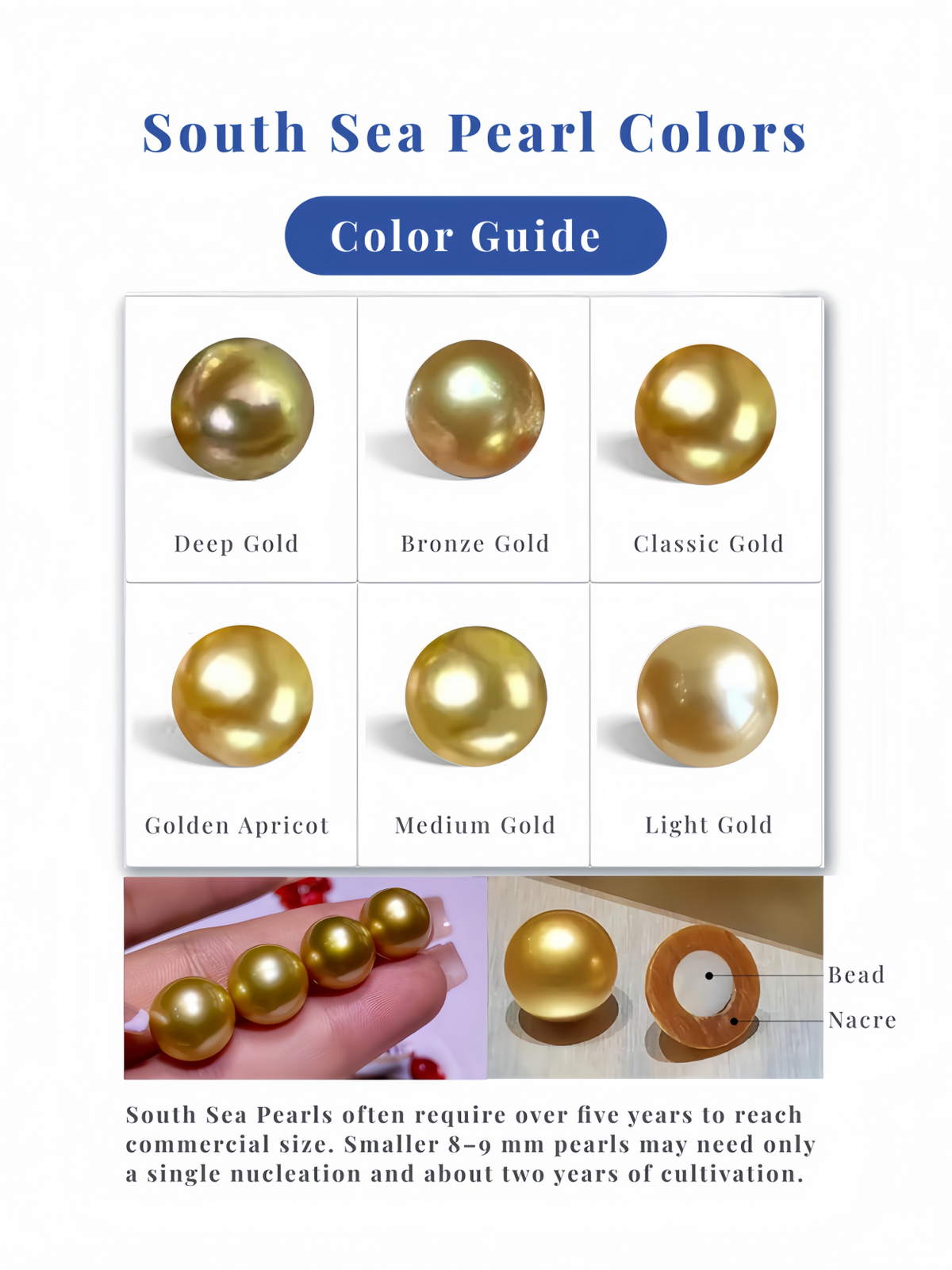
Champagne gold is worth comparing when you prefer a lighter, softer-looking shade. You may find that it sits more comfortably with your everyday clothing or creates the contrast you like against your skin.
Deep gold is a direction I would explore with someone who wants the pearl’s color to be more pronounced.
Gold with greenish overtones offers another possibility. This is an appearance I sometimes describe as “tea gold.” Here, that is descriptive language, not a separate pearl species or a formal quality grade.
Rather than assigning everyone a color based on a fixed skin-tone rule, I recommend comparing a few shades near your face. Look at them with something you would actually wear.
The question is not only, “Which color costs more?”
It is also, “Which one makes me want to put it on?”

Golden south sea pearl size and color guide
Size: Choose for Your Life, Not Just the Measurement
For a first golden pearl purchase, I usually recommend a size that can work in several everyday situations.
A piece does not have to be small to be wearable. But I would rather help someone choose a pendant they reach for regularly than encourage the largest pearl their budget allows.
These are my usual starting suggestions:
| Jewelry type | My suggested starting size | What I would consider next |
|---|---|---|
| Pendant | 12–13 mm | The neckline, chain length, and proportions of the setting. |
| Earrings | 9–12 mm | Whether they are studs or drops, the total weight, and the amount of presence you enjoy. |
| Ring | 9–12 mm | Your hand, the setting height, and how you plan to wear it. |
| Full pearl necklace | 9–11 mm | The strand length and its overall feel when worn. |
These are recommendations, not rules.
For someone who already enjoys larger jewelry, I may discuss pearls around 14 mm for a first piece. Smaller golden pearls around 6–9 mm are also worth considering when available, especially for someone seeking a less substantial look.
I would not describe either choice as more sophisticated or more appropriate for a particular age. The important thing is whether the finished jewelry suits you.
With a full necklace, remember to ask about both pearl diameter and strand length. Choosing a pearl size does not tell you where the necklace will sit.
Shape: Roundness and Good Design Are Different Questions
Round cultured pearls are generally rarer and more valuable when other factors are equal, although well-formed drops and baroque shapes are also valued. gia
That matters when comparing prices, but I do not treat roundness as the only route to a good piece of jewelry.
For a simple ring, I might prefer the balance of a round pearl. For a pendant or drop earring, I would also consider an oval or teardrop shape. An irregular pearl may suggest a design that I would never make with a perfectly round one.
The useful question is: Does the shape look intentional in this setting?
For your own purchase, try separating two decisions. First, decide whether a perfectly round pearl is important to you. Then consider the quality of the individual pearl.
There is little reason to pay specifically for roundness when the piece you genuinely prefer uses a different shape.
Nacre: An Important Detail You Cannot Measure from a Photo
Nacre is the material the mollusk deposits to form the pearl. In bead-cultured pearls, it develops around an introduced nucleus. The outside diameter therefore describes the whole pearl, not just its nacre layer. gia
This is why I would not use “large” as a substitute for a nacre measurement. Nor would I treat a bright photograph as proof of a particular thickness.
Laboratory assessment can provide information that an ordinary product photograph cannot. For example, certain Pearl Science Laboratory reports include nacre-thickness measurements made using X-rays. Sinjuken
For most everyday purchases, I suggest focusing on clear product information rather than trying to estimate an invisible measurement yourself. When nacre thickness is particularly important to you, ask whether it has actually been measured and whether that result appears in the report for the pearl.
A precise number should come from an assessment, not a guess.

Matching: Why a Pair or Strand Is More Than Its Individual Pearls
For multi-pearl jewelry, matching involves several qualities—not diameter alone. Color, shape, luster, and surface appearance all contribute to how the pearls work together. gia
This is a part of selection that I think is easy to overlook when shopping online.
Imagine two earrings with pearls of the same size. One has a deeper gold tone, while the other reflects light more strongly. You might like each pearl individually but not enjoy them as a pair.
A full necklace asks even more questions. I want to look along the strand and see whether one pearl interrupts the overall appearance. For a graduated design, I would also consider how the sizes progress.
When discussing a strand, I recommend asking to see the whole necklace as well as close-ups. For earrings, compare both pearls together.
The goal is not always absolute uniformity—some designs deliberately use contrast. It is that the combination should look considered.
Why Two Golden Pearls of the Same Size Can Have Different Prices
Once you consider these dimensions together, price differences become easier to understand.
Within our own selection, two pearls can share the same size range and both have clean-looking surfaces, yet I may price them differently because of their luster, color, shape, or finer surface appearance.
Then there is the finished jewelry.
I would not compare a sterling silver pendant with an 18K gold pendant as though the pearl were the only difference. I also consider the setting and the work involved in making the piece.
Here is how I suggest approaching a limited budget: decide which qualities matter most to your enjoyment of the pearl.
For me, luster comes first. I would usually explore a slightly smaller size or a less strictly round shape before accepting a pearl whose reflection I do not enjoy. Someone else may have a particular love of deep gold or want a very clean surface for a ring they will examine closely.
That is not a disagreement about quality. It is a decision about where to place your priorities.
“Golden” Does Not Always Mean Golden South Sea
Color alone does not identify a pearl.
Freshwater cultured pearls can have naturally occurring warm colors, including yellowish shades. Freshwater pearls can also be color-treated, so it would be inaccurate to call every warm-colored freshwater pearl dyed—or to assume every golden-looking pearl is South Sea. gia
Laboratory researchers have examined dyed yellow freshwater pearls that resembled golden South Sea pearls. Their work illustrates why appearance and an impressive price are not substitutes for identification. gia
Some dyed pearls I have encountered have looked less convincing to me, but I would not turn that observation into a universal home test. “It looks natural” is not the same as confirming natural color.
My advice is to establish the pearl type and treatment information first, then compare quality.
Our golden pearl jewelry comes with laboratory documentation, most commonly from GRC. Selected higher-quality pearls may have PSL or GUILD reports. The report supplied depends on the piece, so please confirm the available documentation when a particular assessment is important to you.
It is also worth reading what the report actually covers. An identification certificate is not necessarily a quality grade; PSL, for example, offers an identification report without grading. Sinjuken
From a Selected Pearl to a Piece You Can Wear
Choosing the pearl is only part of my work. I also need to consider its relationship with the setting.
Our golden pearl designs use 925 sterling silver or 18K gold, depending on the piece. Some silver settings have 18K gold plating. I recommend checking the individual product description rather than judging the underlying metal from its color.
Our pendants include a complimentary silver chain. A gold chain is a separate purchase, even when the pendant itself has an 18K gold setting.
There is also something important to understand about our product photography. Our images show real examples of designs we have made, often with pearls that have already sold. For a repeat design, we choose another pearl that meets the listed specifications and suits the setting, matching the photographed color and luster as closely as possible.
It will not be an identical pearl. The listed size, material, and surface description remain important parts of what you are buying.
This is why I see selection and design as connected. I am not simply looking for a pearl that fits into a setting. I want the finished piece to work as a whole.
Caring for the Luster You Chose
Once you have spent time choosing a pearl’s luster and surface, it makes sense to protect them.
Pearls can be damaged by perfume, cosmetics, cleaning chemicals, and perspiration. Put them on after applying your beauty products, and remove them before swimming, showering, exercising, or household cleaning. After wearing, wipe them gently with a soft, clean cloth. Never use an ultrasonic or steam cleaner. gia
I recommend keeping each piece in a soft pouch or a separate lined compartment, rather than loose among harder jewelry. Avoid strong heat and excessively dry storage: dehydration and heat can damage pearls. The aim is to protect them from scratches and harsh conditions, not to seal out all air. gia
For a full strand, I also suggest checking the thread and clasp periodically and having any looseness or wear addressed before continuing to use it.
The Pearl I Would Choose Is Not Necessarily the Biggest
My advice for a first golden South Sea pearl is simple: begin with luster, look honestly at the surface, and choose a color and size you will enjoy wearing.
Then check the details that a photograph cannot fully explain—the pearl type, report, setting material, and specifications of the piece you will receive.
The darkest gold, largest diameter, and roundest shape may all have their appeal. But I would not want someone to overlook a pearl they love simply because another one has a more impressive measurement.
You can explore our golden South Sea pearl jewelry to compare the designs we make, or contact us through Instagram at @alyapearls or WhatsApp to discuss pearl selection and a custom piece. Custom making usually takes around 7–15 days, separate from shipping time. Larger pearls, selected higher-quality pieces, and full strands can also be discussed directly.
The best starting point is not “Which pearl has the most?” It is “Which qualities matter most to me?”
Follow @alyapearls on Instagram and join our jewelry channel for daily updates on our newest handmade pearl pieces.


Leave a comment
This site is protected by hCaptcha and the hCaptcha Privacy Policy and Terms of Service apply.