
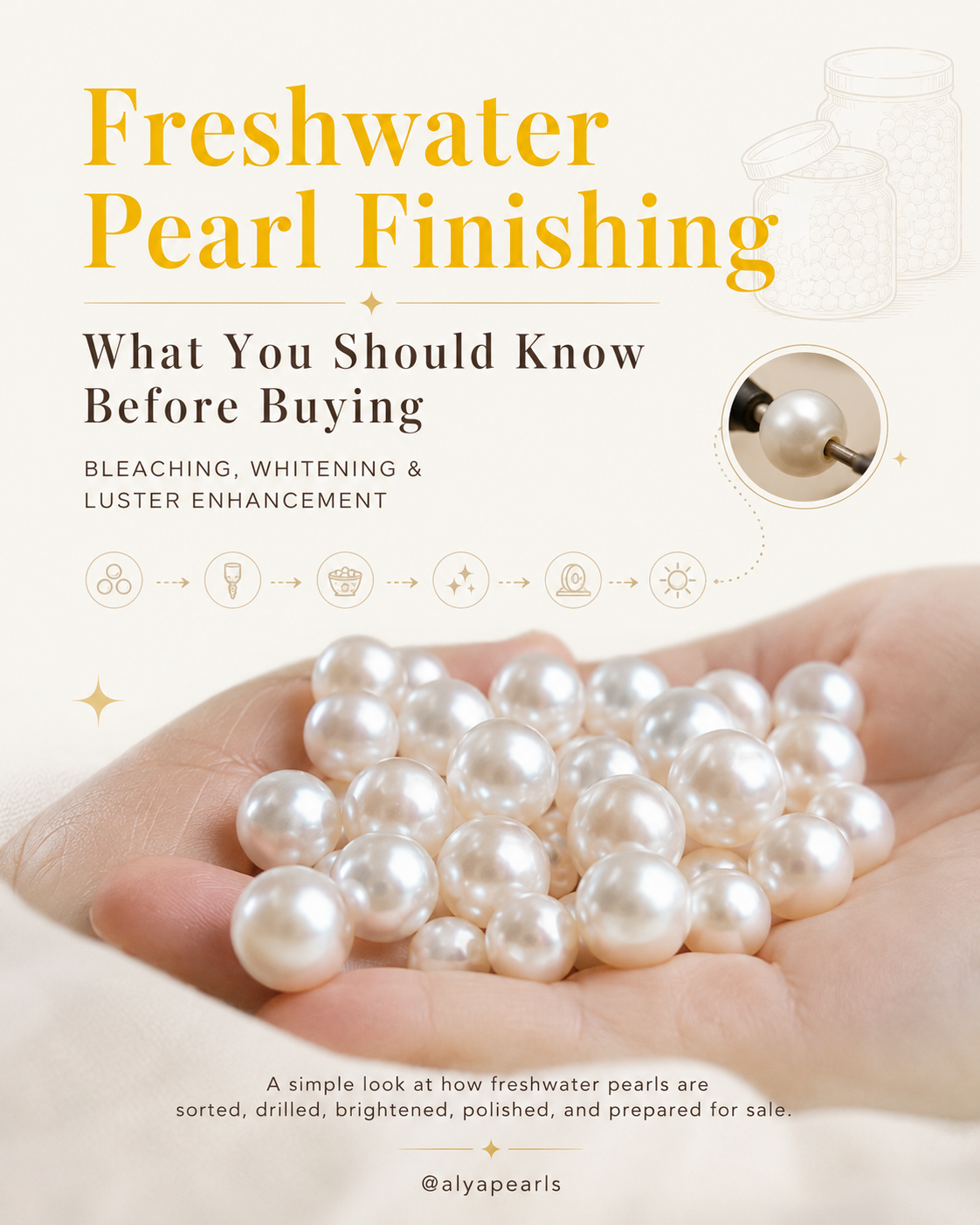
Freshwater pearls may be cleaned, sorted, drilled, bleached, brightened, and polished before they reach a jewelry store. Not every pearl needs every step. These processes do not turn real cultured pearls into imitations, but they can change their appearance. For buyers, the important questions are what was done, what a laboratory actually tested, and whether the seller can explain the difference.
A finished white pearl necklace tells you how the pearls look today. It does not show their entire journey after harvest. As a pearl farmer and jeweler, I think that missing part of the story deserves more attention. GIA documents several post-harvest pearl processes, including bleaching, luster enhancement, and optical brightening.
The photos below follow one finishing workflow. My aim is not to make you suspicious of every white pearl. It is to help you ask more useful questions than simply, “Are these real?”

What Changes Between Harvest and Sale?
Freshly harvested pearls first need cleaning to remove attached tissue and other debris. Then comes an initial sort by size, shape, color, surface, and luster. Cleaning removes material from the outside; bleaching changes color-causing material. They are not the same operation.
At this stage, a harvest is not a perfectly matched bowl of white pearls. There may be cream tones, warmer patches, different overtones, and uneven surfaces. Some pearls already have the color and reflection wanted for a design. Others may be selected for additional processing.
The aim of finishing is not simply to make every pearl whiter. It is to prepare selected pearls for a particular use. A matched white strand has different requirements from a single warm-toned pendant.
| Description | What it tells you | What it does not establish |
|---|---|---|
| Cultured freshwater pearl | A pearl grown in a freshwater mollusk with human assistance. | Whether it was treated after harvest. |
| Natural-color pearl | A description of the origin of its color. | That every kind of finishing or enhancement is absent. |
| Untreated pearl | A claim about processing history. | Proof by itself; ask what the seller means and what evidence supports it. |
This distinction is not just wording. In GIA's study of freshwater “Edison” pearls, some naturally colored samples also showed evidence of optical brightening. “Not dyed” is therefore not a complete treatment history.

The Freshwater Pearl Finishing Process, Step by Step
Read this flowchart as a set of possible routes, not a compulsory treatment schedule. The direct-to-sale branch means some pearls need less intervention after cleaning and selection. It does not mean every high-grade pearl is untreated, or that a treated pearl must be low grade. Producers also vary the order of their operations.

1. Sorting: Deciding What the Pearl Actually Needs
Sorting is more than separating large pearls from small ones. A processor considers the starting color and condition; a jeweler also considers the eventual design. A shallow mark near a possible drill position may be manageable. A crack or unstable nacre needs a different decision, not simply a stronger treatment.
For example, I would not automatically reject a cream-colored pearl with a sharp reflection. In a yellow-gold pendant, that warmth may be exactly what makes the piece work. Whiter is a color preference, not a quality grade.

2. Drilling: Planning the Face That Will Be Seen
Drilling prepares pearls for stringing or mounting. A full hole suits a necklace strand; a half-drilled pearl may suit a stud or pendant post. Placement matters because a small, localized blemish may coincide with the hole or sit beneath a setting.
GIA's pearl quality guidance recognizes that minor blemishes can matter less when concealed by drilling or mounting. That is different from repairing a crack or making an entire rough surface flawless.
In the pictured workflow, drilling comes before chemical processing. Openings can also provide access for solutions during some treatments. This does not mean every drilled pearl has been chemically treated.

3. Bleaching: Reducing Unwanted Color
Pearl bleaching lightens unwanted coloration and can improve consistency within a group. GIA describes hydrogen-peroxide bleaching as an established pearl treatment. It is a controlled manufacturing process—not permission to use household bleach on jewelry.
The comparison below illustrates warmer-looking pearls beside a lighter group labeled “after bleaching.” Reducing a yellow cast can make a pearl read as a cooler white. Pink or green overtones may then be easier to notice, but a cool white color or a pink reflection is not proof of treatment, or proof of its absence.
A useful distinction: bleaching does not grow additional nacre or repair missing layers. It changes appearance, not the years of material the mollusk has already deposited.

4. Brightening and Luster Enhancement: Not Another Word for Bleaching
Bleaching reduces color-causing pigments. Optical brightening works differently: added compounds absorb ultraviolet or violet light and emit blue light, making a pearl appear less yellow. This difference is explained in GIA's optical-brightening study.
“Luster enhancement” is a broader description, not one fixed recipe. A brighter-looking pearl is not necessarily a pearl with better-grown nacre. When choosing jewelry, I assess the reflection and surface separately from how white the pearl appears.
The warm- and cool-soaking photographs show processing arrangements. They do not identify the chemicals, concentrations, or treatment history of an individual pearl. Those details require production records and, where applicable, testing.

5. Polishing: Finishing the Surface
Polishing is another separate operation. The medium described in this photo series is crushed corn cob with paraffin. This is one processing example, not a universal formula for all freshwater pearls.
The aim is a better-finished surface, not removing every imperfection. From a jewelry-making perspective, aggressive polishing is not a substitute for selecting sound pearls. It can remove material, and it cannot replace nacre that never grew.
I would also ask whether any coating or wax finish remains. “Polished” and “coated” are not descriptions I would casually treat as interchangeable.

6. Drying, Final Sorting, and Matching
After the relevant cleaning and finishing stages, pearls are dried and assessed again before matching and sale. The drying-tray photograph is a workshop illustration, not a recommendation to place pearl jewelry under a hot lamp at home.
This last selection matters to the wearer. Two pearls can share a size and still look wrong together if one is creamier or reflects light differently. For a necklace, I want the pearls to work together across the whole strand, not just look impressive individually.

Can UV Light or a Pearl Report Reveal Treatment?
A UV lamp can offer clues, but it is not a yes-or-no treatment detector. Untreated pearls can fluoresce naturally, while some optical brighteners produce a stronger blue response. Weak or absent fluorescence does not rule out every other enhancement.
Laboratories do more than look for a glow. Depending on the question, they examine structure, surface features, pigments, trace elements, and fluorescence spectra. GIA's explanation of pearl testing shows why several methods may be needed. X-rays used to examine internal structure do not answer exactly the same question as tests for color treatment.
Bleaching is especially challenging: GIA notes that single-step bleaching can be virtually impossible to detect in many cases. A report can identify findings within its testing scope; it cannot reconstruct every event in a pearl's processing history.
A report is evidence—not a blanket “untreated” guarantee.
Read the service name, results, and comments. A quality grade is not the same as a treatment assessment, and “no indications detected” is not an unlimited promise that nothing was ever done.
Whether a document comes from GIA, GUILD, or another laboratory, I would ask which processes were evaluated and whether optical brightening was specifically addressed. Confirm that the report belongs to the actual pearl or strand being sold—not merely a sample from a larger batch.

Watch: How Laboratories Examine Pearls
GIA's An Overview of Pearl Identification Techniques provides broader background on pearl identification. It is a laboratory-education companion to this guide, not a tutorial for bleaching pearls at home.
What I Would Ask Before Buying Freshwater Pearl Jewelry
I would judge two things separately: how the pearl looks, and how confidently its processing history is described. A well-presented treated pearl may suit your budget and preferences. An unsupported “untreated” claim should not earn a premium simply because it sounds reassuring.
Start by asking: “Have these pearls been bleached, optically brightened, dyed, irradiated, or coated? What does the report cover, and are there any special care requirements?” Written answers are more useful than vague descriptions such as “natural glow” or “premium finish.”
For U.S. buyers, FTC guidance specifically addresses pearl treatments: disclosure is required under the guides when treatment is not permanent, creates special care requirements, or significantly affects value. For online sales, applicable disclosure belongs in the product description before purchase.
Next, request an ordinary-light video showing the whole strand, including drill holes and surfaces. Use it to assess appearance, not to diagnose treatment. Compare the pearls beside a neutral background and against the clothes you expect to wear.
Imagine choosing between a very white pair with hazy reflections and a slightly warmer pair with clearer reflections. I might choose the warmer pair for yellow-gold earrings. That is not an argument against white pearls; it is a reminder not to confuse whiteness with luster.
Finally, ask about condition and care. GIA cautions that excessive bleaching can make pearls more fragile. That does not mean every bleached pearl is damaged, or that every untreated pearl is durable. The degree of processing and the condition of the actual pearl both matter. Ask about permanence rather than assuming every treatment fades—or that every finish lasts indefinitely.
Are bleached freshwater pearls still real pearls?
Yes. A treatment changes a pearl's appearance, not its biological origin. Cultured, treated, and imitation describe different things. The seller should not confuse them.
Does “not dyed” mean the pearls are untreated?
No. It addresses dyeing only. Ask separately about bleaching, optical brightening, other luster-enhancement processes, and coatings.
Can I bleach or brighten a pearl necklace at home?
No home bleaching is recommended here. Factory processing is different from caring for finished jewelry. Use a very soft, clean cloth after wearing; ask a jeweler about persistent discoloration rather than trying bleach, brightening chemicals, abrasive polishing, steam, or an ultrasonic cleaner.
My view is simple: a good pearl deserves an honest description. You do not need to become a treatment specialist to buy well. You need a seller who answers specific questions, a report whose limits you understand, and a pearl you still enjoy in ordinary light.



Leave a comment
This site is protected by hCaptcha and the hCaptcha Privacy Policy and Terms of Service apply.