
Written by Alya — pearl farmer and jewelry maker. Follow @alyapearls on Instagram and join our jewelry channel for daily updates on our newest handmade pearl pieces.
Tahitian pearls are famous as “black pearls,” but black was always more of a commercial image than the whole truth. In real life, Tahitian pearls can glow in blue, green, peacock, purple, mocha, gold, silver, and multicolor overtones. If you have only seen dark gray or black Tahitian pearls before, this guide will help you see them with a jeweler’s eye.
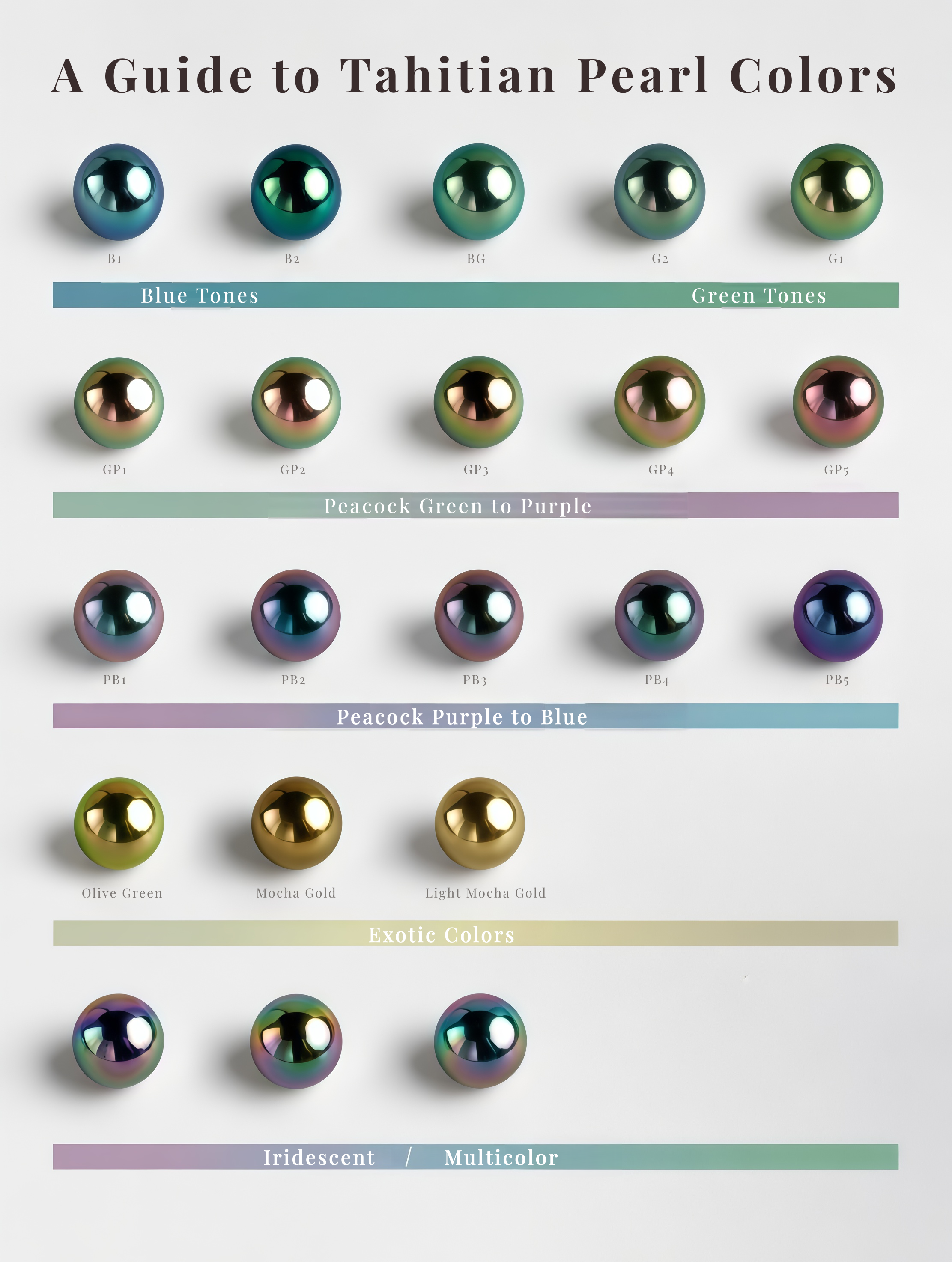
The color chart below is the best place to start. It shows why Tahitian pearls are one of the most expressive pearl families in fine jewelry: they are dark, but not flat; dramatic, but not always black; and sometimes far more colorful than people expect.

Why Are Tahitian Pearls Called “Black Pearls”?
Tahitian pearls come from the black-lipped pearl oyster, Pinctada margaritifera, cultured mainly in French Polynesia. Because many of these pearls have naturally dark body colors, they became widely known as “black pearls.” But in the jewelry world, “black” is only the beginning.
A Tahitian pearl may look graphite gray, deep green, charcoal, blue, purple, silver, mocha, or peacock depending on the pearl’s body color and overtone. Many pearls that shoppers call “black” are actually dark gray or greenish gray with an overtone floating on top.

This is why I always tell clients: do not choose a Tahitian pearl only by asking “Is it black?” A better question is: What color does it become when light moves across the surface?
How to Read a Tahitian Pearl Color Chart
A good Tahitian pearl color chart helps you separate simple darkness from true color character. The most useful way to read the chart is by color families: blue, green, peacock, purple, mocha, gold, and multicolor. Each family creates a different mood in jewelry.
Blue tones: clean, modern, and cool
Blue Tahitian pearls feel fresh and contemporary. They look especially beautiful in white gold, platinum, or silver-toned settings. In recent years, more collectors have been drawn to blue and blue-green Tahitian pearls because they look less traditional and more fashion-forward.
Green tones: the classic Tahitian signature
Green is one of the most recognizable Tahitian pearl overtones. It can range from soft pistachio-like green to deeper forest or peacock green. Green-toned Tahitian pearls are usually easier to style than people expect: they work well with white diamonds, blue sapphires, and clean modern metalwork.
Peacock tones: the collector favorite
“Peacock” is one of the most loved Tahitian pearl color descriptions because it suggests a layered mix of green, rose, purple, and sometimes blue. A strong peacock overtone can make a pearl feel alive, changing as the viewer moves.
Mocha, gold, olive, and exotic colors
Not every Tahitian pearl has to be cool-toned. Some show mocha, olive, bronze, or golden warmth. These are often less expected, and they can look stunning on warmer skin tones or in yellow gold settings.

Body Color, Overtone, and Orient: What Are You Actually Seeing?
When you look at a Tahitian pearl, you are not seeing one flat color. You are seeing several layers of visual information. This is why two pearls can both be called “black,” yet look completely different side by side.
- Body color: the main base color of the pearl, such as gray, charcoal, greenish gray, or dark brown.
- Overtone: the secondary color that appears over the body color, such as green, blue, rose, purple, or peacock.
- Orient: the subtle play of color caused by light interacting with nacre layers. In everyday jewelry language, people often use this word to describe color movement.
In a showroom, I like to tilt a Tahitian pearl slowly under a single light source. If the overtone stays attractive from several angles, the pearl is much easier to use in jewelry. A strong color only from one perfect angle can be beautiful in photos, but less satisfying in real wear.

Tahitian Pearl Size Guide: What Sizes Are Most Common?
Tahitian pearls are usually larger than Akoya pearls and are often seen in the 8mm to 14mm range. Larger pearls exist, but as size increases, clean surface, round shape, and strong luster become harder to find together.
Here is a simple way to think about size when choosing Tahitian pearl jewelry:
| Size range | Best for | Style impression |
|---|---|---|
| 8–9mm | Stud earrings, delicate rings, everyday pendants | Subtle, wearable, less dramatic |
| 10–11mm | Rings, pendants, elegant earrings | Balanced and visibly luxurious |
| 12–13mm | Statement rings, pendant centerpieces, collector pieces | Bold, high-impact, more formal |
| 14mm+ | High-end statement jewelry | Rare, dramatic, premium presence |
For a ring, I usually like 10–13mm because the pearl has enough presence without becoming difficult to wear. For earrings, matching becomes very important: two pearls do not need to be identical, but they should feel balanced in size, color, luster, and mood.
What Makes One Tahitian Pearl More Valuable Than Another?
Color gets the attention, but value comes from a full combination of factors. A beautiful Tahitian pearl is not just “dark” or “peacock.” It also needs good luster, a clean surface, pleasing shape, and the right size for the design.
I use five practical checks when choosing Tahitian pearls:
- Luster: Are reflections sharp and bright, or soft and cloudy?
- Color: Is the body color attractive, and does the overtone stay beautiful from different angles?
- Surface: Are blemishes minor, or do they distract from the pearl?
- Shape: Is it round, near-round, drop, circle, or baroque? Round is often priced higher, but baroque can be very artistic.
- Matching: For pairs and strands, do the pearls belong together visually?
The strongest Tahitian pearls are not always the darkest ones. Sometimes a slightly lighter pearl with a powerful blue-green overtone can look much more special than a very dark pearl with flat color.

How to Choose a Tahitian Pearl for Jewelry
For a Tahitian pearl ring
A ring needs strong personality because the pearl is seen close-up. I look for strong luster, a pleasing top view, and color that stays attractive when the hand moves. Blue-green and peacock tones are especially powerful in rings because the pearl becomes the center of the design.
For Tahitian pearl earrings
Earrings need balance. The pearls do not need to be perfectly identical, but the pair should match in size, luster, and overall color feeling. If one pearl is much greener and the other is more purple, they may look interesting in a creative design, but less classic.
For a Tahitian pearl necklace or pendant
For a pendant, choose the single pearl that makes you stop and look twice. For a necklace, matching becomes more complex: size graduation, body color, overtone, and surface all need to work together. This is why a well-matched Tahitian pearl necklace can be much more expensive than loose pearls of similar individual quality.

Alya’s Buyer Notes: What I Look for First
When I choose a Tahitian pearl, I do not start with the name of the color. I start by asking: does this pearl have life?
A good Tahitian pearl should not look like a flat black bead. It should hold light, reflect clearly, and reveal color as it moves. The best pearls feel almost liquid: blue at one angle, green at another, and quietly dark in between.
For modern jewelry, I personally love blue-green and peacock Tahitian pearls. They feel fresh, less traditional, and easier to style with white gold, diamonds, sapphires, and clean sculptural settings.
Watch: Tahitian Pearls by GIA
This short GIA video is a helpful visual companion if you want to understand where Tahitian pearls come from and why their color range is so special.
FAQ: Tahitian Pearl Colors
Are Tahitian pearls always black?
No. Tahitian pearls are often called black pearls, but they can show gray, green, blue, purple, peacock, mocha, silver, and multicolor tones.
What is the most popular Tahitian pearl color?
Peacock and green tones are among the most recognized and loved. Recently, blue and blue-green Tahitian pearls have become especially attractive to collectors who want a fresher, modern look.
What size are Tahitian pearls?
Tahitian pearls are commonly seen around 8mm to 14mm, with larger pearls available but rarer, especially in clean, round, high-luster quality.
Are blue Tahitian pearls natural?
Blue overtones can occur naturally in Tahitian pearls. As with any high-value pearl, buy from a seller who clearly discloses treatments and provides good close-up photos or documentation when needed.
What color Tahitian pearl should I choose?
Choose by how the pearl looks against your skin and metal preference. Blue and green look modern in white metals; mocha and olive can feel warmer and more unusual; peacock is dramatic and collectible.


1 comment
Excellent information. Thank you.
Judy
Leave a comment
This site is protected by hCaptcha and the hCaptcha Privacy Policy and Terms of Service apply.