Written by Alya Liu — pearl farmer & jeweler.
Rare real pearls are not limited to classic white cultured pearls. Some of the most fascinating pearls in the world come from sea snails, abalone, and giant clams — not only from pearl oysters. Conch pearls, Melo pearls, Abalone pearls, and Giant Clam pearls are rare because they are difficult to find, difficult to culture commercially, and visually impossible to copy perfectly.

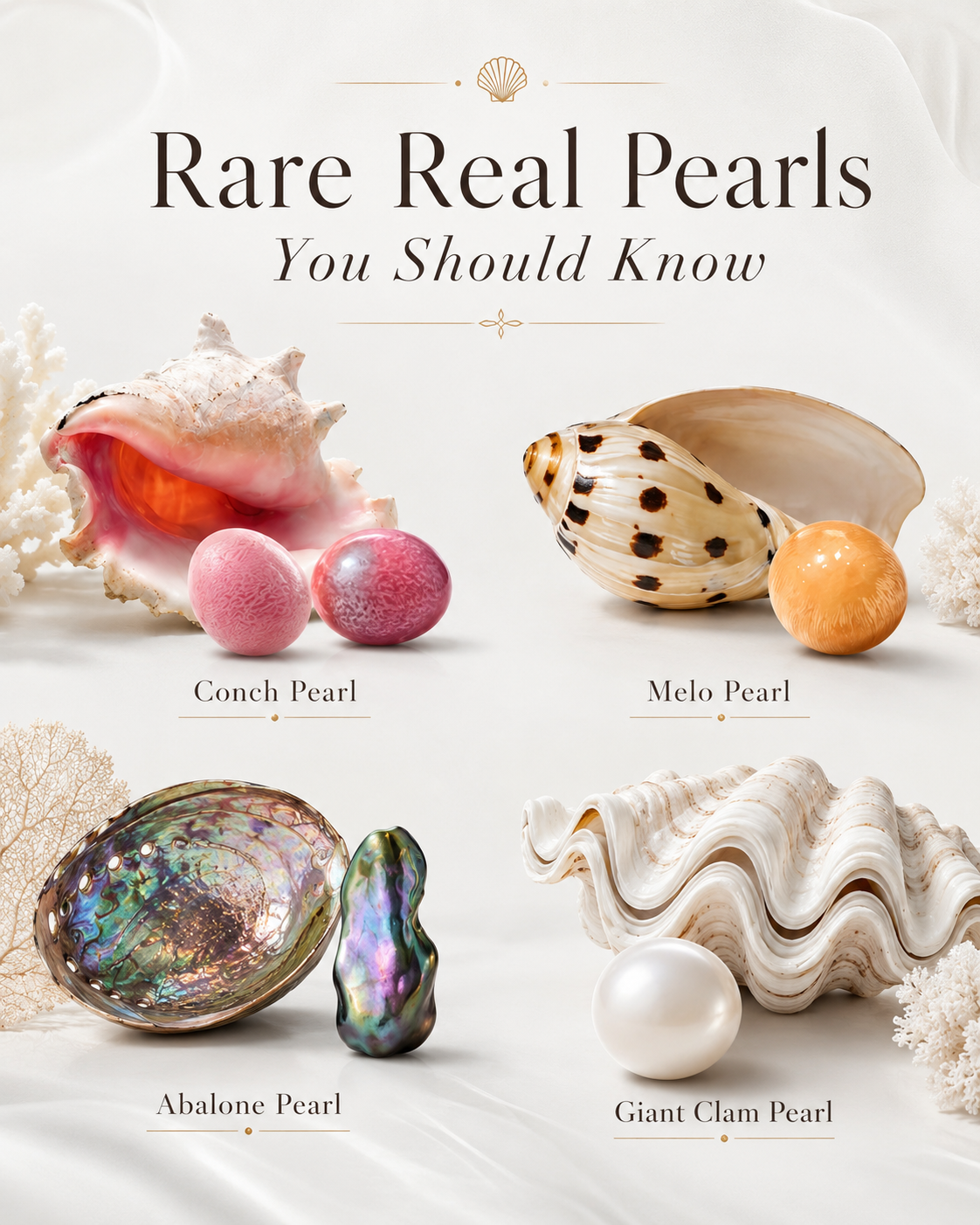
Image 1: Rare real pearls you should know. Conch, Melo, Abalone, and Giant Clam pearls are rare because they come from unusual mollusks and show colors or structures that ordinary cultured pearls cannot easily imitate.
Most pearls on the market today are cultured pearls, and they are real pearls. But in English, the term “natural pearl” usually means a wild pearl formed without human intervention. This distinction matters when we talk about rare collector pearls, because many conch, melo, abalone, and Tridacna pearls are valued not only for beauty, but also for origin, history, and rarity.
As a pearl jeweler, I see these pearls differently from standard jewelry pearls. A white Akoya strand may be judged by roundness and matching. A conch or melo pearl is judged more like a small sculpture: color, skin, flame pattern, shape, story, and emotional pull all matter.
Quick Answer: What Are Rare Real Pearls?
A real pearl is a pearl formed by a living mollusk. It may be natural or cultured. A natural pearl forms without human help; a cultured pearl forms with human assistance, usually through bead nucleation or tissue grafting. Both are real pearls, but natural pearls are far rarer.
The rare pearls in this guide are special because they do not all follow the familiar “round white pearl” image. Some are nacreous, meaning they have the layered mother-of-pearl structure that creates classic pearly orient. Others are non-nacreous, meaning they have a porcelain-like surface and flame-like internal pattern instead of the soft layered orient seen in Akoya or South Sea pearls.

This is why rare pearl collecting feels different from ordinary pearl shopping. With a freshwater strand, a buyer may ask for size, luster, shape, and matching. With a conch pearl, the buyer asks: Is the flame structure strong? Is the pink natural? Is the shape pleasing? Is the origin trustworthy?
Conch Pearl: The Pink Flame Pearl
Conch pearls come from the Queen conch, a large sea snail from the Caribbean region. Unlike classic nacreous pearls, conch pearls are non-nacreous. They usually show a porcelain-like surface and, in fine examples, a silky flame structure. The most desirable colors are often pink, salmon, rose, and peach-pink.
I understand why designers love conch pearls. A fine pink conch pearl does not look like a pearl trying to be a diamond. It has a different language: soft, feminine, warm, and alive. The flame pattern can look almost like silk fibers trapped under the surface. That is why conch pearls work so beautifully in floral jewelry, soft rose-gold settings, and pieces designed around the idea of skin, petals, and warmth.
Historically, conch pearls also remind us that beauty and conservation must be discussed together. Queen conch has long been harvested for meat and shell, and fine pearls are a rare by-product. Today, responsible sourcing matters because the animal itself faces pressure from overharvest and illegal fishing in parts of its range.

My personal view is that conch pearls are loved by women not only because they are pink, but because the pink is not artificial-looking. It is warm, uneven, and organic. A conch pearl feels closer to coral, skin, and sunset than to commercial candy pink. That emotional softness is hard to reproduce.
Melo Pearl: The Orange “Dragon Pearl”
Melo pearls come from the Melo melo sea snail, often associated with Southeast Asia. Like conch pearls, they are natural non-nacreous pearls. Their colors range from orange and yellow to brownish, grayish, or pale tones, but the most famous examples are warm orange with a flame-like pattern.
In Asian collecting culture, Melo pearls are sometimes called “dragon pearls.” I think this name fits beautifully. A fine Melo pearl does not glow like moonlight; it glows like warm fire. The surface can show a silky flame pattern, and the best orange stones feel like ripe papaya, amber, or a small captured sun.
Melo pearls also carry a cultural tension. The Melo melo snail is a food snail in parts of Southeast Asia, and the pearl is a rare accident discovered through that relationship between people and the sea. I would be careful not to say that pearls alone created conservation pressure, because food, shell, trade, and habitat all matter. But melo pearls do show how a food mollusk can become a collector’s gem — and why responsible sourcing should always be part of the conversation.

In jewelry, Melo pearls are often used as center stones rather than repeated strand pearls. Their value comes from singularity. You do not usually design around “matching” Melo pearls the way you would match Akoya pearls. You design around the one pearl’s color, shape, and presence.
Abalone Pearl: Paua, Rainbow Nacre, and Ocean Color
Abalone pearls form in abalone, a marine gastropod with one of the most colorful nacre interiors in the gem world. In New Zealand, abalone is known as pāua or paua, and its shell is famous for vivid blue, green, violet, pink, and purple iridescence.
If conch is soft pink and Melo is fire-orange, abalone is the ocean after a storm. The colors are not still. They move. A good abalone pearl can flash blue, emerald, violet, bronze, and rose in the same piece. This is why designers often treat abalone pearls like abstract art rather than traditional pearls.
Pāua also has cultural weight in New Zealand. The shell’s inner color has long been used in art, carving, and jewelry. To me, pāua represents hidden beauty: a rough exterior, then an inner world of impossible color. That is one reason abalone pearls feel so modern. They are irregular, expressive, and unapologetically colorful.
Natural whole abalone pearls remain extremely difficult to produce consistently. Cultured abalone mabe pearls, including New Zealand pāua blister pearls, are more realistic commercially and can show spectacular blue-green surfaces. Some producers farm pāua for several years before selecting the best blister pearls, but fully natural abalone pearls remain rare and unpredictable.

Giant Clam Pearl: Tridacna, Porcelain Luster, and Sacred Shell
Giant clam pearls, often called Tridacna pearls, come from giant clams. These pearls are rare organic gems, but they are not nacreous like ordinary pearls. Fine examples may show a porcelain-like surface and subtle flame-like structure.
The beauty of a Tridacna pearl is different from abalone. It does not seduce with rainbow color. It is quiet, white, and almost architectural. A fine Tridacna pearl can look like polished porcelain, bone, ivory, or moon-white jade. In a jewelry design, that quietness can be powerful.
Tridacna also has a long cultural story because the shell itself has been valued. In Buddhist material culture, shell, pearl, and other precious substances appear in different lists of sacred or symbolic treasures. In East Asian collecting language, carved giant clam shell beads have often been used for prayer beads, offerings, and devotional objects. That means the value is not only in the pearl. The shell itself can become a sacred material.
This is the point I find most interesting: with Tridacna, the boundary between pearl and shell becomes blurred. A conch or Melo pearl is the rare object hidden inside the animal. But with giant clam, the shell itself can become a spiritual object, a carved bead, a devotional tool, or a gem material. From pearl to shell, the whole mollusk carries value.

Rare Pearl Comparison: Color, Texture, and Jewelry Mood
These pearls are rare for different reasons, and they speak different jewelry languages.
| Rare Pearl | Mollusk | Typical Color / Texture | Jewelry Feeling |
|---|---|---|---|
| Conch Pearl | Queen conch | Pink, peach, salmon; porcelain luster; flame structure | Soft, feminine, floral, romantic |
| Melo Pearl | Melo melo sea snail | Orange, yellow, brown; flame-like pattern | Warm, royal, collector-focused, dramatic |
| Abalone Pearl | Abalone / pāua | Blue, green, violet, pink, rainbow iridescence | Artistic, oceanic, modern, expressive |
| Giant Clam Pearl | Tridacna giant clam | White to cream; porcelain-like; subtle flame structure | Sacred, quiet, sculptural, museum-like |
For me, the lesson is simple: rare pearls should not all be judged by the same rules. A perfectly round Akoya pearl is beautiful because it is controlled and matched. A conch pearl is beautiful because its pink flame cannot be repeated. A Melo pearl is beautiful because it feels like a royal accident. An abalone pearl is beautiful because it refuses to be calm. A Tridacna pearl is beautiful because it is almost silent.
How to Buy Rare Natural Pearls Safely
Rare pearls require more caution than ordinary cultured pearl jewelry. If you are buying conch, melo, abalone, or giant clam pearls, I recommend checking four things.
- Origin: What animal produced it? A conch pearl and a dyed shell bead are not the same thing.
- Structure: Is it nacreous or non-nacreous? Does it show flame structure, orient, or porcelain luster?
- Treatment: Has it been dyed, filled, assembled, polished, or modified?
- Documentation: For expensive pieces, ask for a report from a respected gemological lab.
This is especially important with pink conch-style pearls, orange Melo-style pearls, and white Tridacna shell beads, because imitations exist. A beautiful object can still be beautiful, but it should be sold honestly.
As a designer, I love rare pearls most when the setting respects their origin. A conch pearl should not be forced into a design that hides its flame. A Melo pearl should have enough space to show warmth. An abalone pearl needs open light. A Tridacna pearl needs simplicity.
Watch: Pearl Identification and Rare Pearl Testing
If you want to understand how laboratories separate natural, cultured, nacreous, and non-nacreous pearls, this GIA webinar is a useful starting point.
FAQ
Are conch pearls real pearls?
Yes. Conch pearls are real natural pearls from the Queen conch. They are usually non-nacreous and are valued for pink color, porcelain-like luster, and flame structure.
Are Melo pearls cultured?
Most gem-quality Melo pearls are natural pearls from the Melo melo sea snail. They are rare non-nacreous pearls and are not produced in standardized pearl farms like Akoya or freshwater pearls.
What makes abalone pearls so colorful?
Abalone pearls and shells show strong iridescence because of the way light interacts with the nacre layers. New Zealand pāua is especially famous for vivid blue, green, violet, and pink color.
Are giant clam pearls the same as normal pearls?
Giant clam pearls, or Tridacna pearls, are real organic pearls, but they are usually non-nacreous. They often show porcelain-like luster rather than the classic pearly orient of nacreous pearls.
What animal makes pearls?
Many mollusks can produce pearls, including oysters, mussels, conchs, melo sea snails, abalone, and giant clams. Different animals produce very different pearl colors, structures, and textures.
Are rare natural pearls a good investment?
Rare natural pearls can be collectible, but value depends on origin, condition, color, size, structure, and documentation. Buy them because you understand and love them, not only because they are rare.