
Written by Alya — pearl jewelry maker, raised in a pearl-farming family. I design and hand-select pearls for modern, wearable fine jewelry.
If you’ve ever wondered where pearls are found or what animal makes pearls, you’re asking the same question I hear in my studio every week. Pearls are one of the few gemstones created by living creatures — and the “type” of pearl you see (South Sea, Tahitian, Akoya, freshwater, and more) is closely tied to which mollusk made it and where that mollusk lives.

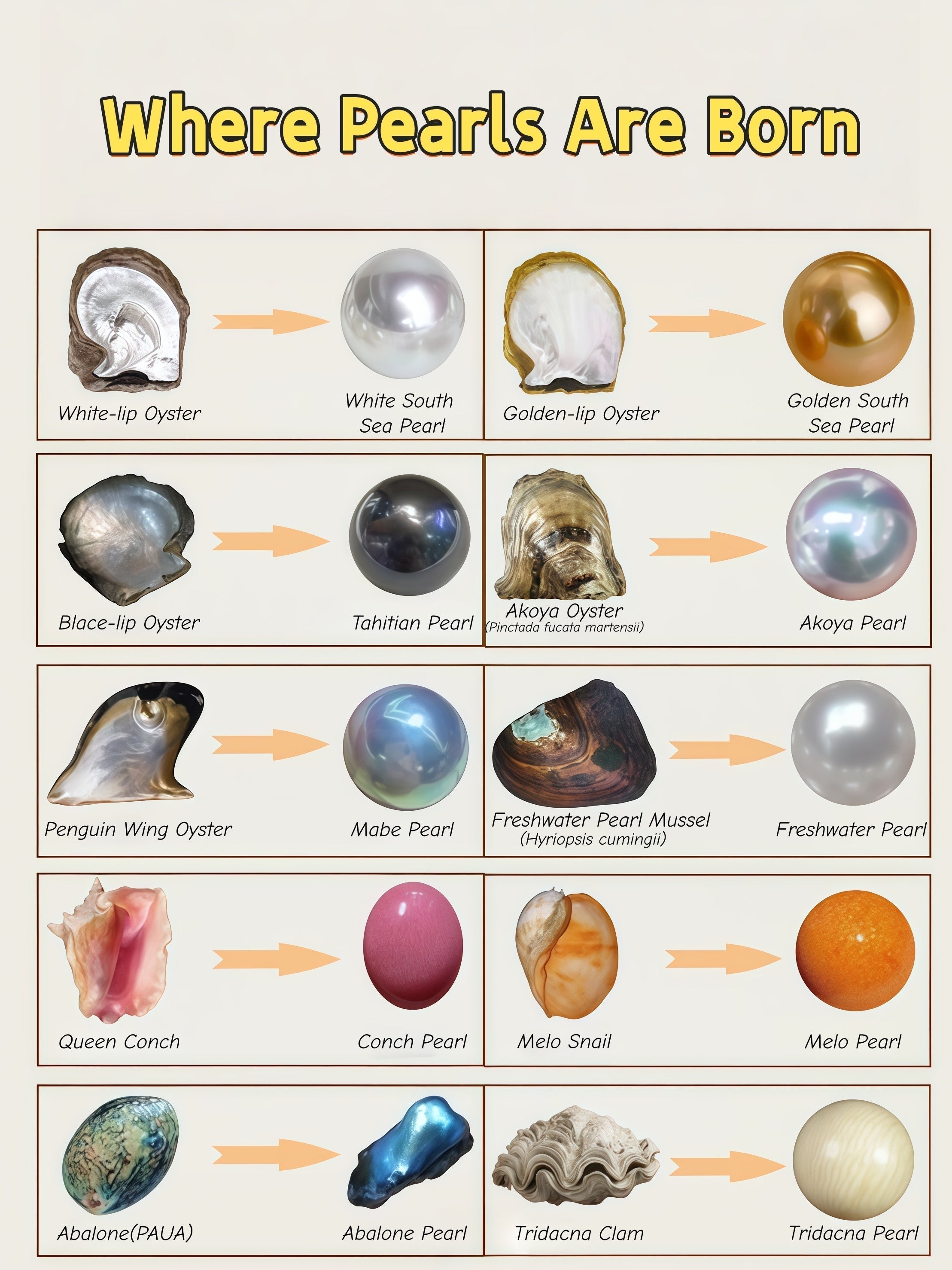
Core visual: this chart maps types of pearls to the animals that create them — from South Sea and Tahitian pearl oysters to freshwater mussels, plus rarer “non-traditional” pearl sources like conch and melo.
Key Takeaways
- Pearl origins start with the animal: pearl oysters (saltwater), mussels (freshwater), and a few special snails/clams.
- The “big four” most shoppers compare are South Sea pearls (white & golden), Tahitian pearls, Akoya pearls, and freshwater pearls.
- Size, color, and price range vary because the host animal and environment vary — warm ocean lagoons create different pearls than calm freshwater lakes.
- At Alya Pearls, we specialize in freshwater pearl jewelry — especially modern, wearable strands and one-of-a-kind shapes.
What Makes Pearls? (What Animal Makes Pearls)
Pearls are made by mollusks — usually bivalves like oysters and mussels, and occasionally certain snails and clams. When the animal’s soft tissue (the mantle) reacts to an irritant or damage, it can deposit mineral layers over time. In nacre-producing species, those layers form nacre — the shimmering structure behind that famous pearl glow.

From irritant to gem: how a pearl forms
Think of a pearl as the mollusk’s slow, layered response. In the wild, that “starter” might be a tiny intrusion or tissue injury. In modern farming, it’s usually a controlled process: technicians introduce a small starter (for many saltwater pearls, a bead plus mantle tissue; for many freshwater pearls, tissue-based stimulation), then the animal deposits layers over months or years.
Nacreous vs non-nacreous pearls (why conch & melo look different)
Most pearls used in fine jewelry are nacreous — they show classic pearl luster because they contain nacre. A few famous pearls are non-nacreous (like conch and melo). They don’t have that “mirror glow” nacre; instead they can show a porcelain-like sheen and a unique internal pattern often described as a flame structure.
Pearl Oyster vs Mussel: Where Are Pearls Found?
When people search pearl oyster vs mussel, they’re usually trying to understand why some pearls are larger, rarer, or more expensive. The simplest difference is saltwater vs freshwater habitats — and what each animal can naturally produce.
Saltwater pearl oysters (ocean habitats)
Saltwater pearl oysters live in warm seas, lagoons, and coastal waters. These oysters produce iconic pearl types like South Sea, Tahitian, and Akoya. Ocean conditions — temperature, plankton, water quality, and growth time — strongly influence size, luster, and overtone.
Freshwater mussels (lakes & rivers)
Freshwater pearls come from mussels raised in lakes, rivers, and ponds — most famously in China today. Freshwater mussels can produce a wide range of sizes and shapes, from near-round strands to baroque, drop, and keshi-like forms.
Types of Pearls at a Glance (Quick Table)

Here’s a fast, shopper-friendly map of pearl origins — where the animal lives, what the pearl tends to look like, and a realistic price range (U.S. retail) so you can set expectations.
| Pearl type | Animal | Where found | Typical size | Typical colors | Typical price range |
|---|---|---|---|---|---|
| South Sea (White) | White-lip pearl oyster | Warm Indo-Pacific seas | ~9–20mm | White, silver, creamy white | Often thousands to tens of thousands for strands (quality-driven) |
| South Sea (Golden) | Golden-lip pearl oyster | Warm Indo-Pacific seas | ~9–20mm | Deep gold to champagne | Often premium; fine strands can be very high |
| Tahitian | Black-lip pearl oyster | Central/South Pacific lagoons | ~8–18mm | Gray, green, peacock, aubergine | From a few hundred to thousands+ (size/grade) |
| Akoya | Akoya pearl oyster | Cooler coastal waters (Japan/China) | Usually <9mm | White with rose/silver overtones | Often hundreds to several thousands+ for strands |
| Freshwater | Freshwater mussel | Lakes/rivers/ponds | Wide range (commonly ~4–12mm; larger exist) | White, cream, peach, lavender | Best value range: approachable to premium |
Note: Prices vary dramatically with size, luster, surface, matching, and brand markup. Use ranges as expectations, not a quote.
South Sea Pearls (White-Lip vs Golden-Lip)
If you love statement-size pearls, South Sea pearls are usually the first category to explore. They’re grown in the largest pearl oysters, which is a big reason South Sea pearls can reach impressive sizes. They’re also famous for a “satiny” luster — not always sharp like Akoya, but very luxurious in real life.

Typical size, color, and price range
In everyday shopping terms: South Sea pearls are often 9–20mm. White South Sea pearls commonly show white-to-silver body colors, while Golden South Sea pearls show warm gold tones (from pale champagne to deep, saturated gold). Price ranges are wide, but fine strands often live in the high four figures to five figures, with exceptional strands far beyond that.
Buying cues: luster, surface, overtone
- Luster: look for a glow that feels “lit from within,” not chalky.
- Surface: South Sea pearls are large, so tiny blemishes show more—clean surfaces matter.
- Overtone: silver/rose overtones can make white South Sea look brighter; richer overtones deepen golden pearls.
Alya’s studio note: If you’re choosing between white and golden South Sea, hold them next to your skin in daylight. White South Sea reads crisp and elevated; golden tones can make skin look warmer and more luminous.
Tahitian Pearls (Black-Lip Oyster)
Tahitian pearls are the reason many people fall in love with “black pearls” — though most are not truly jet black. They’re better described as a spectrum of dark tones with complex overtones that shift under light.

Color spectrum & “peacock” overtones
Tahitian pearls often range about 8–18mm. The most-requested looks include medium-to-dark gray body color with green, teal, or aubergine overtones — and the famous “peacock” effect (a layered look where green and rose tones show together). Price depends heavily on luster and color rarity; fine strands can quickly climb into multiple thousands.
Akoya Pearls (Classic Saltwater Pearls)
Akoya pearls are the “classic strand” look most Americans picture when they hear pearl necklace. They tend to be smaller than South Sea, but can look extremely bright and crisp — especially in well-matched strands.
Why Akoya is the “bright classic” look
Akoya pearls are usually under 9mm, often white with rose or silver overtones. If you love sharp reflections and a polished, dressy finish, an Akoya pearl necklace is a timeless direction. Price ranges vary with grading and matching — from accessible strands to high-end strands that rival fine gemstones in cost.
Freshwater Pearls (Our Specialty)
Freshwater pearls are where I personally spend the most time — because the range of shapes, overtones, and styling options is huge. If you want pearls that feel modern (not “too formal”), freshwater pearls are often the best place to start.

Freshwater pearl necklace: what to look for
- Luster first: pick pearls that look alive in daylight, not dull indoors.
- Matching: a strand can be “perfectly uniform” or “intentionally organic.” Both are valid — choose the vibe you want.
- Surface: tiny marks are normal; the question is whether they distract at arm’s length.
- Color: freshwater pearls can lean white, cream, peach, and lavender — skin tone matching matters.
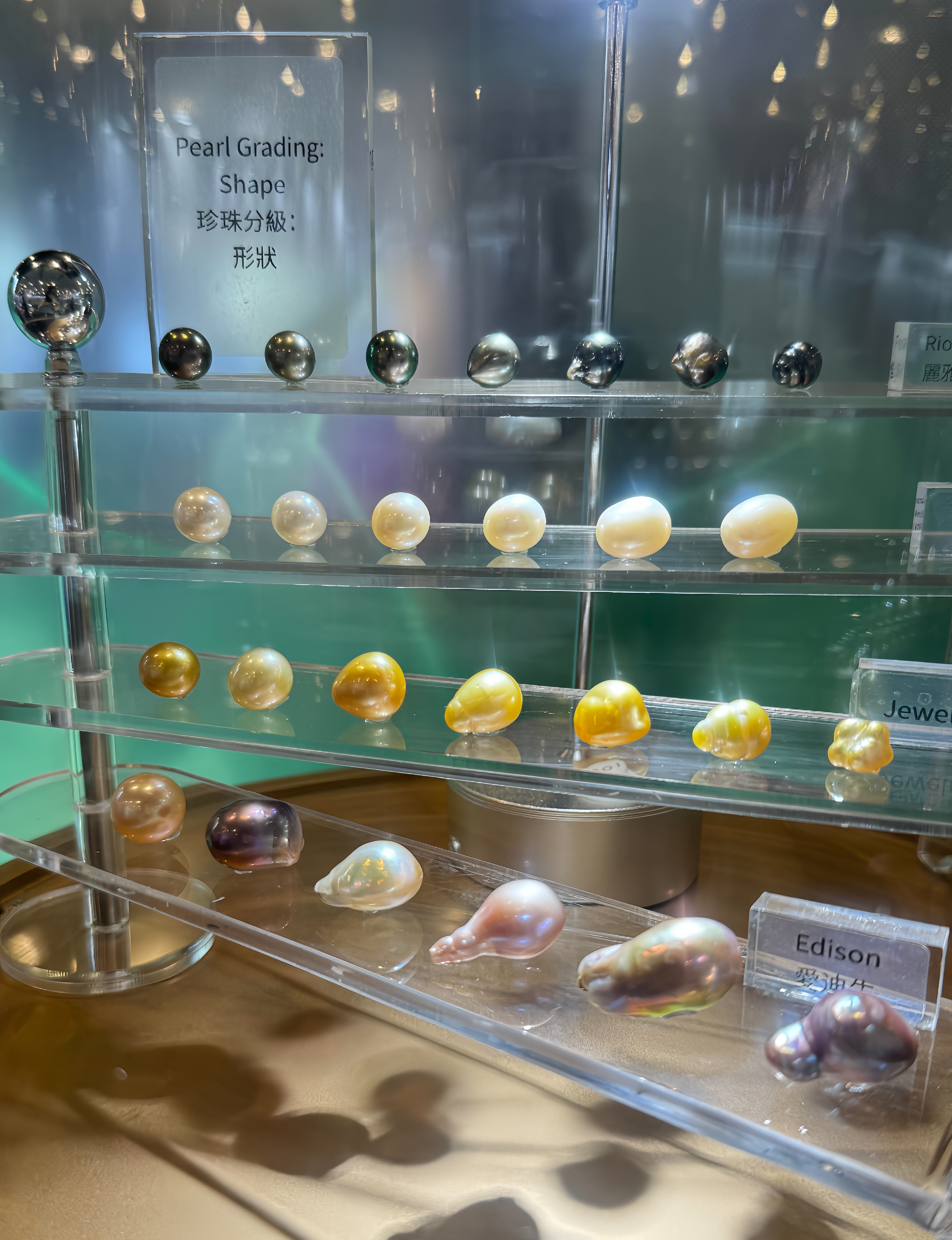
Shapes & styling: round, oval, drop, baroque, keshi
Freshwater pearls are loved for shape variety. If you want a clean classic look, choose near-round or round strands. If you want something artistic, explore baroque and keshi-like forms — they photograph beautifully and feel personal in real life. This is also why “freshwater pearl necklace” is one of my favorite categories to design: you can make it minimal, romantic, or editorial just by changing shape and spacing.
View pearl jewelry in Alya Pearls:
Other Rare Pearls (Mabe, Conch, Melo, Abalone, Tridacna)
Your infographic also includes a few pearl types that are rarer, more niche, or structurally different. Think of these as “collector categories.” They’re real — but they don’t behave like classic nacreous pearls in luster, care, or pricing.
Mabe Pearl
Often a “half pearl” (blister pearl) grown against the shell and finished as a dome. Great for statement earrings and pendants. Sizes can look large because of the dome shape.
Conch Pearl
From queen conch (a sea snail). Usually non-nacreous, often pink to salmon with a porcelain sheen. Rare in jewelry-grade quality; often priced like collectible gems.
Melo Pearl
From a sea snail. Non-nacreous with warm orange tones; extremely rare and often sold as loose collector stones.
Abalone Pearl
From abalone. Iridescent colors can be spectacular; often forms as blister/baroque shapes rather than perfectly round pearls.
Tridacna (Giant Clam) Pearl
Very rare. Often described as porcelain-like rather than nacreous. In many regions, giant clams are regulated — always buy with transparency and documentation.
Watch: A Visual Explanation of Pearl Formation & Types
If you want a quick visual overview, this video helps explain how pearls form and why freshwater vs saltwater pearls can look different.
FAQ: Pearl Origins & Types of Pearls
Where are pearls found?
Pearls are found in both oceans and freshwater. Saltwater pearls come from pearl oysters in seas and lagoons; freshwater pearls come from mussels in lakes and rivers. A few rare pearls come from snails (conch, melo) or certain clams.
Are pearls from oysters or mussels?
Both. Many famous categories (South Sea, Tahitian, Akoya) are from pearl oysters. Most freshwater pearls are from mussels. The difference matters because it changes the pearl’s typical size, color range, and how consistent strands can be.
What makes pearls expensive?
Big size, high luster, clean surfaces, rare colors, and strong matching in a strand are the biggest value drivers. South Sea and fine golden tones often cost more because large, high-quality pearls are harder to grow and harvest.
Which pearl type is best for everyday wear?
Many people love freshwater pearls for daily wear because they’re versatile, modern, and can be styled casually. The best choice depends on your lifestyle and what look you want.
Do “types of pearls” determine quality?
Not automatically. Type tells you origin and typical traits — but within every type there are low grades and exceptional grades. Always evaluate luster, surface, shape, and matching.


Leave a comment
This site is protected by hCaptcha and the hCaptcha Privacy Policy and Terms of Service apply.