
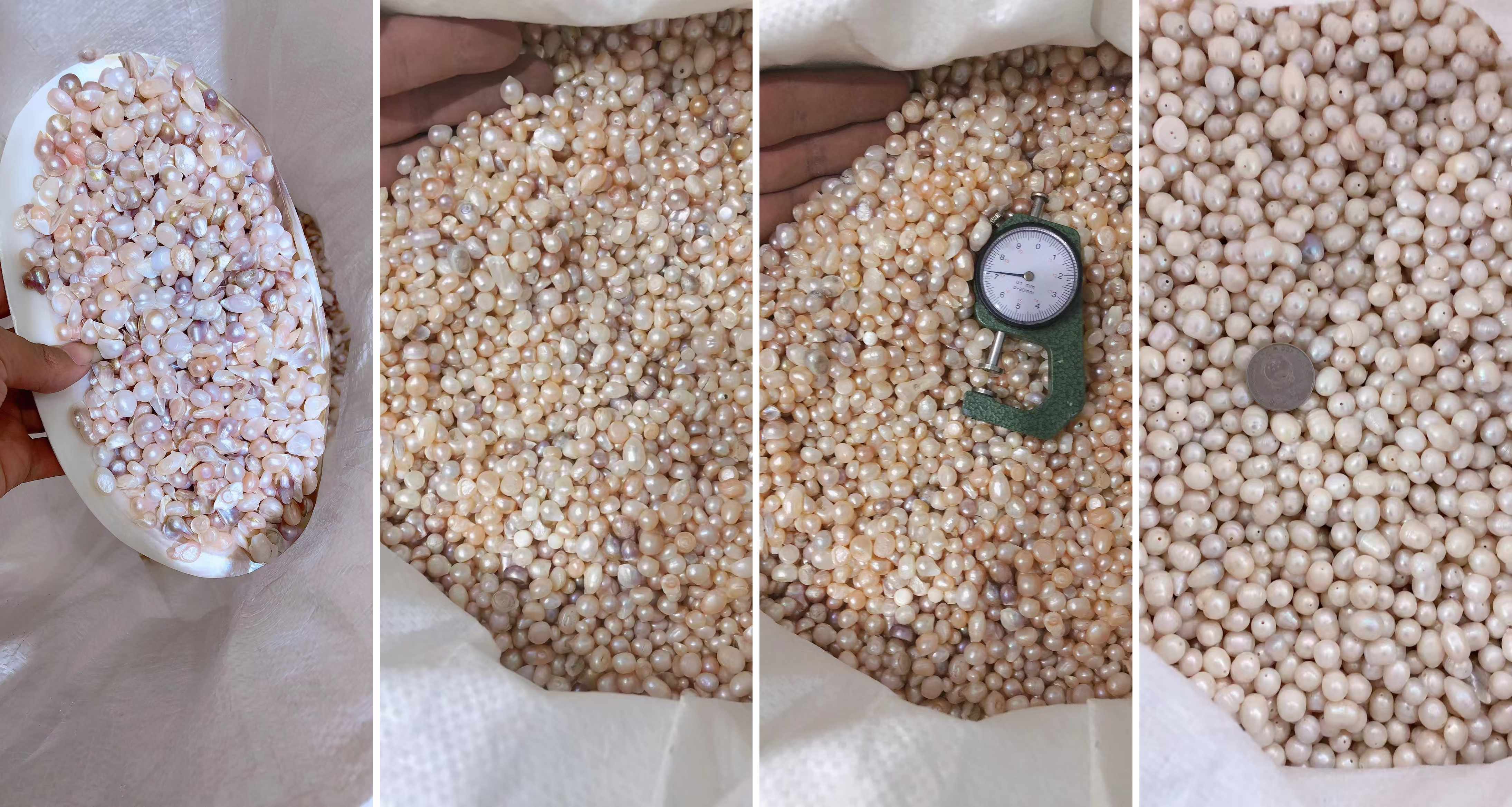
A Pearl Farmer’s Farm-to-Jar Price Breakdown
Written by Alya Liu — pearl farmer & jeweler.
The price of pearl powder is not decided by grinding alone. A jar of real freshwater pearl powder carries the cost of aged pearls, cleaning, sterilizing, milling, testing, packaging, export shipping, customs duties, and final delivery. From the farm side, the raw powder may be affordable; from the retail side, the finished product becomes much more expensive because every step after grinding adds cost.
Many people search for pearl powder benefits or compare pearl powder supplement prices online, but very few buyers know what happens before the powder reaches the jar. As a pearl farmer, I want to show you the real supply chain: where the cost starts, why some pearl powder is cheap, and why tested, traceable pearl powder cannot be priced like unknown bulk powder.

Quick Cost Breakdown: What Makes Pearl Powder Expensive?
Here is the simple answer: on the farm side, raw pearls and grinding are only part of the cost. Once you add testing, packaging, international shipping, customs, and retail delivery, the final price changes quickly.
| Cost Stage | Example Cost / Range | Why It Matters |
|---|---|---|
| Raw medicinal-grade pearls | Usually about $50–$90/kg, depending on age and quality | Older pearls represent more farming time, risk, and nacre growth. |
| Our farm-side raw pearl cost | Around $40/kg for 7-year non-nucleated pearls in our own supply chain | Because we grow the pearls ourselves, we avoid part of the outside raw-material markup. |
| Grinding and basic processing | Relatively low at scale | Equipment, trained workers, and repeated production lower the cost per kilogram. |
| Finished bulk powder internal cost | Around $50/kg in our current structure | This is before retail jars, labels, testing, shipping, customs, and final delivery. |
| Export logistics to the U.S. | A 10kg shipment can approach about $300 after specialized shipping and customs-related costs | International shipping, documentation, and duties change the landed cost significantly. |
| Retail packaging | Around $4 per jar in our current packaging setup | Retail buyers expect a clean, attractive, sealed product — not a plain factory bag. |
This is why two sellers can offer “pearl powder” at very different prices. One may be selling anonymous bulk powder with little documentation. Another may be selling traceable, tested, farm-direct pearl powder in retail packaging.
How Pearl Powder Is Made: From Harvested Pearls to Fine Powder
To understand what is pearl powder, start with the raw material. Pearl powder is made from pearls or nacre that are cleaned, disinfected, dried, milled, screened, and packed. In our supply chain, we use freshwater pearls from our own farming side, especially pearls that are not selected for fine jewelry but are still suitable as clean raw material.
1. Harvesting and sorting the pearls
After harvest, pearls are sorted by use. The finest pearls go into jewelry: necklaces, earrings, pendants, and rings. Pearls that are too irregular, damaged, too small, or unsuitable for jewelry design may still be valuable for powder if the material is clean and appropriate.
This is an important point: powder-grade pearls are not always “bad pearls.” They may simply be pearls that are not beautiful enough for jewelry but still valuable as nacre material. A pearl can be too irregular for a necklace and still be suitable for freshwater pearl powder.


2. Cleaning and sterilizing
Before grinding, raw pearls must be cleaned and disinfected. This step matters because pearl powder may be used in beauty, skincare, or supplement products depending on the market and product category.
When I compare pearl powders, this is one of the first questions I ask: where did the pearls come from, and how were they prepared before milling? A cheap powder with no source and no testing is not the same product as farm-direct, cleaned, processed, and documented pearl powder.

3. Milling, screening, and consistency
Grinding sounds like the expensive part, but for a producer with proper equipment and trained workers, milling is often less costly than buyers expect. Scale changes everything. Once a farm has its own raw material, equipment, and workers, the per-kilogram grinding cost becomes much more efficient.
The true challenge is consistency: fine texture, clean handling, stable batches, proper screening, and packaging that protects the powder after production.

Why Wholesale Pearl Powder Costs More After Export
At the farm, cost may look simple: raw pearls plus grinding. But wholesale export adds a second layer of cost. For example, when shipping to the United States, our practical minimum shipment is around 10kg. For that shipment, we currently need to use a specialized FedEx channel, and after shipping and customs-related costs, the total can approach about $300 for the 10kg shipment.
This is why wholesale pearl powder pricing cannot be calculated only from the farm-side cost per kilogram. By the time the powder is exported, the landed cost includes transport, documentation, handling, duties, and risk.
For a buyer, this explains why “factory cost” and “wholesale export price” are different numbers. The farm cost is the beginning. The export cost is the bridge between the farm and the buyer’s country.

Current Wholesale Cosmetic Ingredient Order Options
When comparing pearl powder suppliers, compare the delivered cost and the processing grade together. Our current 10 kg and 25 kg cosmetic ingredient packs include shipping and import duties to enabled destinations, so the product prices below are delivered prices rather than farm-side raw-material costs. The logistics example above explains cost structure; it is not an extra shipping charge added to these direct-order packs.
Choose genuine freshwater pearl powder from a farming and supply business with over 60 years of family experience. Select the grade that fits your cosmetic formula, then review its product specifications before ordering.
FARM-DIRECT · COSMETIC INGREDIENTS

Wholesale Ultrafine Freshwater Pearl Powder
A finely dispersible, non-hydrolyzed powder made from genuine freshwater pearls, with no fillers or additives. A practical choice for developing creams, masks and makeup where a smooth pearl-powder suspension suits the formula.
10 kg: $800 ($80/kg)
25 kg: $1,500 ($60/kg)
View ultrafine pearl powder, batch documents and order options →

Water-Soluble Hydrolyzed Pearl Powder
A freshwater pearl-derived ingredient processed with natural citric acid for customers seeking good water solubility. Explore it for compatible serum, cream, lotion and mask formulas; assess dissolution, pH and stability in your own formulation.
10 kg: $850 ($85/kg)
25 kg: $1,625 ($65/kg)
View hydrolyzed pearl powder specifications and order options →
Choose your packaging: 10 kg orders contain either 10 × 1 kg or 50 × 200 g aluminium foil pouches. The 25 kg option is one sealed wooden drum. Direct-order prices include shipping and import duties to countries and regions enabled for our store.
For 100 kg+ or custom packing, use the ultrafine pearl powder quotation form or the hydrolyzed pearl powder quotation form. Powder photographs show representative appearance. These wholesale listings are cosmetic raw materials.
Why Retail Pearl Powder Costs More Than Bulk Powder
Retail is a completely different cost structure. A customer buying one jar is not buying raw powder by the kilogram. They are buying a finished product: jar, lid, label, seal, batch handling, storage, customer service, platform fees, shipping, and sometimes replacement cost when packages are delayed or lost.
Today, packaging matters. People like beautiful products. A clean jar, a clear label, and a premium presentation create trust and product value. In our current setup, packaging alone can cost around $4 per jar.
Shipping also rises quickly. Pearl powder is heavy for its size, and every retail package must be packed safely. When shipping inside the United States, even basic last-mile delivery can add several dollars per package. In our experience, services such as USPS can also create extra cost through delivery fees, missing-package risk, and replacement handling.
This is why a small retail jar looks expensive compared with bulk powder. The product is no longer just powder; it is powder plus presentation, compliance, delivery, and service.
| Retail Cost | Why It Exists |
|---|---|
| Jar, label, seal, and outer packaging | Retail buyers expect an attractive, trustworthy finished product. |
| Testing and documentation | Important for safety, batch confidence, and brand trust. |
| International freight and customs | Raises the landed cost before the product can be sold in another country. |
| Domestic delivery | Each jar must be packed, shipped, tracked, and sometimes replaced. |
| Customer service and platform fees | Retail selling includes payment processing, support, and after-sale care. |
What Buyers Should Check Before Comparing Pearl Powder Prices
If you are comparing pearl powder supplement prices, do not compare price alone. Compare the supply chain behind the powder.
- Is it real freshwater pearl powder or mixed shell powder?
- Is the pearl source traceable?
- Is it supplement-grade, cosmetic-grade, or only craft-grade?
- Does the seller provide testing or batch documentation?
- Is the product packaged and labeled clearly?
- Does the seller explain whether it is for skincare, supplement, or cosmetic use?
This is also where pearl powder dangers should be discussed honestly. The main concern is not that pearl powder is mysterious; the concern is poor sourcing, contamination, unclear labeling, heavy metals, or sellers making medical claims without evidence.
A very cheap powder with no origin, no testing, and no clear product category is not the same as traceable farm-direct pearl powder. As a farmer, I believe the buyer deserves to know what kind of material is in the jar.

Watch: What Pearl Powder Is and How People Use It
This video gives a general introduction to pearl powder as a supplement and beauty ingredient. I recommend using it as a visual companion, not as a replacement for checking sourcing and testing.
A Farmer’s Final Note
Pearl powder looks simple in a jar, but from the farm side, it carries years of pearl growth and many small production steps. The raw pearl must be grown, harvested, sorted, cleaned, milled, tested, packed, exported, and delivered.
Our advantage is that we grow the pearls ourselves and control the processing chain. This helps us keep production cost lower than many resellers. But once pearl powder becomes a retail product, packaging, testing, shipping, duties, and customer service become part of the price.
So when someone asks me how much pearl powder is worth, my honest answer is: look behind the jar. The cheapest powder is not always the best value. The best value is clean, traceable, properly processed pearl powder from a seller who can explain exactly what you are buying.
Follow @alyapearls on Instagram and join our jewelry channel for daily updates on our newest handmade pearl pieces.



Leave a comment
This site is protected by hCaptcha and the hCaptcha Privacy Policy and Terms of Service apply.