
Baroque Pearls & Freshwater Pearl History: Baroque Style, Art, and a Living Gem
From a Dutch painting to my workbench—there was a message I received once that I still remember clearly.
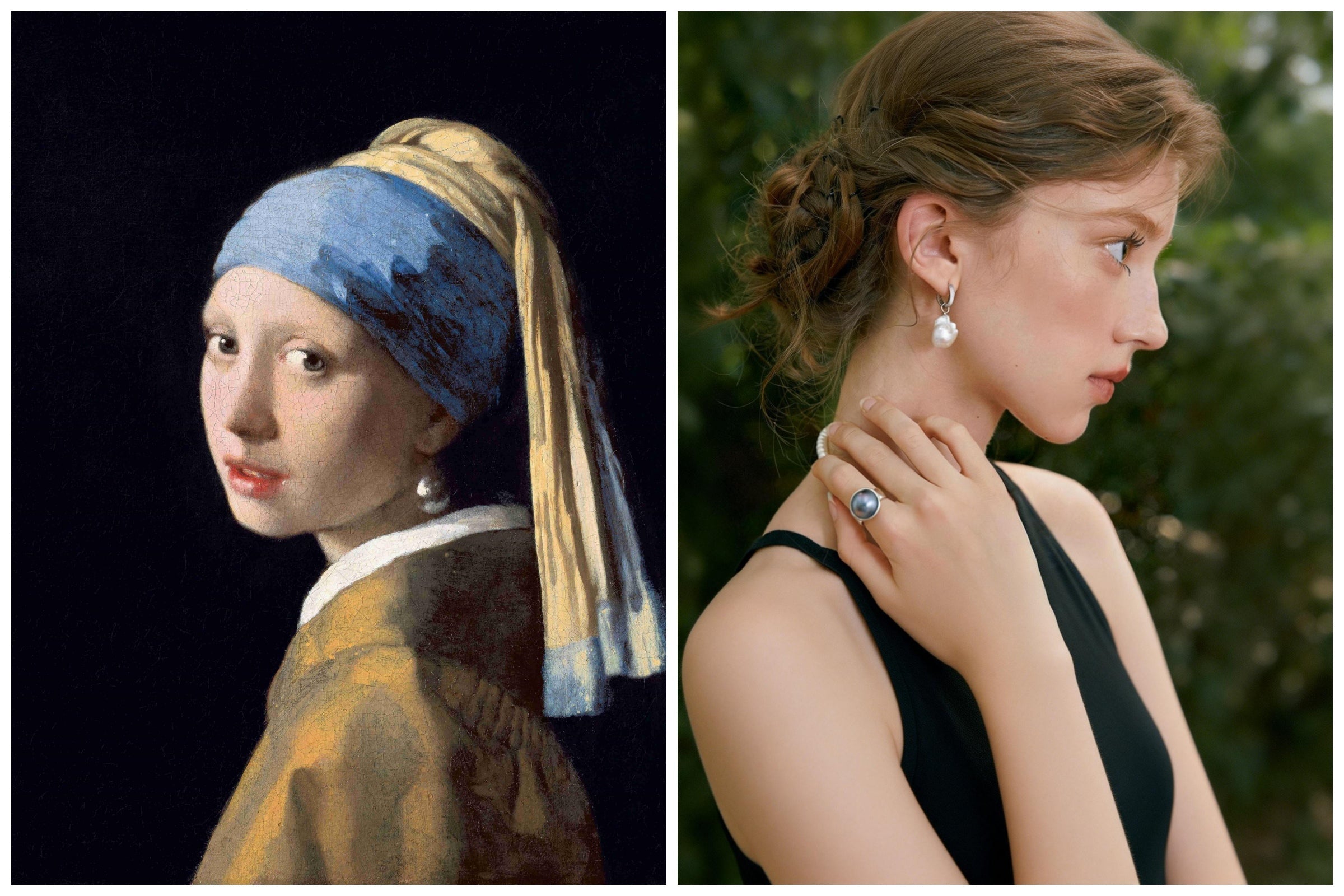
A customer sent me an image of Girl with a Pearl Earring—Vermeer’s quiet, luminous girl turning her head over her shoulder—and asked, “Could you make a pair of earrings exactly like this?” In that moment, she pulled my thoughts back to another era: candlelight, velvet shadows, and the way a single pearl could make a portrait feel alive.
In the end, I chose a pair of luminous baroque pearls and set them as simple studs. When she finally put them on, she looked radiant—like the painting had stepped into the present.
And I couldn’t help thinking: this is what pearls have always done—across centuries and across styles. Especially baroque pearls, with their sculptural shapes and living, imperfect elegance.

Meisje met de parel vs alya pearl baroque earrings
View our Baroque Earrings in Alya Pearl in the pic
What “Baroque” Really Means (And Why Baroque Pearls Feel So Right)
Before we talk about baroque pearls, we need to separate two meanings of the word Baroque:
- Baroque style is a European artistic era known for drama, movement, ornament, and emotional intensity—curves, scrollwork, rich textures, and “stage-light” contrast.
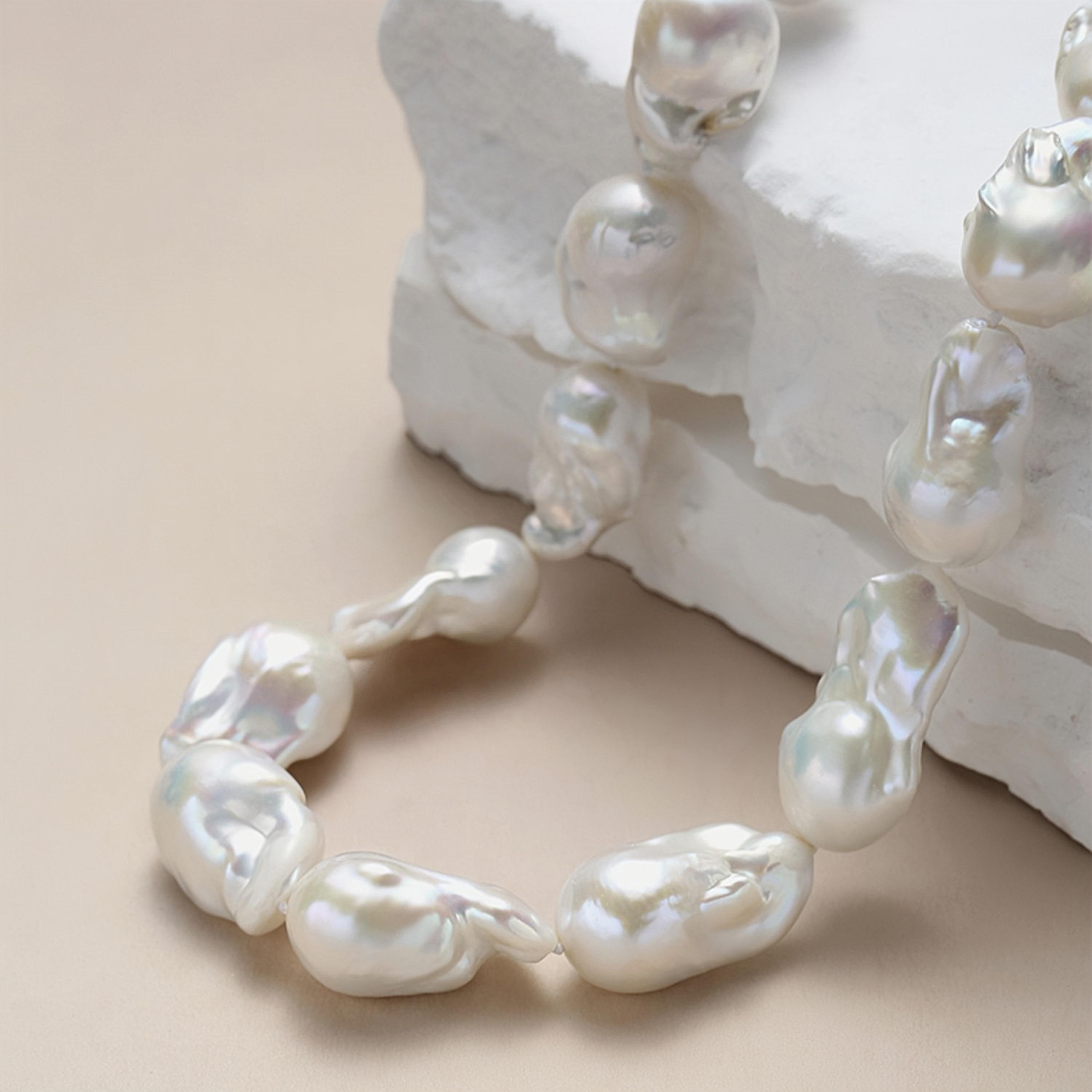
- Baroque pearls are pearls with irregular, organic shapes—each one unique, like a miniature sculpture formed by nature.
Here’s the beautiful overlap: Baroque style loves movement and asymmetry. It celebrates forms that look alive—like drapery caught mid-sway, or architecture that curves like music. That’s exactly why baroque pearls feel timeless inside Baroque-inspired jewelry.
And when those baroque pearls are also freshwater pearls, the story becomes even richer—because freshwater pearl farming is one of the biggest reasons baroque shapes are so widely available today.

The First Pearls: A Surprise From the Water
The history of pearls begins long before “jewelry” was even a word. Imagine someone, thousands of years ago, opening a shell for food and finding a tiny, glowing sphere inside—no cutting, no polishing—just a ready-made gem.
Across cultures, pearls felt different. They came from living water. They looked like small moons. And they didn’t behave like any other stone.
- In many ancient traditions, pearls were tied to protection, purity, and status.
- In portrait culture, a pearl wasn’t only decoration—it was a message: refinement, power, and control.
This is the earliest reason pearls became “historical objects.” A pearl is not mined—it is grown. That fact alone made it feel almost mystical for centuries.
Pearls, Power, and the Birth of “Pearl Legends”
For a long time, pearls were the most exclusive gem in the world. Diamonds could be cut and improved; pearls either appeared in a shell… or they didn’t. That rarity turned them into a kind of secret passcode for power.
- In elite societies, pearls became part of the visual language of class—crowns, ceremonial clothing, heirloom portraits.
- Stories formed around pearls because they felt almost impossible: perfect light born inside a living creature.
The most famous legend is Cleopatra’s “pearl cocktail”—the story that she dissolved a priceless pearl to win a bet about hosting the most expensive dinner in history. Whether every detail is true or not almost doesn’t matter; the story survived because it captured how unbelievable pearls once were.
Today, when I hold a dramatic baroque pearl, I still feel that myth-energy. A baroque shape looks like it belongs to a story—because it refuses to be ordinary.

Hope Pearl
Known as the largest saltwater natural pearl ever found, the 45-carats is believed to have been discovered in the early 18th century in the waters of the Persian Gulf.
Natural Pearls, Pearl Rushes, and Why Freshwater Pearls Matter
Before the 20th century, every pearl was natural. Mollusks created them by accident, as a response to irritation inside the shell. That meant divers had to search countless shells to find one beautiful pearl.
This scarcity led to intense harvesting across oceans and rivers. In many regions, ecosystems paid the price.
But here is a detail that matters for our keywords and our craft: freshwater pearl history isn’t only a modern story. Rivers and lakes have long produced pearls, and freshwater pearl sources have shaped trade routes and local economies in different eras.
Freshwater pearls also introduced something that feels very “Baroque”: variety. Oceans often pushed the market toward classic “ideal rounds.” Rivers and lakes offered more shapes, more character, and more surprises.

The Quiet Revolution: Cultured Pearls (And the Rise of Freshwater Pearls)
The biggest plot twist in pearl history came with one idea:
What if we help the mollusk start the pearl, instead of waiting for accidents?
Cultured pearls transformed the world. Pearls became more accessible, and pearl farming became a skilled, long-term craft—part science, part patience.
And this is where freshwater pearls become central to modern jewelry:
- Freshwater pearls are grown in lakes and rivers, primarily in China today, with incredible diversity in shape and color.
- Because freshwater cultivation can produce many non-round forms, it has become the most playful canvas for baroque pearls.
- That means “baroque pearls” are not a niche anymore—they’re a modern classic in creative fine jewelry.
In other words: if Baroque style celebrates movement and individuality, then the modern rise of freshwater pearls gave designers the perfect material to speak that language.
A Quick Tour of Today’s Pearl World (With Baroque Pearls in Mind)
Most pearls on the market today are cultured, but their personalities are very different.
- Akoya pearls – Known for classic round shapes and crisp, mirror-like luster.
- South Sea pearls – Large pearls with thick nacre and a soft glow, often in white or golden tones.
- Tahitian pearls – Naturally dark body colors with deep overtones.
- Freshwater pearls – The most diverse field of shapes and colors, and a major source of modern baroque pearls.
If you are specifically searching for baroque pearls, freshwater pearl options are often the most varied—ranging from softly irregular to bold sculptural forms.
Baroque Style Jewelry: How Baroque Pearls Fit the Aesthetic
If you want jewelry that truly feels Baroque, the trick is not just the pearl—it’s the design language around it.
Key Baroque style features (that work beautifully with baroque pearls)
- Ornament and framing: scrollwork, leaf motifs, dramatic metal silhouettes.
- Movement: drops, drapes, tassels, and multi-part earrings that sway.
- Contrast: light vs shadow (think candlelight), polished metal vs textured surfaces.
- Asymmetry with intention: not “messy,” but sculptural—like a carved detail on a historic façade.
Why baroque pearls feel “Baroque” even in simple settings
Even when set as studs, baroque pearls carry a built-in sense of drama. Their silhouettes catch light unevenly—creating depth, highlights, and shadow in a way perfectly round pearls can’t. That’s Baroque, in the purest visual sense.

How to Choose Baroque Pearls (Freshwater Pearl Edition)
Not all baroque pearls look the same—and “irregular” doesn’t mean “lower quality.” For freshwater baroque pearls, use these practical checks:
| What to Check | What You Want | Why It Matters for Baroque Pearls |
|---|---|---|
| Luster | Bright, clear reflections | Baroque shapes look best when light “travels” across the surface |
| Surface | Clean overall appearance | Baroque pearls can have character, but avoid distracting damage |
| Nacre / Glow | Depth and soft inner light | Creates that “painting glow” effect people love |
| Shape | Sculptural, intentional silhouette | The “design” is already inside the pearl |
| Matching (pairs) | Same mood, not identical clones | Great baroque pairs match in harmony, not perfection |
For many customers, the best part of buying baroque pearls is choosing a shape that feels personal—like picking a small piece of natural sculpture that you’ll wear for years.
Pearls in a Warming World: The Next Chapter of Freshwater Pearl Supply
The next chapter in pearl history is being written right now—and it’s not only romantic.
Pearl farms and wild mollusk populations are sensitive to water temperature, pollution, changing salinity, and extreme weather. In the last twenty years, many saltwater farms have faced shifting conditions that can affect yield and consistency.
This is one reason attention continues to grow around freshwater pearls. Lakes and ponds allow more controlled environments, and freshwater pearl farming can adapt in ways that are sometimes harder in open sea conditions.
That doesn’t make freshwater pearls a “second choice.” It makes them a flexible, modern material—especially for baroque pearls, where individuality is the entire point.
Why Pearl History Matters When You Hold One Baroque Pearl
So what does all of this mean for someone who just wants a beautiful pair of earrings?
It means every pearl is a small timeline in your hand:
- a memory of ancient divers and forgotten rivers,
- a trace of farmers and technicians who learned to work with nature instead of against it,
- and a reminder that clean water and healthy ecosystems are not guaranteed—they’re something we have to keep choosing.
In our studio, we try to honor that history in practical ways: choosing better sources, respecting the material, and designing pieces that feel timeless enough to be worn for years—not just for one trend cycle.
I like to think that when you wear baroque pearls—especially freshwater pearls shaped by nature’s hand—you’re not just wearing jewelry.
You’re wearing a tiny, glowing chapter of a very long story.
Explore: If you’re curious to see how these stories look in real life, you can explore our pearl earrings collection and find your own “Girl with a Pearl Earring” moment.
Pearl History & Baroque Pearls FAQ
Are baroque pearls real pearls?
Yes. Baroque pearls are real pearls—the word “baroque” refers to their natural, irregular shapes, not to imitation or lower authenticity.
Are freshwater pearls real pearls?
Yes. Freshwater pearls are real pearls grown in lakes and rivers. They are known for their diversity in shapes and colors and are a major source of modern baroque pearls.
What is the difference between Baroque style and baroque pearls?
Baroque style is a historic art and design language known for drama and ornament. Baroque pearls are pearls with organic, irregular shapes. They pair naturally because both celebrate movement and individuality.
How do I choose a good pair of baroque pearl earrings?
Focus on luster first, then overall surface appearance, then the silhouette. The best baroque pairs don’t need to be identical—they should match in “mood,” size balance, and glow.
Do baroque pearls work for everyday wear?
Absolutely. Baroque pearls can feel dramatic, but in simple settings (like studs), they become an effortless signature—modern, sculptural, and timeless.


Leave a comment
This site is protected by hCaptcha and the hCaptcha Privacy Policy and Terms of Service apply.