
Writen By Alya Liu (Founder & Designer of Alya Pearls)
Key takeaway: In the professional jewelry world, pearl color isn’t judged by what a seller calls it. It’s judged by the mechanism: Did foreign pigment enter the nacre? That one question separates true dyeing from other forms of color modification.
A Clear Statement from Alya Pearls (Our Non-Negotiable Policy)

At Alya Pearls, we sell natural-color pearls only. We refuse any dyed pearls and do not work with pearls that rely on external pigments or aggressive chemical color modification. This policy also applies to Akoya: we select natural-color pearls—not toned or color-adjusted lots—because we prioritize stable luster, honest provenance, and long-term wearability over short-term “perfect color.”
If you’re looking for high-end freshwater pearl jewelry, a natural-color akoya pearl necklace, or a custom piece made with carefully selected pearls, you can shop or request customization through alyapearl.com.
Why Pearl Color Treatments Cause Confusion
Pearls are organic gems. Their color isn’t a coat of paint—it’s an interaction of body color, overtone, and luster created by layered nacre. That layered structure is also why pearls can be modified after harvest. Treatments can change how a pearl looks, how it ages, and how it should be valued.
Many shoppers searching “how to tell if pearls are real” or comparing real pearls vs fake pearls don’t realize a pearl can be real and still treated. Treatments aren’t automatically “bad”—but they must be disclosed clearly, because they affect long-term durability, appearance stability, and value.
Dyeing vs Coloring vs Toning — The Clean Framework
| Term | What it means (mechanism) | Typical example | Main risk | Disclosure reality |
|---|---|---|---|---|
| Dyeing (Dyed pearls) | Foreign pigment is introduced and penetrates nacre. | Freshwater baroque pearl necklace dyed peacock blue. | Fading, blotches, pigment concentration at drill holes; sometimes reduced luster. | Should be disclosed as color treated / dyed. |
| Coloring (Color enhanced) | A broad commercial label. Often still dyeing; sometimes chemical color modification without “traditional dye.” | Some golden pearl lots enhanced to deepen gold tone. | If poorly done: diminished luster, surface instability, unnatural uniform tone. | Ask for method; may be disclosed as “color modified” or “treated.” |
| Toning (Optical adjustment) | No pigment added into nacre; subtle optical/surface adjustments shift overtone appearance. | Akoya strands adjusted toward cleaner silver/rose overtone. | Confusion: buyers assume “natural color.” Should not be confused with dyeing. | Often not labeled as “dyed,” disclosure varies by market/report. |
How to use this table: When you see “color enhanced” or “coloring,” don’t debate wording. Ask for the mechanism: Was pigment introduced into the nacre?

1) Dyeing: The Clearest Category (Example: Peacock Blue Dyed Freshwater Baroque Pearls)
Dyeing means external pigments are intentionally introduced to change a pearl’s color. In practice, pigment can enter pores and micro-pathways in nacre. This is why dyed pearls often show telltale signs under magnification—especially near drill holes.
Why Baroque Freshwater Pearls Are Commonly Dyed
A freshwater baroque pearl has organic contours and surface texture. That natural texture can visually “camouflage” uneven pigment distribution, making baroque pearls a frequent candidate for bold fashion colors. A popular example is peacock blue—a high-saturation, dramatic tone that is rarely natural in freshwater pearls at scale.
Professional Signs of Dyed Pearls
- Unnaturally uniform saturation across many pearls in a strand (especially at low price points).
- Color concentration around drill holes (a classic giveaway).
- “Too perfect” color with less depth—luster looks flatter than expected for the grade.
- Over time, some dyed pearls may show uneven fading or patchiness depending on process quality and exposure.
Important nuance: dyed pearls are not necessarily fake pearls. They can be real, cultured pearls that are treated. But dyeing must be disclosed clearly, because it affects long-term stability and value. If you’re shopping for heirloom quality, a dyed baroque pearl necklace is rarely the right choice.
2) “Coloring” (Color Enhanced): The Most Misused Term in Pearl Sales
“Coloring” is often a commercial word rather than a strict gemological category. In many listings, “coloring” is simply a softer way to say dyed pearls. In other cases, it can refer to chemical or process-driven modifications that change how the surface appears.

Example: Some Golden Pearls Enhanced to Deepen Gold Tone
With pearls marketed as golden pearl or a gold pearl necklace, you may encounter lots that appear unusually intense and uniform in gold tone. Some sellers describe this as “enhanced color” or “coloring.” In real-world trade, this can overlap with dye-like outcomes—especially when the treatment introduces coloring agents or strongly alters surface chemistry.
Why It Can Hurt Luster
Pearl beauty is fundamentally about luster: sharp reflection, depth, and a clean surface that returns light like a soft mirror. If a color enhancement is applied too aggressively, it can:
- reduce surface clarity (reflection looks foggy)
- create an unnaturally uniform “coated” look
- weaken long-term surface stability
If you love golden tones, focus on luster and transparency first. A natural-looking gold with high luster will age more gracefully than an over-enhanced tone. And always ask direct questions: Is the color natural? Is it color modified? Is it dyed?
Buyer tip (simple rule): If a pearl looks “too perfectly golden” at a surprisingly low price, treat it as a disclosure check. Request close-up photos and ask for treatment transparency.
3) Toning: Akoya’s Typical Optical Adjustment (Often Accepted, Often Misunderstood)
Toning (sometimes described as optical adjustment) generally aims to refine how the pearl’s surface displays overtone. Unlike dyeing, toning is not primarily about adding pigment into nacre. It’s about subtle surface-level changes that shift perceived silver, rose, or cream notes.
Why Akoya Pearls Are the Classic Example (Toning Explained in Detail)
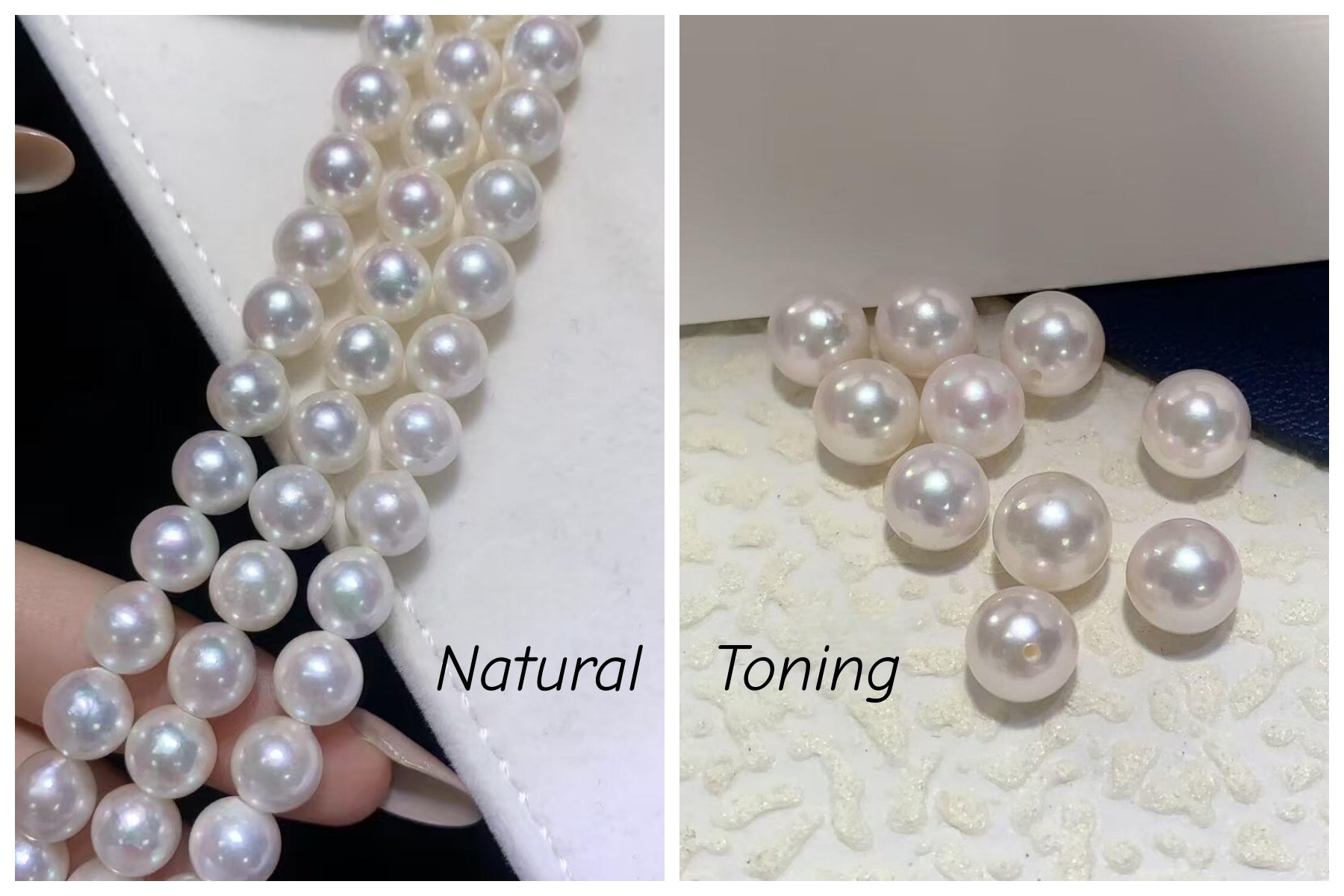
Akoya pearls are loved for their crisp, luminous luster and refined sizes—especially in a classic akoya pearl necklace. But here’s the part most shoppers don’t hear clearly: the vast majority of Akoya pearls on the market have been “toned.” In the international pearl trade, Akoya toning is a widely recognized and generally accepted finishing practice. It is not the same as dyeing, and it does not automatically make the pearls “fake.”
Important clarity: Toning is designed to optimize the pearl’s existing color, not to create a new color that the pearl never had. The goal is to refine how Akoya pearls appear—especially to reduce yellow/brown undertones and create a cooler white or soft “sakura-pink” look that most buyers prefer.
What Is Akoya Pearl Toning?
Toning (sometimes described as optical adjustment) typically involves soaking pearls in a mild chemical solution (commonly discussed in the trade as gentle oxidizing solutions, such as hydrogen peroxide-based processes). The purpose is not to inject pigment into the nacre, but to refine the pearl’s visual presentation:
- Reduce yellow or brown undertones so the strand appears cleaner, cooler white (often perceived as “icy white” or “sakura-pink” overtone).
- Improve overall uniformity across a strand and minimize visible spotting or uneven tone.
- Enhance the surface brightness so reflections look sharper and more “mirror-like,” which many consumers associate with premium Akoya.
Toning vs Dyeing: The Difference That Matters
Many shoppers confuse “toned” with “dyed.” They are fundamentally different, and the difference matters for disclosure, value, and long-term performance.
| Comparison | Toning (Akoya) | Dyeing (Dyed pearls) |
|---|---|---|
| Mechanism | Redox/chemical refinement without adding new pigment into nacre | Foreign dyes/pigments are introduced and can penetrate nacre |
| Color result | Optimizes the pearl’s existing color range (cleaner white, refined overtone) | Can fully change color into non-natural ranges (e.g., vivid peacock blue) |
| Stability | Generally stable and commonly accepted in the Akoya trade | Can fade or shift over time depending on dye quality and wear |
| Report / disclosure | Often not explicitly stated as “toned” in some markets; rules vary | Must be disclosed; treated color is typically stated clearly |
Industry Reality: Most Akoya Is Toned (Natural-Color Akoya Is Rarer)
In the Japanese market, it is commonly understood that 90%+ of Akoya pearls may undergo toning as a standard refinement step. This is why truly exceptional natural-color Akoya—especially strands with beautiful overtone and minimal yellowing without toning—can be rarer and may command a higher price.
How Some Japanese Certificates Treat “Toning” (Practical Buyer Guidance)
In certain Japanese lab conventions, toning is often treated as an expected baseline for Akoya unless the pearls are so outstanding in their natural color that the certificate specifically highlights “no toning” (for example, exceptional lots sometimes marketed under special designations). However, treatments such as dyeing or irradiation are typically disclosed more explicitly as “treated” on reports.
Why this matters for trust: A certificate can help confirm quality factors (luster, roundness, surface) and flag obvious treatments. But the most reliable shopping practice is still the same: ask direct questions about processing, request close-up photos, and buy from a brand with written standards.
Can Toned Akoya Still Be High Grade?
Yes. A mature, well-controlled toning process does not prevent Akoya pearls from achieving high-grade standards. Premium designations in the market (for example, top-luster Akoya lots) still rely on core quality factors: luster, roundness, surface cleanliness, and matching.
How to Tell Toned Akoya (Practical Signs)
If you’re comparing strands and wondering how to tell if pearls are real (and also how they were processed), here are realistic visual indicators that can suggest toning—keeping in mind that only a lab can confirm with certainty:
| Visual cue | Toned Akoya | Natural-color Akoya |
|---|---|---|
| Overall tone | Cleaner, cooler white; often pink/blue overtone appears more “focused” | May show a gentle cream/ivory warmth or more complex subtle layering |
| Uniformity | Highly even color across a strand | Slight nuance/variation can appear in different lighting |
| Reflection style | Strong “mirror” effect is common (especially in well-matched strands) | Often looks slightly softer and more “silky” while still high-luster |
Some professionals also use UV fluorescence and magnification as part of a broader assessment. Under UV, certain toned Akoya lots may show a cooler blue-white fluorescence response. Under magnification, natural-color strands can show subtle color depth and layered nuance. (These are supportive indicators—not a single “guaranteed” test.)
Is Toned Akoya Worth Buying?
For many buyers, yes. Toned Akoya can offer excellent value because the color is widely preferred, the look is clean and classic, and the overall stability is generally good when processing is well controlled. If your budget is limited, a high-grade toned Akoya strand can be more satisfying than a lower-quality natural-color strand with weak luster.
Quick reminder: “Toned” does not mean fake pearls. It can still be a real, high-quality strand. When comparing real pearls vs fake pearls, authenticity depends on material and nacre—not whether the pearl is cultured. The distinction of cultured pearls vs natural pearls describes how pearls are formed, and both can be completely real.

How to Tell If Pearls Are Real (Real Pearls vs Fake Pearls)
Color treatments are one issue. Authenticity is another. If you’re searching for how to tell if pearls are real or how to tell if pearls are real or fake, use a combination of checks—never only one internet trick.
1) Surface Reality: Real Pearls Are Not Identical
Even high-grade pearls show subtle growth features under strong light. Fake pearls (or faux pearl) products often look too perfect, too smooth, and too identical.
2) Luster Depth: “Glow from Within”
Fine pearls show layered depth: light seems to come from inside the nacre. Many faux pearls show a simple surface shine (plastic-like or glass-like).
3) Drill Hole Inspection (If Available)
- Real pearls often show layered nacre structure near the hole.
- Dyed pearls may show color concentration or staining around the hole.
- Fake pearls often show chipped coating or flaking around the hole.
4) Cultured Pearls vs Natural Pearls
A common misconception: “cultured” means fake. It doesn’t. Cultured pearls vs natural pearls is about formation, not authenticity: cultured pearls are real pearls grown with human assistance; natural pearls form without it and are extremely rare.
Buyer Checklist: Avoid Misleading Color Claims
- Ask directly: Is it dyed, color modified, or toned? (Do not accept vague “coloring” as an answer.)
- Request close-ups: Surface + drill holes + strong lighting photos.
- Prioritize luster: Color is secondary to luster for long-term beauty and value.
- Be cautious with extreme saturation: Especially low-priced “perfect” peacock blue or jet-black freshwater strands.
- Buy from brands with written standards: Clear disclosure policies protect you long-term.
Our approach: Alya Pearls offers natural-color freshwater pearls and natural-color Akoya only. Shop or customize at alyapearl.com.
FAQ (Featured Snippet Friendly)
Are dyed pearls real pearls?
Yes. Dyed pearls are real cultured pearls with color treatment. They should be disclosed clearly and priced as treated pearls.
Is “coloring” the same as dyeing?
Often, yes—because “coloring” is frequently used as a softer commercial label for dyeing. Always ask how the color was achieved.
Are black pearl necklaces always natural?
No. Naturally dark pearls exist, but many dark freshwater strands are dyed. Ask for origin and treatment disclosure.
How can you tell if pearls are real or fake?
Check surface realism, luster depth, drill holes, and seller transparency. Faux pearls often look too uniform and show chipped coating at holes.
How much is a real pearl necklace worth?
Value depends on luster, surface quality, shape, size, matching, and craftsmanship—not just whether the pearls are cultured. Ask for quality details, not just labels.

%0A%0AKey%20takeaway:%20In%20the%20professional%20jewelry%20world,%20pearl%20color%20isn%E2%80%99t%20judged%20by%20what%20a%20seller%20calls%20it.%20It%E2%80%99s%20judged%20by%20the%20mechanism:%20Did%20...)